
Global LiDAR Market Size and Forecast 2025–2033
How Rapid Urbanization, Autonomous Vehicles, and 3D Mapping Tech Are Reshaping the Future of LiDAR


The global LiDAR (Light Detection and Ranging) market is entering one of the most transformative decades in its history. According to Renub Research, the LiDAR market is projected to reach US$ 12.81 billion by 2033, rising from US$ 2.31 billion in 2024, expanding at a robust CAGR of 20.96% from 2025 to 2033.
This explosive growth is fueled by sharply rising demand for autonomous vehicles, unprecedented urban expansion, precision agriculture, and heightened focus on infrastructure monitoring.
In today’s world—where cities are getting smarter, farms smarter still, and vehicles increasingly driverless—LiDAR has emerged as one of the most mission-critical technologies of the next decade.
What Exactly Is LiDAR? Why Is It So Important Today?
LiDAR is a remote-sensing technology that uses rapid laser pulses to measure distances and create highly precise 3D models of objects, landscapes, and environments. Unlike traditional imaging, LiDAR can “see” through environmental challenges such as low light, fog, and dense vegetation, making it indispensable for:
Autonomous vehicle navigation
Smart city planning
Forestry and environmental monitoring
Geography and GIS applications
Agriculture and resource management
Construction and infrastructure maintenance
The technology has become especially valuable as industries increasingly rely on real-time, high-precision geospatial data. Falling sensor prices, improved data-processing capabilities, and robust demand from automotive and smart-city sectors have accelerated global adoption.
Key Growth Drivers Fueling the Global LiDAR Boom
1. Urban Population Expansion and Smart Infrastructure Needs
According to the World Bank, around 50% of the global population lived in urban regions in 2023, creating immense pressure on transportation, housing, utility planning, and environmental management.
City planners now rely on LiDAR for:
Mapping road networks
Studying traffic flows
Designing safer intersections
Modeling new buildings and utilities
Disaster preparedness and risk assessment
LiDAR’s capability to generate quick, accurate 3D models improves operational efficiency and supports sustainable urban expansion.
2. Precision Farming is Reshaping Agriculture
As farmers worldwide adopt high-tech farming tools, precision agriculture using LiDAR has become essential for crop management, field analysis, and yield improvement.
LiDAR enables:
Accurate crop height measurement
Plant spacing and alignment
Precision planting and harvesting
Soil and terrain mapping
The outcome?
Higher yields, reduced crop losses, and significant cost savings.
With food demand rising and climate uncertainty increasing, LiDAR helps farmers make smarter, data-driven decisions.
3. Autonomous Vehicles: The Biggest Demand Generator
The IMARC Group reports the global autonomous vehicle market was valued at US$ 81 billion in 2023—and LiDAR is the backbone of AV safety systems.
LiDAR ensures self-driving cars can:
Detect obstacles in real time
Measure distances precisely
Navigate in low light
Operate in complex urban environments
Avoid collisions
With road safety becoming a major concern—33,000 deaths and 1.8 million injuries in US road accidents reported in 2019—the adoption of ADAS technologies surged.
As of 2020, 92% of US vehicles included at least one ADAS feature.
LiDAR’s integration into vehicles is accelerating, especially after innovations like Aeva & Daimler Trucks’ Atlas FMCW-ToF LiDAR, unveiled at CES 2024.
Challenges Slowing Down Market Expansion
Even with exponential demand, LiDAR still faces several barriers.
1. High Costs and System Complexity
LiDAR systems remain expensive due to:
Advanced optics
High-performance scanning components
Supercomputing-level data processors
This often makes adoption difficult for startups, SMEs, and cost-sensitive sectors.
2. Integration Difficulties
LiDAR is not plug-and-play; it demands:
Extensive calibration
Platform-specific customization
Highly trained operators
It also competes with cheaper technologies like radar and camera systems. For LiDAR to become mainstream, integration must become more seamless and cost-efficient.
Market Trends Defining the Future of LiDAR
Terrestrial LiDAR Is Gaining Worldwide Adoption
Terrestrial LiDAR has surged because of its unmatched accuracy for:
Building modeling
Mining surveys
Tunnel mapping
Archaeological documentation
Technological upgrades and lower costs are further enhancing global adoption.
Laser Scanners Are Rising Across Industries
Laser scanners now dominate use-cases in:
Automotive engineering
Archaeology
Forestry
Construction
Their precision and ability to capture high-quality spatial data are unmatched.
Corridor Mapping Holds a Dominant Market Share
LiDAR-based corridor mapping is extensively used for:
Railways
Highways
Power lines
Pipelines
The ability to map long linear infrastructure with minimal effort has made LiDAR indispensable to global infrastructure planning.
3D LiDAR Technology Is Becoming Standard
With its superior:
Accuracy
Depth perception
Object recognition
3D LiDAR is becoming the top choice over older 2D systems.
Industries increasingly demand high-resolution 3D models for planning, simulation, and monitoring.
Short-Range LiDAR Leads the Global Market Share
Short-range LiDAR is in high demand due to use in:
Consumer electronics
Robotics
Automotive safety systems
Drones and indoor navigation
Its compact design and affordability make it ideal for mass-market products.
Regional Analysis: How LiDAR Demand Varies Across Global Markets
United States
The US remains one of the fastest-growing markets due to:
Heavy investment in autonomous vehicles
Strong aerospace and defense demand
Expanding construction and GIS applications
Government-backed environmental programs
Companies across automotive and defense sectors are accelerating LiDAR integration to meet safety and compliance requirements.
United Kingdom
The UK market is growing thanks to:
Smart city initiatives
Rising AV testing zones
Environmental sustainability projects
Infrastructure modernization
Government-supported environmental monitoring and updated GIS programs further strengthen demand.
India
India represents one of the hottest emerging LiDAR markets.
Reasons include:
Massive infrastructure rollouts
Digital mapping initiatives
Smart City Mission
Agricultural modernization
LiDAR is rapidly being integrated for surveying, highways, railways, metro expansion, and forest management.
Challenges remain due to high equipment costs and shortage of LiDAR-trained professionals.
United Arab Emirates (UAE)
In the UAE, LiDAR demand is booming due to:
Smart city pioneers like Dubai and Abu Dhabi
Mega construction projects
Environmental surveillance
Transportation and mobility planning
Government investments and digital transformation programs are key growth drivers.
Market Segmentation Snapshot
By Type
Terrestrial
Aerial
Mobile
Short Range
By Component
Laser
Inertial Navigation System
Camera
GPS/GNSS Receiver
MEMS
By Application
Corridor Mapping
Engineering
Environment
Exploration
ADAS
Others
By Technology
3D
2D
1D
By Range
Short Range
Medium Range
Long Range
By Region
North America (US, Canada)
Europe (UK, Germany, France, Italy, Spain, etc.)
Asia Pacific (China, Japan, India, Korea, ASEAN, Australia, etc.)
Latin America (Brazil, Mexico, Argentina)
Middle East & Africa (Saudi Arabia, UAE, South Africa)
Competitive Landscape: Leading LiDAR Companies
Faro Technologies Inc.
Hexagon AB
Vaisala Oyj
Sick AG
Teledyne Technologies Inc.
Innoviz Technologies Ltd.
LeddarTech Inc.
NV5 Global Inc.
Each company is working on improving accuracy, reducing costs, and advancing AV-compatible LiDAR systems. Their strategies revolve around new product launches, mergers, and expanding into infrastructure and environmental sectors.
Final Thoughts: The Future of LiDAR Is Borderless
The LiDAR market’s upcoming decade will be defined by rapid technological evolution, falling sensor costs, robotics integration, and the global race for autonomous mobility.
Whether it’s building safer cities, smarter farms, greener transportation, or futuristic vehicles, LiDAR’s role is only set to expand.
By 2033, LiDAR will no longer be a niche mapping tool; it will be an essential digital infrastructure technology powering the world’s most ambitious innovations.
About the Creator
Janine Root
Janine Root is a skilled content writer with a passion for creating engaging, informative, and SEO-optimized content. She excels in crafting compelling narratives that resonate with audiences and drive results.
Keep reading
More stories from Janine Root and writers in The Swamp and other communities.
Global Electric Vehicles Market Size and Forecast 2025–2033
The global transition toward clean mobility is accelerating at an unprecedented pace — and the electric vehicles (EVs) market stands at the epicenter of this shift. According to Renub Research, the global electric vehicles market will surge from US$ 600.13 billion in 2024 to a massive US$ 1,589.38 billion by 2033, expanding at a CAGR of 11.43% between 2025 and 2033.
By Janine Root 2 months ago in The Swamp
Europe Direct Drive Wind Turbine Market Size and Forecast 2025–2033
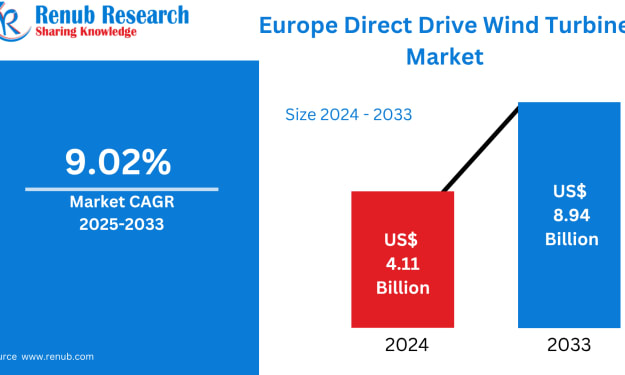
Market Snapshot The Europe Direct Drive Wind Turbine Market is anticipated to reach US$ 8.94 billion in 2033 from US$ 4.11 billion in 2024, growing at a CAGR of 9.02% during 2025–2033. This expansion is driven by rising investments in renewable energy, supportive government policies, and growing demand for efficient, low-maintenance turbine systems. As Europe accelerates toward carbon-neutral targets, direct drive technology is emerging as a cornerstone of its sustainable energy future.
By Marthan Sir2 days ago in The Swamp



Comments
There are no comments for this story
Be the first to respond and start the conversation.