
Global Elevator and Escalator Market Size & Forecast (2026–2034)
Vertical Mobility Redefined as Urban Skylines Grow Taller and Smarter

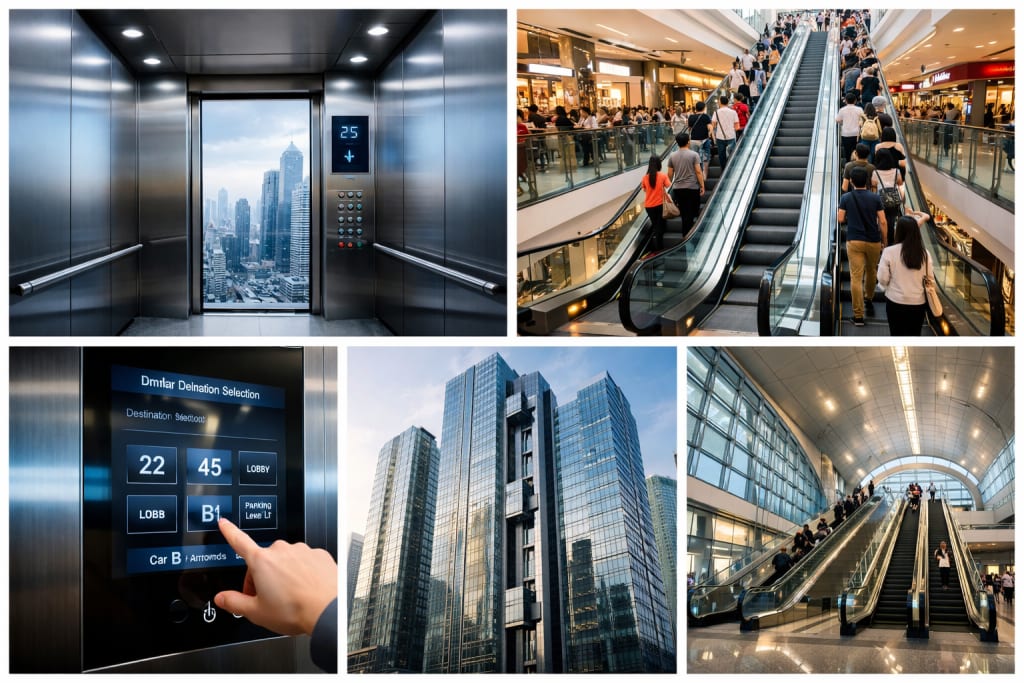
Introduction
The Global Elevator and Escalator Market is positioned for sustained expansion over the next decade, driven by accelerating urbanization, rapid high-rise construction, and continuous technological innovation in vertical mobility solutions. According to Renub Research, the market is expected to grow from US$ 163.44 Billion in 2025 to US$ 249.45 Billion by 2034, registering a Compound Annual Growth Rate (CAGR) of 4.81% during 2026–2034.
Elevators and escalators have become essential infrastructure components in modern cities, enabling efficient vertical movement across residential towers, commercial complexes, transport hubs, and industrial facilities. As cities expand vertically rather than horizontally, demand for advanced, energy-efficient, and intelligent vertical transportation systems continues to rise globally.
Global Elevator and Escalator Market Outlook
Elevators and escalators fall under the broader category of vertical transportation systems, designed to move people and goods efficiently between different levels of buildings and public spaces. Elevators are powered lifting systems that travel vertically within shafts, while escalators are moving staircases primarily deployed in high-traffic public environments.
The widespread adoption of these systems is closely linked to increasing urban population density and the global shift toward multi-story construction. High-rise residential buildings, office towers, hospitals, shopping malls, airports, and metro stations all rely heavily on elevators and escalators to ensure smooth people movement and operational efficiency.
Technological evolution has further strengthened market acceptance. Smart elevators equipped with destination control systems, regenerative drives, predictive maintenance, and IoT-based monitoring are transforming user experience while reducing operational costs. Meanwhile, escalators remain indispensable in public facilities due to their ability to manage continuous passenger flow effectively.
Additionally, global demographic trends—particularly aging populations and rising accessibility requirements—are significantly contributing to market growth, as buildings increasingly prioritize inclusive design and mobility solutions.
Key Growth Drivers in the Elevator and Escalator Market
Rapid Urbanization and High-Rise Construction
Urbanization remains the single most influential growth driver for the elevator and escalator market. As global cities continue to attract large populations, land scarcity has pushed construction vertically. Multi-story residential apartments, commercial towers, and mixed-use developments now dominate urban landscapes.
Developing regions across Asia-Pacific, the Middle East, and Latin America are experiencing especially rapid urban expansion, leading to substantial infrastructure investment. Elevators are no longer optional but mandatory in most multi-story buildings, while escalators are increasingly deployed in retail spaces, metro systems, and airports to manage pedestrian traffic efficiently.
In February 2025, Lennar Corporation expanded its footprint by acquiring Rausch Coleman Homes, strengthening its presence across several U.S. states and further highlighting ongoing residential construction momentum.
Infrastructure Development and Smart City Initiatives
Government-led infrastructure development and smart city programs are significantly boosting demand for advanced vertical transport systems. Large-scale investments in airports, metro rail networks, commercial hubs, and public buildings require reliable and high-capacity elevators and escalators.
Smart cities emphasize efficiency, connectivity, and sustainability. As a result, elevators and escalators are increasingly integrated with digital building management systems, enabling optimized traffic handling, real-time monitoring, and reduced energy consumption.
Developing economies are allocating substantial budgets toward modernizing urban infrastructure, further reinforcing long-term demand for vertical transportation solutions.
Technological Advancements and Energy Efficiency
Innovation is reshaping the elevator and escalator industry. Manufacturers are introducing smart elevators with destination dispatch systems that reduce waiting times and improve passenger flow. Energy-efficient motors, regenerative braking systems, and lightweight materials are helping reduce power consumption and operational costs.
IoT-enabled predictive maintenance solutions allow operators to detect potential faults before breakdowns occur, minimizing downtime and extending equipment lifespan. Touchless controls, improved ride comfort, and enhanced safety features have also gained traction, particularly in the post-pandemic environment.
In March 2024, Otis Worldwide Corporation secured a long-term contract to modernize and maintain 34 elevators at the Burj Khalifa, the world’s tallest building, underscoring the industry’s focus on advanced, high-performance systems.
Challenges in the Elevator and Escalator Market
High Installation and Maintenance Costs
Despite strong demand, high installation and lifecycle maintenance costs remain a key challenge. Advanced elevator and escalator systems require significant upfront investment, particularly for smart technologies and customized solutions.
Maintenance expenses, compliance upgrades, and spare parts further add to total ownership costs. In cost-sensitive markets and smaller buildings, these financial barriers can delay adoption or modernization projects, slowing overall market penetration.
Safety Regulations and Skilled Labor Shortages
The industry operates under stringent safety regulations that vary by region. Compliance often requires frequent inspections, system upgrades, and certified personnel. However, many countries face shortages of skilled technicians trained in installation, maintenance, and servicing of modern vertical transport systems.
Labor shortages increase operational costs and response times, while training new professionals requires long-term investment. Balancing regulatory compliance with workforce availability remains an ongoing industry challenge.
Market Analysis by Product Type
Global Elevator Market
The global elevator market continues to expand steadily, supported by urban densification and rising high-rise construction. Modern elevators are central to efficient space utilization in metropolitan areas, enabling higher population density without compromising mobility.
The integration of IoT-based remote monitoring and predictive maintenance has significantly improved reliability while reducing downtime and service costs. Growing accessibility requirements and aging populations are further driving demand for new installations and retrofits worldwide.
Global Escalator Market
Escalators are critical for managing large volumes of foot traffic in public and commercial spaces. Their extensive use in shopping malls, airports, railway stations, and metro systems makes them indispensable infrastructure assets.
Technological advancements such as energy-efficient drives, intelligent speed control, and enhanced safety mechanisms are increasing adoption. As global investment in transport infrastructure and commercial development continues, escalators remain a vital solution for seamless crowd movement.
Market Analysis by End-Use Sector
Residential Sector
Residential elevators are gaining popularity in apartment buildings, condominiums, and even private homes. Rising urban housing density, aging populations, and increasing focus on comfort and accessibility are driving demand.
Modern residential elevators are compact, energy-efficient, quiet, and aesthetically appealing. While escalators remain less common in private residences, they are occasionally installed in large residential complexes.
Commercial Sector
The commercial segment represents one of the largest contributors to global market revenue. Office buildings, hospitals, hotels, shopping centers, and airports rely heavily on elevators and escalators for efficient people movement.
Smart features such as destination dispatch and traffic management systems are widely adopted in commercial buildings to enhance operational efficiency and user experience.
Industrial Sector
Industrial elevators are designed for rugged environments such as factories, warehouses, power plants, and mining facilities. These systems prioritize durability, safety, and high load-bearing capacity.
While escalators see limited industrial use, elevators remain critical for transporting heavy goods, machinery, and personnel safely across multiple levels.
Regional Market Insights
United States
The U.S. market is driven by modernization of aging infrastructure and adoption of smart building technologies. Retrofit projects dominate demand, particularly in commercial buildings, hospitals, and airports.
In April 2025, Schindler Elevator Corporation launched the Schindler 5000, a machine-room-less elevator designed for modern commercial applications.
United Kingdom
The UK market emphasizes retrofitting and modernization, driven by strict safety and accessibility regulations. Smart, compact, and energy-efficient solutions are gaining popularity in dense urban environments.
China
China remains the world’s largest and fastest-growing elevator and escalator market. Massive urban development, high-rise housing, and extensive public transportation networks continue to fuel demand. Government support for smart infrastructure further accelerates market growth.
Brazil
Brazil’s market growth is supported by expanding urban populations and ongoing residential and commercial construction. While cost sensitivity remains high, demand for reliable and energy-efficient systems is steadily increasing.
Saudi Arabia
Saudi Arabia is witnessing rapid market expansion due to large-scale infrastructure projects, smart cities, and tourism development. In August 2025, TK Elevator finalized a joint venture with Alat, backed by PIF, reinforcing the region’s strong growth outlook.
Competitive Landscape
Key players operating in the global elevator and escalator market include:
Schindler Group
Otis Worldwide Corporation
ThyssenKrupp AG
KONE Oyj
Hitachi Limited
Fujitec Co. Limited
Toshiba Corporation
Mitsubishi Electric Corporation
Each company has been evaluated across five viewpoints: overview, key personnel, recent developments, SWOT analysis, and revenue performance.
Final Thoughts
The Global Elevator and Escalator Market is on a steady upward trajectory, supported by urbanization, infrastructure development, technological innovation, and evolving accessibility needs. While challenges such as high costs and skilled labor shortages persist, ongoing advancements in smart and energy-efficient solutions are reshaping the industry’s future.
With sustained investments in smart cities, transport infrastructure, and high-rise construction worldwide, elevators and escalators will remain essential components of modern urban life—driving long-term growth through 2034 and beyond.
About the Creator
I'm Not Surprised with Nicki Minaj
Nicki Minaj has turned into MAGA Barbie and I am not surprised since I had never been a fan of Nicki, I did liked her music, and I never really liked Nicki since the 2010s. Honestly, during the 2010s era, I was a teen in high school, all teens were obsessing with Young Money artists like Lil Wayne, Drake, Lil Twist, Birdman, and then there was Nicki Minaj, the Barbie wig wearing bimbo wearing wack ass fashion wannabe Lady Gaga even though she admires and respects her. Recently, Rapper Nicki Minaj made a surprise appearance at the Turning Point USA AmericaFest summit invited by Erika Kirk, the widow of Charlie Kirk and the new leader of Turning Point. At the event, Maga Minaj was speaking for her administration and upmost respect for President Trump. Minaj was calling the current Vice President J.D. Vance an "assassin" in a cringey way like why say that in front of a widow whose husband got assassinated. Her remarks led to significant fan backlash, and as of Wednesday, her Instagram account now reads: “Sorry, this page isn’t available.” A number of followers unfollowed the supposed Queen of Rap after showing support for Trump. Barbz fans were mixed with emotions about Nicki's support. Honestly, it didn't surprise me that Ms. Minaj is showing support for Trump. Here are reasons why...
By Gladys W. Muturiabout 7 hours ago in The Swamp
What Did the UK and China Get Out of Starmer’s Reset Visit?
British Prime Minister Sir Keir Starmer’s visit to China marked a significant moment in UK foreign policy, widely described as a “reset” after years of strained relations. As the first UK prime minister to travel to China in nearly a decade, Starmer arrived with a message of pragmatic engagement rather than ideological confrontation. But beyond the diplomatic optics, an important question remains: what did the UK and China actually gain from the visit?
By Ayesha Lashari5 days ago in The Swamp




Comments
There are no comments for this story
Be the first to respond and start the conversation.