
Germany E-Commerce Payment Market Size & Forecast, 2026–2034
Germany E-Commerce Payment Market is projected to witness robust and sustained growth over the forecast period, expanding from US$ 252.37 Billion in 2025 to US$ 673.32 Billion by 2034, registering a Compound Annual Growth Rate (CAGR) of 11.52% during 2026–2034,

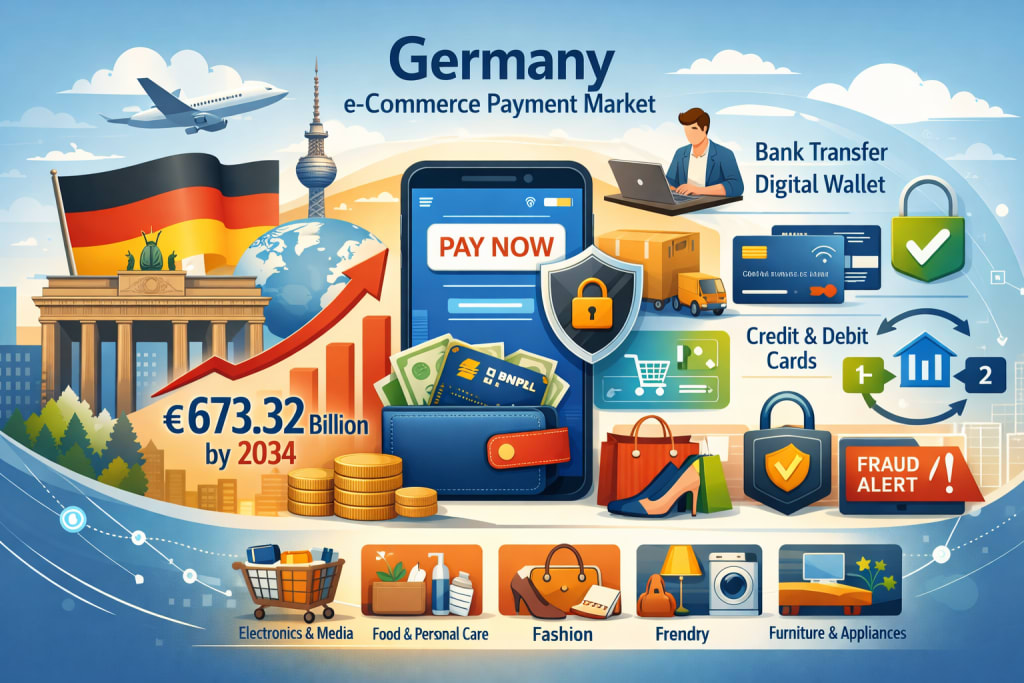
Germany E-Commerce Payment Market Outlook
The Germany E-Commerce Payment Market is projected to witness robust and sustained growth over the forecast period, expanding from US$ 252.37 Billion in 2025 to US$ 673.32 Billion by 2034, registering a Compound Annual Growth Rate (CAGR) of 11.52% during 2026–2034, according to insights provided by Renub Research. This steady expansion reflects Germany’s mature digital economy, high internet penetration, and a strong consumer inclination toward secure, transparent, and efficient payment solutions.
E-commerce payments refer to a broad set of electronic methods that allow consumers to pay for goods and services purchased online. In Germany, these include debit and credit cards, account-to-account (A2A) transfers, digital wallets, prepaid solutions, buy now pay later (BNPL) services, and invoice-based payments. The German market stands out globally for its emphasis on data protection, consumer rights, and payment security, all of which have shaped payment behaviors and influenced innovation across the ecosystem.
As online retail continues to embed itself deeper into everyday life—from electronics and fashion to groceries and subscriptions—e-commerce payments have become a foundational pillar of Germany’s digital commerce infrastructure. Continuous improvements in mobile commerce, fraud prevention, and user experience are accelerating adoption across both consumers and merchants.
Strong Online Retail Adoption and Consumer Trust
Germany is one of Europe’s most advanced and trusted e-commerce markets. German consumers routinely purchase electronics, clothing, groceries, digital content, and professional services online, driving high transaction volumes across payment platforms. A key factor supporting this growth is consumer trust. Germans are particularly sensitive to privacy, transparency, and data security, and payment providers that meet these expectations enjoy long-term loyalty.
Well-defined return policies, buyer protection mechanisms, and reliable refund processes further strengthen confidence in online transactions. The rapid shift toward omnichannel retailing—where traditional brick-and-mortar retailers expand their digital storefronts—has also increased demand for dependable, scalable, and secure e-commerce payment solutions.
Cross-border e-commerce is another important catalyst. As German merchants increasingly sell to customers across Europe and beyond, seamless cross-border payment capabilities are becoming essential. In September 2025, Adyen introduced enhanced cross-border payment functionalities aimed at simplifying international transactions for German online retailers, reflecting the growing importance of global payment interoperability.
Preference for Secure Bank-Based and Wallet Payments
German consumers have long demonstrated a preference for bank-linked and wallet-based payment methods over traditional credit cards. Account-to-account transfers, invoice payments, and digital wallets resonate strongly with consumers who value control, transparency, and real-time transaction visibility.
Digital wallets and online banking integrations offer faster checkouts, strong authentication, and reduced exposure of sensitive card details. These attributes align well with Germany’s risk-averse consumer culture. For merchants, these payment options reduce chargeback risks, improve cash flow through quicker settlement, and enhance checkout conversion rates.
The rise of mobile commerce has further amplified the use of digital wallets and app-based payments. In October 2025, PayPal partnered with a leading German bank to expand its localized payment offerings, strengthening its position in the country’s highly competitive e-commerce payment landscape.
Regulatory Frameworks Enhancing Payment Security
Germany benefits from one of the most comprehensive regulatory environments for electronic payments in Europe. Strict data protection laws, strong customer authentication requirements, and consumer protection regulations ensure a high level of trust in digital transactions. While compliance can be demanding, it has significantly reduced fraud and boosted confidence among online shoppers.
Payment service providers operating in Germany continuously invest in advanced fraud detection, encryption, and authentication technologies. In August 2025, Stripe launched enhanced fraud-prevention tools tailored specifically for the German market, using machine-learning algorithms to detect and prevent suspicious online payment activity. Such innovations not only protect consumers and merchants but also reinforce Germany’s reputation as a secure digital commerce hub.
Challenges in the Germany E-Commerce Payment Market
Complex Regulatory Compliance and Operational Costs
Although strict regulations strengthen security, they also increase operational complexity. Payment providers must constantly update systems to comply with evolving data protection and authentication requirements. For smaller merchants and fintech startups, compliance costs can be significant, potentially slowing innovation and limiting the introduction of new payment features.
Fragmented Consumer Payment Preferences
German consumers exhibit diverse payment preferences—ranging from bank transfers and invoices to digital wallets, BNPL, and cards. This fragmentation forces merchants to integrate multiple payment methods to avoid losing sales, increasing technical complexity and platform costs. Failure to offer preferred payment options can negatively impact conversion rates and customer satisfaction.
Germany E-Commerce Digital Wallet Payment Market
The digital wallet segment is experiencing strong growth as consumers increasingly prioritize speed, convenience, and security. Digital wallets use encryption, tokenization, and multi-factor authentication, aligning well with Germany’s strict data protection culture. Shoppers benefit from simplified checkouts and the ability to store payment credentials securely, while merchants enjoy lower cart abandonment rates and faster transactions.
Growth is further fueled by mobile commerce and app-based shopping, where wallet payments enable seamless in-app purchases. Features such as instant refunds, loyalty integration, and transaction tracking enhance customer experience, making digital wallets a core component of Germany’s evolving e-commerce payment ecosystem.
Germany E-Commerce Prepaid Payment Market
Prepaid payment solutions cater to consumers seeking controlled spending and reduced financial exposure. Prepaid cards, vouchers, and electronic prepaid accounts are widely used for online shopping, digital entertainment, gaming, and gift purchases. These solutions appeal particularly to younger users, parents, and individuals reluctant to link bank accounts directly to online platforms.
For merchants, prepaid payments reduce fraud risks and chargebacks, while also promoting financial inclusion by enabling participation from unbanked or underbanked consumers. As e-commerce adoption widens, prepaid solutions continue to play a valuable role in expanding access to online retail.
Germany E-Commerce BNPL Payment Market
The Buy Now Pay Later (BNPL) segment is gaining momentum in Germany, driven by consumer demand for flexibility and transparency. BNPL services allow customers to receive goods before making payments, aligning with German preferences for financial control and buyer protection.
BNPL solutions appeal to consumers who prefer alternatives to traditional credit cards, while merchants benefit from higher conversion rates, increased average order values, and reduced cart abandonment. As regulations and transparency standards strengthen, BNPL is expected to become an increasingly mainstream payment option within Germany’s e-commerce landscape.
Application-Wise Market Insights
Electronics & Media:
High-value electronics, digital media, and subscription services rely heavily on secure and reliable payment systems. Bank-based payments, wallets, and installment options support large transaction values while minimizing fraud risks. Subscription billing for ebooks, magazines, and streaming services further drives demand for stable payment infrastructures.
Fashion Accessories:
Impulse buying, frequent returns, and size variations make convenience and refund efficiency critical. Digital wallets, BNPL, and post-payment options dominate this segment, supported by fast refunds and mobile-friendly checkouts that build long-term consumer trust.
Food & Personal Care:
Reliability and speed are essential for groceries and daily essentials. One-click payments, digital wallets, and saved payment credentials enable repeat purchases and smooth checkout experiences. Failed payments can disrupt essential purchases, making payment reliability a top priority for merchants.
Market Segmentation Overview
By Type:
Digital Wallet, Credit Card, Debit Card, Account-to-Account (A2A), Buy Now Pay Later (BNPL), Cash on Delivery (CoD), PrePay, Others
By Application:
Electronics & Media, Food & Personal Care, Fashion Accessories, Furniture & Appliances, Others
By Cities:
Frankfurt, Munich, Hamburg, Berlin, Düsseldorf, Stuttgart, Cologne, Leipzig, Nuremberg, Dortmund, Rest of Cities
Competitive Landscape
The Germany E-Commerce Payment Market is highly competitive, featuring global payment leaders and technology innovators. Key companies profiled with comprehensive viewpoints—including overview, key personnel, recent developments, SWOT analysis, revenue analysis, and company analysis—include Amazon.com Inc., American Express Company, Apple Inc., Fiserv Inc., Mastercard Incorporated, PayPal Holdings Inc., and Visa Inc.. These players continue to invest in security, user experience, and localized solutions to strengthen their market positions in Germany.
Final Thoughts
The Germany E-Commerce Payment Market is entering a phase of sustained, innovation-driven growth. Strong consumer trust, high online retail penetration, and a regulatory framework that prioritizes security and transparency collectively support long-term expansion. While regulatory complexity and fragmented payment preferences present challenges, they also encourage innovation and differentiation among payment providers.
With digital wallets, BNPL, and bank-based payments gaining traction, and mobile commerce accelerating adoption, Germany is well positioned to remain one of Europe’s most sophisticated and secure e-commerce payment markets through 2034.
About the Creator
Kevin Warsh: The Fed Chair Nominee Forged by the 2008 Financial Crisis
A New Chapter in Federal Reserve Leadership As the United States continues to navigate a complex economic landscape, Kevin Warsh has emerged as a prominent figure. Recently nominated to serve as Chair of the Federal Reserve, Warsh’s appointment is being closely watched by economists, investors, and policymakers alike. His career trajectory, shaped significantly by the 2008 financial crisis, offers insights into how crisis management can define a generation of economic leaders. Early Life and Education Kevin Warsh was born in the late 1970s and displayed early aptitude in economics and finance. His educational path includes: Harvard University, where he earned a degree in Economics Additional studies in public policy and finance, sharpening his understanding of macroeconomic systems These formative experiences equipped him with the analytical tools necessary to navigate volatile economic conditions later in his career. Career Beginnings: From Wall Street to Public Service Warsh’s professional journey began in investment banking and financial consulting, where he gained firsthand experience in financial markets. However, his move into public service marked a turning point: He joined key financial advisory roles, advising policymakers on banking regulation and economic policy His early experience during the dot-com bubble and the housing market fluctuations provided a solid foundation for understanding systemic risk By the time the 2008 financial crisis struck, Warsh was already positioned to play a significant role in shaping policy responses. The 2008 Financial Crisis: Defining Moment The 2008 global financial crisis tested the resilience of the U.S. economy and the world at large. Kevin Warsh became a key advisor in navigating the crisis: He worked on strategies to stabilize the banking system Contributed to the Federal Reserve’s emergency measures Provided input on monetary policy decisions, including interest rate adjustments and liquidity injections Observers note that this period was formative for Warsh, forging his reputation as a crisis-ready economist. His hands-on involvement gave him deep insights into systemic vulnerabilities and the importance of proactive policy intervention. Nomination to Federal Reserve Chair Kevin Warsh’s nomination as Fed Chair reflects confidence in his experience and strategic thinking. Analysts expect him to: Address inflationary pressures while supporting economic growth Oversee monetary policy adjustments with a keen understanding of market reactions Promote financial stability, drawing on lessons from previous crises His leadership style is described as analytical, cautious, and forward-looking, qualities shaped by the high-stakes environment of 2008. Economic Philosophy and Policy Approach Warsh is known for a balanced, data-driven approach to economic policy: Emphasis on financial stability: He prioritizes reducing systemic risk while supporting growth Pragmatic monetary policy: Decisions are guided by empirical data rather than ideological biases Focus on long-term planning: Recognizes the need to anticipate market shifts and structural changes This philosophy positions him as a Fed Chair capable of navigating both short-term shocks and long-term challenges. Challenges Ahead Warsh faces a complex economic environment: Inflation fluctuations post-pandemic Global economic uncertainty, including trade tensions and geopolitical risks Technological disruption in financial markets, including digital currencies and fintech innovations His experience during the 2008 crisis may provide a roadmap for managing unexpected economic turbulence while maintaining public and market confidence. Criticism and Public Perception While Warsh has strong credentials, some critics highlight potential concerns: Connections to Wall Street could raise perceptions of bias toward financial institutions His measured, analytical style may be seen as less bold during urgent crises Navigating political pressures from Congress and the Executive branch could challenge independence Supporters, however, argue that experience during past crises outweighs these concerns, positioning him as a competent and steady leader. Impact of His Leadership If confirmed, Kevin Warsh’s tenure could influence: Interest rates and borrowing costs for businesses and consumers Financial regulations, potentially strengthening safeguards against systemic risks Global confidence in U.S. economic policy, especially among international investors His leadership may also set precedents for how future Fed Chairs respond to economic shocks and crises. Lessons from Kevin Warsh’s Career Warsh’s journey offers several takeaways: Crisis shapes leaders: Real-world challenges provide practical experience that cannot be replicated in textbooks Analytical thinking is essential: Data-driven approaches are crucial for complex economic decisions Resilience matters: Long-term success in economic policy requires the ability to adapt under pressure For aspiring economists and policymakers, Warsh exemplifies how experience, preparation, and analytical rigor combine to form effective leadership. Conclusion: A Fed Chair Forged by Crisis Kevin Warsh’s nomination as Federal Reserve Chair is not just a career milestone—it symbolizes the rise of a generation of economic leaders molded by financial crises and global uncertainty. His experience, particularly during the 2008 financial meltdown, gives him a unique perspective on risk management, monetary policy, and systemic stability. As the U.S. faces new economic challenges, Warsh’s leadership will be closely watched, both domestically and internationally. The lessons from his career highlight the importance of preparedness, insight, and adaptability, qualities essential for navigating the complex world of modern finance.
By Zahid Hussain4 days ago in The Swamp
China Sends Police to Australia in Hunt for Man Who Doused Baby with Coffee
In a startling development that has drawn global attention, Chinese authorities are sending investigators to Australia to assist in the search for a man accused of pouring boiling hot coffee over a baby in a Brisbane park — a disturbing crime that shocked the nation and sparked an ongoing international investigation. �
By Ayesha Lashari6 days ago in The Swamp




Comments
There are no comments for this story
Be the first to respond and start the conversation.