
Global Commercial Drone Market Size and Forecast 2025–2033
How Drones Are Re-Shaping Modern Industries Worldwide

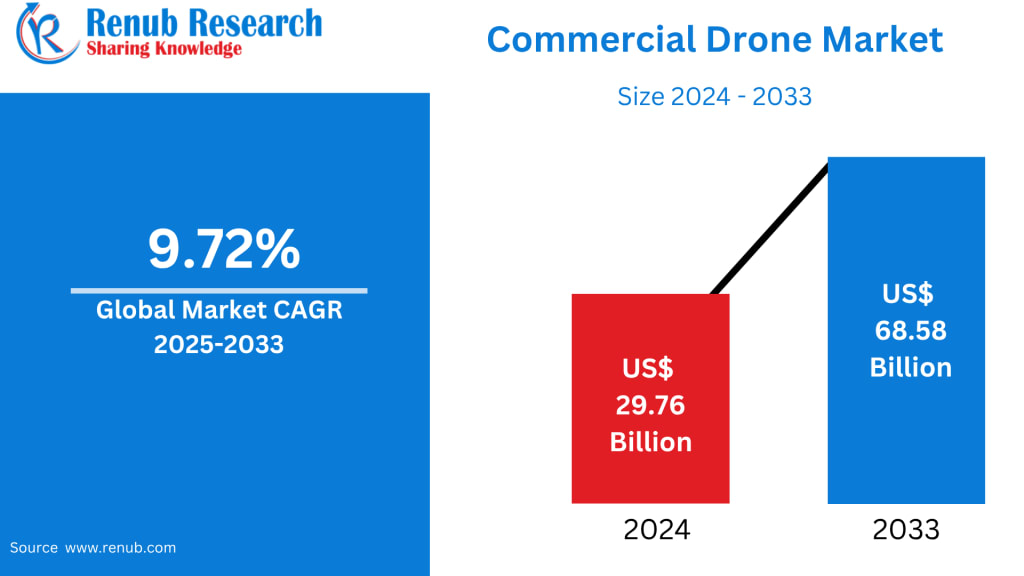
The Global Commercial Drone Market is preparing for one of the strongest growth phases in the history of unmanned aerial systems. According to Renub Research, the market is expected to surge from US$ 29.76 billion in 2024 to an impressive US$ 68.58 billion by 2033, expanding at a 9.72% CAGR during 2025–2033.
This rapid expansion is powered by rising drone adoption across agriculture, smart infrastructure, security surveillance, logistics, and public safety. Innovation in automation, flight control, imaging, and sensor technology—along with friendlier regulations—is cementing drones as mainstream business tools rather than futuristic experiments.
From farms to megacities, and from warehouses to search-and-rescue operations, drones are becoming indispensable assets across industries striving for efficiency, real-time insight, and intelligent automation.
A New Age of Business Intelligence: Global Commercial Drone Market Outlook
A commercial drone—or UAV (Unmanned Aerial Vehicle)—is an aircraft operating without a human pilot onboard, equipped with sophisticated systems such as cameras, GPS, sensors, and AI-based software for autonomous or remote-controlled operations.
Unlike recreational drones, commercial drones support paid, professional, and industrial applications, including:
Precision agriculture (crop monitoring, spraying, soil analysis)
Construction site monitoring and infrastructure inspections
Energy sector surveys (wind turbines, pipelines, powerlines)
Logistics and last-mile delivery
Search-and-rescue and emergency response
Public safety surveillance and firefighting
Their ability to deliver real-time data, reduce operational costs, and improve safety is accelerating adoption across North America, Europe, and Asia-Pacific, where regulatory reforms have unlocked broader commercial use.
Growth Drivers Transforming the Commercial Drone Industry
1. Technological Breakthroughs Fueling Innovation
The commercial drone market is riding a wave of unprecedented technological advancement, with breakthroughs in:
Battery efficiency and extended flight time
Obstacle avoidance and autonomous navigation
AI-driven data analytics
High-resolution imaging and multispectral sensors
Increased payload capacity
These innovations have greatly expanded industrial applications. Drones are no longer just data-gathering tools—they are now performing operational tasks.
Industry Example:
In August 2024, Rotor Technologies (USA) unveiled the world’s two largest commercial drones—Airtruck and Sprayhawk—built from modified Robinson R44 helicopter airframes. These UAVs can lift heavy cargo and conduct agricultural spraying autonomously.
Such advancements are redefining how businesses perceive operational efficiency, accuracy, and cost savings.
2. Rising Demand From Agriculture & Infrastructure
Precision agriculture is one of the top beneficiaries of drone technology. Farmers increasingly rely on drones for:
Crop health monitoring
Irrigation planning
Soil management
Fertilizer and pesticide spraying
Similarly, the infrastructure sector uses drones for:
Construction monitoring
Site surveillance
Bridge inspections
Mining activity mapping
These tasks, previously slow and labor-intensive, can now be completed with greater accuracy and safety.
July 2025 Spotlight:
DJI launched the Agras T100, T70P, and T25P, designed for fully autonomous agricultural operations, deepening drone integration across farming communities globally.
3. Supportive Government Regulations Unlock Growth
Regulatory clarity is a major catalyst for commercial drone adoption. Authorities such as:
FAA (United States)
EASA (Europe)
DGCA (India)
ANAC (Brazil)
are establishing streamlined frameworks that define airspace access, licensing, and operational safety.
Example:
France’s 2025 drone regulations incorporate EU-wide directives to create uniform commercial drone standards, improving safety and integration across Europe.
Clearer rules boost industry confidence, attract investments, and encourage commercial pilots and enterprises to adopt drones on a larger scale.
Market Challenges Slowing Adoption
Despite its momentum, the drone industry faces hurdles that cannot be ignored.
1. Fragmented Global Regulations
Different countries have varying policies around:
Flight permissions
No-fly zones
Weight limits
Pilot licensing
Data/privacy laws
This regulatory inconsistency increases complexity and cost for global enterprises operating across borders.
2. High Upfront and Maintenance Costs
Commercial-grade drones, especially those used for logistics, industrial inspections, or agriculture, require significant investments in:
Hardware
Software systems
Insurance and certifications
Operator training
Repairs and upgrades
For SMEs, ROI concerns can slow adoption, especially without guaranteed efficiency improvements.
Market Breakdown: Segment-Wise Insight
Commercial Drones (2 Kg – 25 Kg Category)
The 2–25 kg segment is the global bestseller due to its perfect balance of:
Payload capacity
Flight endurance
Cost efficiency
Safety compliance across multiple countries
This weight class dominates mapping, delivery, surveying, and surveillance applications, commonly used by both SMEs and large enterprises.
Commercial Drone Software Market
Software is the backbone of modern drone operations. Capabilities include:
Flight automation
Real-time data transmission
Image processing
3D mapping
AI-driven analytics
Cloud-based fleet management
As industries shift toward data-centric models, drone software is becoming increasingly vital—turning simple flights into actionable intelligence.
Rotary Blade Commercial Drone Market
Rotary-blade drones continue to dominate commercial usage due to:
Vertical takeoff and landing (VTOL)
Ability to hover in place
Smooth maneuverability in tight spaces
Industries relying on these drones include:
Public safety
Agriculture
Construction
Infrastructure inspection
Their agility makes them ideal for tasks requiring precision and close-range observation.
Semi-Autonomous Commercial Drone Market
Semi-autonomous drones represent a middle ground between manual and fully autonomous systems. They:
Reduce operator workload
Improve mission repeatability
Enhance safety
Lower training requirements
Industries such as real estate, media, and agriculture prefer semi-autonomous platforms as they provide automation without losing human oversight.
Key Applications Driving Global Market Expansion
1. Mapping & Surveying
High-resolution topographic mapping using drones with LiDAR, thermal, or multispectral sensors is replacing slow traditional land surveys.
Industries: mining, construction, environmental monitoring.
2. Delivery & Logistics
Companies such as Amazon and UPS are embracing drone fleets for:
Last-mile delivery
Medical supply transport
Emergency shipments
Drones offer faster, contactless, and cost-effective logistics solutions.
3. Security & Law Enforcement
Authorities use drones for:
Border surveillance
Crowd monitoring
Crime detection
Disaster response
Thermal imaging and real-time video analytics have made drones essential for public safety operations.
Country-Level Insights: Global Market Penetration
United States
The U.S. dominates global commercial drone adoption due to:
FAA Part 107 certifications
High demand in agriculture, security, and construction
Strong startup ecosystem in Silicon Valley
Defense-driven drone innovation
Germany
Germany leads Europe in:
Infrastructure inspections
Precision agriculture
Drone software development
EASA support and strong engineering capabilities continue to accelerate market penetration.
India
India is emerging as a major growth hotspot. Drivers include:
Digital Sky Platform for drone permissions
Government-backed agricultural drone programs
Expanding mining and infrastructure use
Indian startups are increasingly building scalable drone solutions for rural and urban needs.
Brazil
Brazil’s drone market is heavily influenced by vast agricultural landscapes.
Applications include:
Crop spraying
Field mapping
Livestock monitoring
ANAC’s updated regulations have simplified commercial drone operations across large territories.
Saudi Arabia
Saudi Arabia’s Vision 2030 is pushing drone adoption in:
Oil & gas inspections
Smart city development (NEOM)
Public safety
Urban planning
Government-backed pilot programs are driving rapid market acceleration.
Market Segmentation Overview
Product
Fixed Wing
Rotary Blade
Hybrid
Mode of Operation
Remotely Operated
Semi-Autonomous
Autonomous
Application
Filming and Photography
Inspection and Maintenance
Mapping and Surveying
Precision Agriculture
Surveillance & Monitoring
Others
End Use Industries
Agriculture
Delivery and Logistics
Energy
Media & Entertainment
Real Estate & Construction
Security & Law Enforcement
Others
Key Companies Covered
Aeronavics Ltd.
AeroVironment Inc.
Autel Robotics
Delair
Insitu Inc. (The Boeing Company)
Leptron Unmanned Aircraft Systems Inc.
PrecisionHawk Inc.
SenseFly (AgEagle Aerial Systems)
Skydio Inc.
Yuneec International
Each company includes 5 viewpoints:
Overview, Key Person, Recent Developments, SWOT Analysis, Revenue Analysis
Final Thoughts
The global commercial drone market is on the brink of a transformative decade. As industries increasingly embrace digitization, automation, and aerial intelligence, drones are evolving from optional tools to operational necessities. The blend of stronger regulations, improved autonomy, longer flight time, AI-powered analytics, and expanding commercial acceptance ensures steady and sustainable market growth.
From precision farming in Brazil to urban delivery pilots in the U.S., or from smart city infrastructure in Saudi Arabia to inspection solutions in Germany—commercial drones are becoming the eyes, hands, and data engines of modern industries.
With a strong CAGR of 9.72% through 2033, the next decade will belong to drone-enabled enterprises, smarter ecosystems, and more efficient global operations.
About the Creator
Keep reading
More stories from Aaina Oberoi and writers in The Swamp and other communities.
United States Short Haul Road Freight Transport Market Size and Forecast
The United States Short Haul Road Freight Transport Market is on a steady upward trajectory, powered by the nation’s thriving e-commerce ecosystem, expanding manufacturing activities, and rapid advances in fleet management technologies. According to Renub Research, the market is expected to reach US$ 202 billion by 2033, rising from US$ 147.83 billion in 2024, growing at a CAGR of 3.53% from 2025 to 2033. This sustained demand reflects the critical role that short-distance freight plays in supporting modern supply chains, last-mile delivery, and urban logistics across the U.S.
By Aaina Oberoiabout a month ago in The Swamp
A Deadly Lottery: When an Entire City Hunts One Person Before Sunset
The story begins in Los Angeles. In the year 2030, a man is running like a mad person. He is extremely terrified. The entire city is chasing him to kill him. Even private car drivers step out of their cars just to kill him. With great difficulty, he reaches the house of a poor woman. The woman asks, “What are you doing here?”
By Filmon Ke Raaz | Movie Mysteries Explaineda day ago in The Swamp




Comments
There are no comments for this story
Be the first to respond and start the conversation.