
Gaza Children Risk Snipers to Attend Tent Schools
Children brave deadly danger each day in pursuit of education amid Gaza’s ongoing conflict

In Gaza, education has become an act of courage. As conflict continues to devastate neighborhoods and displace families, children are risking sniper fire to attend makeshift “tent schools”, driven by a determination to learn even amid fear, hunger, and destruction.
These informal classrooms—often little more than tarpaulins stretched over wooden poles—stand as symbols of resilience in a place where traditional schools have been damaged, destroyed, or rendered inaccessible by ongoing violence.
For Gaza’s children, the journey to class is no longer routine. It is a calculated risk.
Tent Schools Born From Desperation
With many school buildings reduced to rubble or repurposed as shelters for displaced families, teachers and volunteers have created tent schools in camps, open fields, and crowded neighborhoods.
Inside, children sit on thin mats or the bare ground, sharing donated notebooks and pencils. Lessons are improvised, schedules are uncertain, and learning is frequently interrupted by nearby explosions or gunfire.
Yet parents continue to send their children, believing that education offers not only knowledge but a sense of normalcy and hope in a life otherwise defined by trauma.
Children Crossing Danger Zones
Reaching these tent schools often means crossing areas exposed to sniper fire or active military presence. Aid workers report that children sometimes wait for quieter moments or travel in small groups to reduce risk.
Parents describe agonizing choices: keep children safe at home with no schooling, or allow them to venture out for education despite the danger.
“We know it’s risky,” said one mother in Gaza. “But if they stop learning, they lose their future. We cannot let that happen.”
Education as Psychological Survival
Beyond academics, tent schools provide critical psychological support. Teachers incorporate play, storytelling, and group activities to help children cope with fear, grief, and displacement.
Mental health experts warn that prolonged exposure to violence without educational structure can cause lasting emotional damage. In this context, even a few hours of learning can offer stability and routine.
“For these children, school is not just about math or reading,” said a volunteer teacher. “It’s about feeling human again.”
Teachers on the Front Line
Many teachers running tent schools are themselves displaced, grieving lost homes or family members. Despite this, they continue teaching with little pay, limited supplies, and constant risk.
Some educators travel long distances through unsafe areas to reach their students. Others sleep near the tents to ensure consistency when movement becomes too dangerous.
Their commitment underscores the belief that education is not a luxury, but a necessity—even, and especially, during war.
International Law and the Right to Education
Under international law, children have the right to education, even in conflict zones. Schools are meant to be protected spaces, and attacks on educational facilities are prohibited.
Human rights organizations argue that the conditions forcing children to risk sniper fire to attend school represent a profound failure of protection.
Aid agencies are calling for safe corridors, ceasefires around learning spaces, and increased humanitarian access to ensure children can learn without fear.
A Generation at Risk
Gaza’s population is overwhelmingly young, and prolonged disruption to education threatens to create a lost generation. Years of missed schooling could limit future employment, deepen poverty, and prolong cycles of instability.
Experts warn that denying education today will have consequences that last decades, affecting not just individuals but the entire region.
Despite this, funding for emergency education remains limited compared to other humanitarian needs.
Global Response and Limited Support
International organizations have provided some learning materials and psychosocial support, but resources are stretched thin. Tent schools often lack textbooks, trained counselors, and safe infrastructure.
Teachers report that even basic supplies—chairs, whiteboards, clean water—are scarce. In some cases, children attend class hungry or exhausted from nights spent fleeing bombardment.
Calls for increased international support have grown louder, urging governments and donors to prioritize education alongside food, shelter, and medical aid.
Voices of the Children
Children attending tent schools speak with a mixture of fear and determination. Some dream of becoming doctors, engineers, or teachers—aspirations unchanged despite their circumstances.
“I like school because it makes me forget the noise,” said one young student. “When I’m learning, I feel safe for a little while.”
Their words highlight the extraordinary resilience of children who continue to hope, even when surrounded by uncertainty.
Education as Resistance and Hope
In Gaza, attending school has become an act of quiet resistance—a refusal to allow violence to erase childhood, identity, and the future.
Tent schools may be fragile, but their impact is profound. They affirm that learning matters, that children matter, and that hope can survive even in the harshest conditions.
Conclusion: Courage in the Classroom
As Gaza’s children risk sniper fire to attend tent schools, their courage exposes a harsh reality: education has become a frontline struggle. These young students are not asking for privilege—only the chance to learn safely.
Their determination is a powerful reminder to the world that protecting education is not optional. It is a moral obligation. In the face of war, Gaza’s children continue to choose books over fear—and that choice deserves protection, support, and global attention.
About the Creator
Keep reading
More stories from Aarif Lashari and writers in The Swamp and other communities.
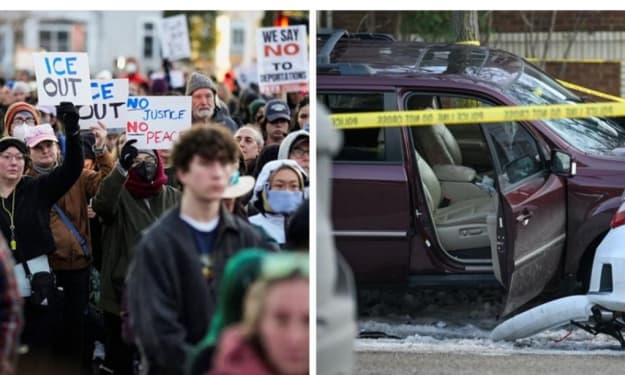
Protests Held in Minneapolis After Woman Shot Dead by US Immigration Agent
Protests erupted across Minneapolis after a woman was shot and killed during an encounter with a US immigration enforcement agent, sparking renewed national debate over the use of force, accountability, and immigration policing. Demonstrators gathered near the site of the shooting and outside government buildings, demanding answers, justice, and systemic reform.
By Aarif Lashari2 months ago in The Swamp
A Gathering of Evil Bosses
“I’m the queen of chin jutting while I smooth my hair, attacking, insulting, and deflecting to protect my appointer.” “Oh, please, Blondi, my hair is curled, highlighted, and longer than yours. I feature television commercials telling immigrants that we will give them a free plane ride home, and if they voluntarily turn themselves in, they will be allowed to legally apply for re-entry. It runs everywhere, and I look good in it! You can’t compete because of your blond hair. Mine is nicer, and my lips are prettier than yours.”
By Andrea Corwin 10 days ago in The Swamp


Comments
There are no comments for this story
Be the first to respond and start the conversation.