
"From Swords to Drones: The Evolution of Weapons in War"
How human conflict shaped technology — and how weapons changed the face of history from ancient times to today.

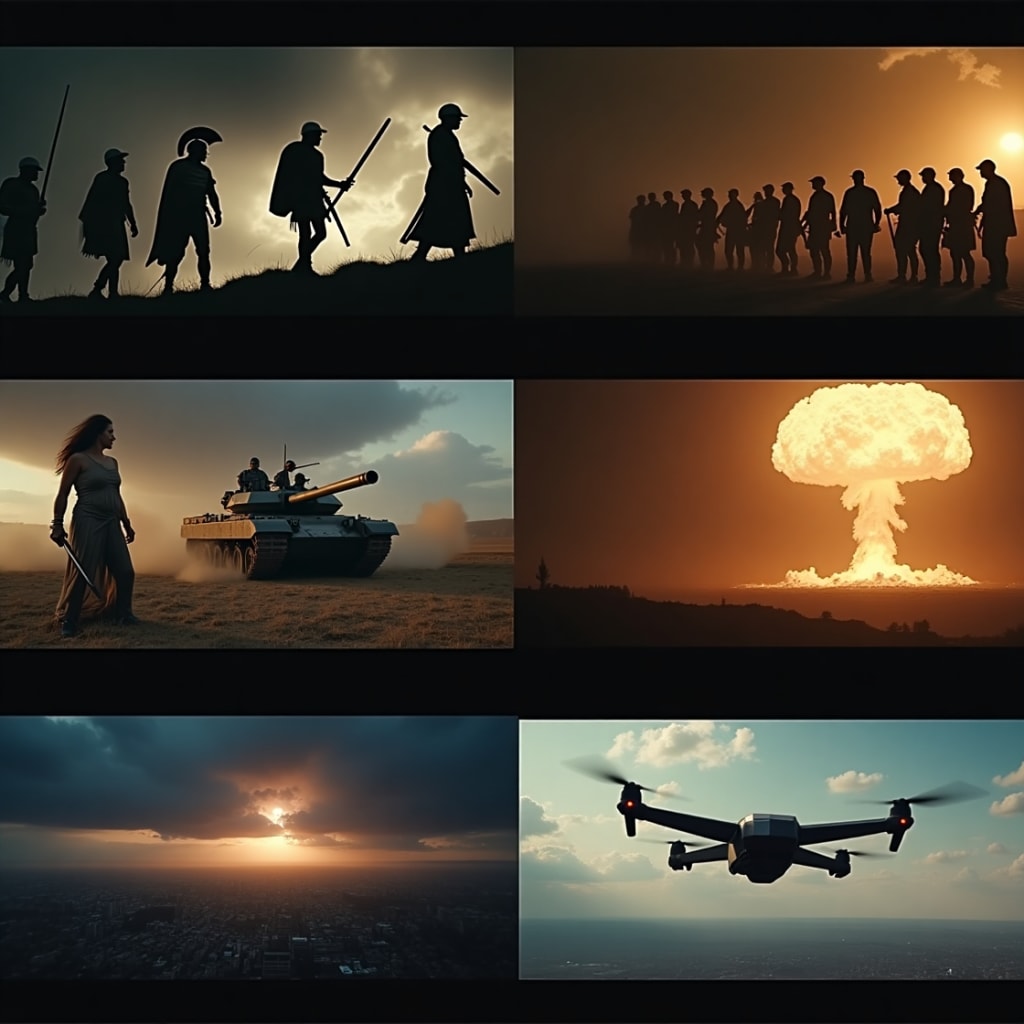
"From Swords to Drones: The Evolution of Weapons in War"
War has always been one of humanity’s darkest realities. From the earliest battles between tribes to the world-spanning conflicts of the 20th and 21st centuries, weapons have played a central role in shaping history. Every new invention — from the sword to the nuclear bomb — has changed the way humans fight, the way nations rise or fall, and the way ordinary people live through war.
This is the story of how weapons evolved, and how they continue to define the balance between survival and destruction.
Ancient Weapons: The Age of Swords and Spears
Thousands of years ago, before firearms or explosives, battles were fought face to face. Warriors carried spears, bows, and swords, forged from bronze and later iron. These weapons required skill and courage, since combat was often fought at arm’s length.
Famous armies like the Spartans with their spears, the Roman legions with their short swords (gladius), and the Mongol horse archers with their powerful bows shaped empires with these tools. The clash of metal against metal was the soundtrack of war for centuries.
Gunpowder Revolution
Everything changed with the discovery of gunpowder in China over a thousand years ago. At first, it was used for fireworks, but soon it was transformed into cannons, muskets, and pistols.
Gunpowder weapons gave armies a new advantage: distance. Soldiers no longer needed to fight face-to-face. Walls that once seemed unbreakable crumbled under cannon fire. The battlefield was forever transformed.
By the 17th and 18th centuries, rows of soldiers with muskets replaced knights with swords. Battles became louder, deadlier, and more destructive.
Industrial Age: Machine Guns and Explosives
The 19th and early 20th centuries saw the rise of machine guns, rifles, and explosives. The American Civil War introduced repeating rifles. World War I brought weapons like the Maxim machine gun, barbed wire, and chemical gas attacks.
Trenches filled with soldiers while artillery shells rained down. Millions perished, and the world realized that industrialized weapons meant industrialized death.
World War II: Total War
World War II was the deadliest conflict in human history, and weapons were central to it. Tanks rolled across Europe, fighter planes battled in the skies, and navies clashed with powerful battleships. The German V-2 rocket was the world’s first long-range missile, paving the way for modern rocketry.
And then came the ultimate weapon: the atomic bomb. Dropped on Hiroshima and Nagasaki in 1945, it ended the war but opened a terrifying new chapter in human history. For the first time, humanity had the power to destroy itself completely.
The Cold War: Nukes, Jets, and Missiles
After World War II, nations raced to build more advanced weapons. Nuclear stockpiles grew into the thousands. Fighter jets broke the sound barrier. The AK-47 rifle, simple and durable, became the most widely used firearm in the world.
The Cold War wasn’t just about politics — it was about an arms race. Satellites, intercontinental ballistic missiles (ICBMs), and submarines capable of launching nuclear warheads changed global strategy forever.
Modern Wars: Drones and Cyber Weapons
Today’s battlefields look very different from those of the past. Soldiers still carry rifles, but the most powerful weapons are often unmanned drones, smart bombs, and cyber-attacks.
Drones can strike targets thousands of kilometers away without risking a pilot’s life. Precision-guided missiles can destroy a single building without touching the one next to it. Cyber weapons can disable power grids, steal secrets, or disrupt entire nations without a single bullet being fired.
Meanwhile, nations still fear nuclear weapons — more powerful now than ever before. The danger of conflict escalating into nuclear war remains a shadow over humanity.
The Cost of Weapons
Weapons are not just machines. They are tools of both defense and destruction. While they have shaped empires and determined the outcomes of wars, they also carry a heavy cost: millions of innocent lives, cities reduced to ruins, and generations scarred by conflict.
History teaches us that with every new weapon comes a question: Will humanity use this power to protect or to destroy?
Final Thoughts
From the sharp edge of a sword to the silent hum of a drone, weapons reflect human progress — and human conflict. They show our genius for invention, but also our capacity for violence.
The challenge of the future is not just creating new weapons, but learning how to prevent them from being used. Because in the end, the greatest weapon humanity holds is not a bomb or a gun — it is the choice of peace.
About the Creator
Wings of Time
I'm Wings of Time—a storyteller from Swat, Pakistan. I write immersive, researched tales of war, aviation, and history that bring the past roaring back to life
Keep reading
More stories from Wings of Time and writers in The Swamp and other communities.
Israel Accused: War Crimes and Global Outcry
Israel Accused: War Crimes and Global Outcry Israel has long been a focal point of international attention, but in the 21st century, it faces mounting accusations of war crimes and human rights violations. From Gaza airstrikes to the ongoing occupation of Palestinian territories, these issues have sparked global debates, United Nations inquiries, and criticism from human rights organizations around the world.
By Wings of Time 6 months ago in The Swamp
Parallel Protests
I haven't written for quite some time, but I have A LOT of thoughts about yesterday's protest rally against our government's involvement and complicity in America's war on Iran, on the harbourside of my home city Bristol, and I need to put them somewhere. My gorgeous girlfriend is always a loving and listening ear and sharing it all with her will always be a healthy and happy way of processing the mental and emotional weight, but getting it straight in my brain to share means writing it all down in straight lines, so, here we are and thanks for being here.
By Steph Cole7 days ago in The Swamp
The Economic Crisis of the Iran War Could Get Very Bad, Very Fast
As the war involving the United States, Israel, and Iran intensifies, economists and market analysts warn that the global economic fallout could be steep, deep and fast‑moving. What began as a military confrontation in late February 2026 has already rippled through oil, gas, financial markets and supply chains — and if the conflict persists, the consequences could quickly worsen. Energy Shock: Oil Prices Near Record Levels One of the most immediate economic effects of the conflict is on energy markets. Oil prices have surged sharply in recent days amid fears of supply disruptions. On March 6, 2026, Brent crude crude — the international benchmark — climbed above $90 per barrel, marking one of the largest weekly gains since the COVID‑19 pandemic, driven by concerns over production and export routes in the Middle East. The strategic Strait of Hormuz, a narrow maritime chokepoint through which roughly 20 per cent of the world’s crude oil and LNG supplies flow, has been particularly affected. Reports indicate that activity there has slowed dramatically as shipping companies avoid the area due to the risk of missiles and drones, raising the specter of an effective closure if hostilities worsen. These developments have led traders to price in a “geopolitical risk premium,” pushing energy futures higher and contributing to market volatility. Goldman Sachs analysts say that risks of sustained disruption could boost oil prices substantially higher — potentially above $100 per barrel if instability persists — with knock‑on effects for inflation and economic activity. Inflation, Growth and Consumer Costs Higher energy prices typically feed directly into inflation. Fuel is a core cost component for transportation, manufacturing and households; when gasoline and gas prices rise, it often triggers broader price increases in goods and services. Analysts warn that continued escalation of the conflict could push inflation higher at a time when many central banks are already grappling with moderately elevated price pressures. Europe is particularly vulnerable. With reduced Russian pipeline imports since 2022, European economies have become more dependent on seaborne LNG and oil passing through strategic Middle Eastern routes. Disruptions to these supplies could force countries to compete for limited cargoes, driving up prices and reducing growth projections. Oxford Economics forecasts that energy market shocks from the conflict could dent eurozone GDP and force inflation above policymakers’ targets if they persist. In emerging markets like Türkiye, the impact could be even more pronounced. Analysts there suggest that sustained high energy prices could push consumer inflation toward 30‑40 per cent — levels that would dramatically weaken purchasing power and currency stability. Global Supply Chains and Market Volatility Beyond energy, global supply chains are already feeling strain. Logistics firms have suspended bookings to ports in the Persian Gulf, and freight rates have risen noticeably as shipping routes become less reliable. Disruptions to maritime trade not only affect oil but also other commodities that move through the region, adding further inflationary pressures. Financial markets have also responded. In recent sessions, stock indices in Europe and Asia have slid as investors reassess risk and seek safe‑haven assets like gold and U.S. Treasury bonds. Volatility in equity markets can dampen investment sentiment and slow corporate hiring and expansion — factors that influence broader economic growth forecasts. Household Impact: From Pump Prices to Heating Bills At the consumer level, the effects are tangible. Already, fuel prices have begun creeping higher in many countries, with motorists in several regions facing noticeable increases at the pump. In the UK, for example, rising crude oil costs have nearly doubled heating fuel prices for millions of households — a stark reminder of how geopolitical shocks translate into everyday costs for families. Higher energy and transport costs can also squeeze household budgets, leading to reduced discretionary spending — which in turn can slow sectors like retail and services that rely on consumer demand. Downside Risks: Prolonged Conflict and Stagflation Most economic projections hinge on the duration of the conflict. A short‑lived flare‑up might cause a temporary spike in prices and market volatility, but a prolonged confrontation — particularly one that expands beyond current theaters — carries the risk of deeper economic dislocation. Economists warn that if the conflict drags on, the global economy could face stagflation: the toxic combination of slowing growth and rising inflation. This scenario would limit central banks’ ability to respond effectively, as raising interest rates to combat inflation could further suppress economic activity. In such a scenario, the world could experience slower growth, higher energy costs, diminished consumer confidence, and heightened financial market volatility — creating a cycle of economic strain that feeds back into politics, public sentiment, and fiscal policy decisions. Conclusion The economic crisis triggered by the Iran war has already begun to ripple across global markets. Rising energy prices, logistical disruptions, and increased inflationary pressures are only the first signs of a broader economic risk. If the conflict persists or expands, the impacts could soon reach far beyond the Middle East — affecting fuel bills, investment decisions, growth forecasts and the everyday economic reality of millions worldwide.
By Fiaz Ahmed 4 days ago in The Swamp
From ad men to mad men
It's after 2am in the morning when a local police patrol vehicle in Northern New Jersey spots a figure costumed as Quasimodo, The Hunchback of Notre Dame, proceeding southbound on the sidewalk along Lydecker Street. Though the hunchback’s costume stuffing offers added insulation, it's January, and friggin’ freezing. Carefully, the officers slow down, gently question the subject, and offer him a ride home.
By David W. Maury5 days ago in Humor


Comments
There are no comments for this story
Be the first to respond and start the conversation.