
For Serbia’s Muslim Students, Protest Brings a Long-Missing Sense of Belonging
Protest Brings a Long-Missing Sense of Belonging

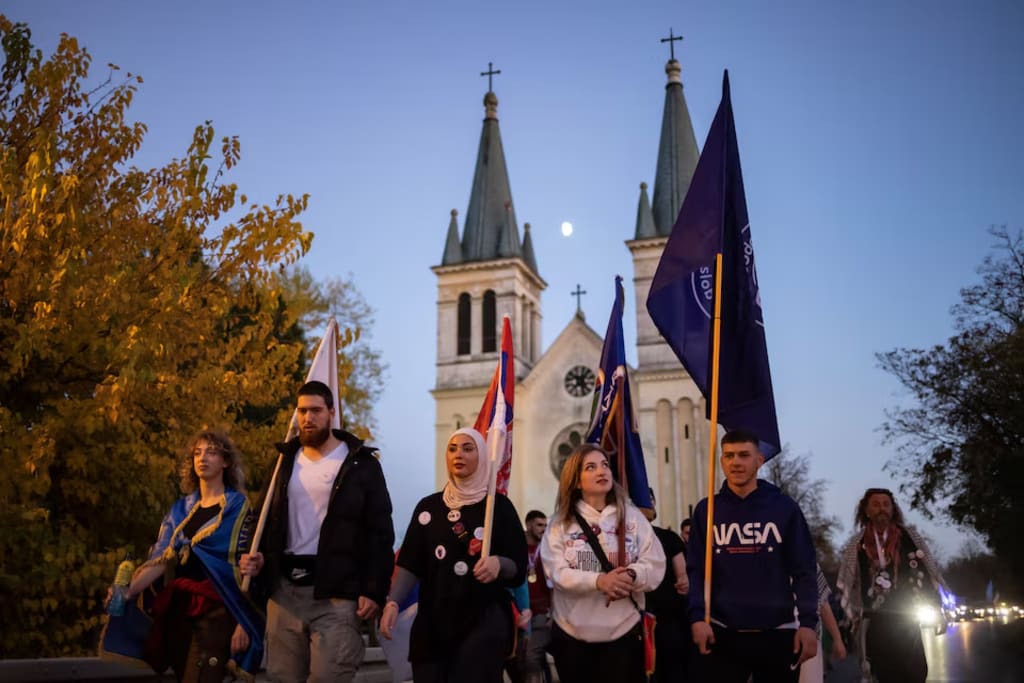
In Serbia, public protests have long been associated with political change, economic frustration, or demands for accountability. But for a growing number of Muslim students, recent demonstrations have carried a more personal meaning. Beyond slogans and banners, these protests have become spaces where young people feel seen, heard, and included in a society where they have often felt peripheral.
Muslims make up a small but significant minority in Serbia, concentrated largely in regions such as Sandžak and parts of southern Serbia. Many Muslim students leave their hometowns to study in larger cities like Belgrade or Novi Sad, where cultural and religious differences can feel more pronounced. While university life offers opportunity, it can also heighten feelings of isolation, particularly in environments where minority identities are rarely reflected in public discourse.
For these students, participation in protest movements has offered something unexpected: a shared civic identity. Standing shoulder to shoulder with fellow students from different ethnic and religious backgrounds, many Muslim participants describe feeling part of a broader collective for the first time. The protests, often centered on issues like education standards, political transparency, or civil rights, have created a rare space where identity is defined less by background and more by shared purpose.
Several Muslim students have spoken about how protest participation changed their relationship with the state and society. Rather than feeling like observers on the margins, they felt like contributors to Serbia’s future. This shift may seem subtle, but in a country still shaped by the legacy of ethnic conflict and political polarization, it carries real weight.
Universities have played a key role in this transformation. Student-led movements tend to emphasize inclusivity and solidarity, focusing on common struggles such as rising living costs, limited job prospects, and concerns about academic freedom. These issues cut across identity lines, allowing Muslim students to engage without feeling singled out or tokenized.
For many participants, the protests also provided emotional affirmation. Public spaces in Serbia have not always felt welcoming to visibly Muslim individuals, particularly women who wear hijab. During demonstrations, however, students describe an atmosphere of mutual protection and respect. Shared chants and collective movement helped dissolve social barriers, even if only temporarily.
This sense of belonging has had a ripple effect beyond the protests themselves. Muslim student groups report increased confidence in organizing discussions, cultural events, and civic initiatives on campus. The visibility gained through protest participation has encouraged some students to speak more openly about their experiences, both positive and negative, within Serbian society.
Importantly, this moment has not erased longstanding challenges. Muslim students still face structural inequalities, underrepresentation, and occasional discrimination. Participation in protests does not guarantee lasting inclusion, nor does it resolve deep-rooted social tensions. However, it has opened a door—one that allows minority students to imagine themselves as active stakeholders rather than passive residents.
Some students describe the protests as a form of civic education. Through organizing, debating, and negotiating differences, they learned how democratic engagement works in practice. For those who previously felt disconnected from national politics, this hands-on experience reshaped their understanding of citizenship.
The protests have also challenged assumptions held by the broader public. Seeing Muslim students visibly engaged in movements advocating for shared national concerns disrupts simplistic narratives about loyalty or integration. It reinforces the idea that minority identities and civic commitment are not mutually exclusive.
Faculty members and observers note that such moments are especially significant for young people. University years are formative, shaping how individuals relate to authority, community, and self-expression. When Muslim students find inclusion during this period, it can influence how they engage with society long after graduation.
There is also a symbolic dimension to these protests. Public squares, streets, and campuses have historically been spaces where power dynamics are contested. For Muslim students to occupy these spaces confidently signals a quiet but meaningful shift. It asserts presence without confrontation, belonging without assimilation.
The sense of unity experienced during protests may not be permanent. Movements lose momentum, demands evolve, and political realities intrude. Yet many students say the memory of collective action stays with them. Knowing that solidarity is possible, even if fragile, changes how they view both themselves and others.
In a region where identity has often been used to divide, these protests offer a different narrative—one centered on shared aspirations rather than inherited differences. For Serbia’s Muslim students, the demonstrations have been more than acts of dissent. They have been moments of recognition.
Ultimately, the significance of these protests lies not only in their political outcomes but in their social impact. They have shown that inclusion does not always begin with policy; sometimes it begins with standing together in public, demanding change, and realizing that one’s voice belongs there too.
For Muslim students in Serbia, that realization has been powerful. It has transformed protests from events into experiences—and from expressions of frustration into affirmations of belonging
About the Creator
Saboor Brohi
I am a Web Contant writter, and Guest Posting providing in different sites like techbullion.com, londondaily.news, and Aijourn.com. I have Personal Author Sites did you need any site feel free to contact me on whatsapp:
+923463986212
Keep reading
More stories from Saboor Brohi and writers in The Swamp and other communities.
New Arms Race Looms as Clock Ticks Down on Last Russia-US Nuclear Treaty
The world is facing a growing threat of a renewed nuclear arms race as the clock ticks down on the last remaining major nuclear treaty between the United States and Russia. The New Strategic Arms Reduction Treaty (New START), which limits the number of deployed nuclear warheads and delivery systems for both countries, is set to expire soon, raising alarms among diplomats, military experts, and international security analysts. Signed in 2010 and extended in 2021 for five years, New START has long been viewed as a cornerstone of nuclear stability between the two largest nuclear powers. Its provisions allow for regular inspections, transparency measures, and caps on deployed warheads, providing a degree of predictability in an otherwise unpredictable global security environment. The Stakes of Expiration With the treaty’s expiration approaching, fears are mounting that a breakdown in arms control could spur both nations to accelerate nuclear weapons development. Analysts warn that without binding limits, the United States and Russia could enter a competitive cycle, rapidly expanding their arsenals and increasing the risk of miscalculations or accidental escalation. The potential consequences extend far beyond the two countries. Allies in Europe, Asia, and beyond could face heightened security concerns, prompting them to reconsider their own defense postures. Experts caution that a new arms race could also divert resources away from pressing global issues such as climate change, economic development, and conventional military preparedness. Drivers Behind the Tensions Several factors have intensified the risk of a renewed arms race. Geopolitical tensions between Moscow and Washington remain high, exacerbated by conflicts in Eastern Europe, cyber confrontations, and differing strategic priorities. Both countries are investing in modernizing their nuclear arsenals, including hypersonic missiles, submarine-launched systems, and advanced intercontinental ballistic missiles. These developments are compounded by the absence of new, comprehensive arms control frameworks. While New START has provided a temporary mechanism for stability, negotiations for successor agreements have stalled, leaving a vacuum in global nuclear governance. International Reactions and Concerns Global leaders and non-proliferation experts have voiced serious concerns about the treaty’s potential collapse. The United Nations and the International Atomic Energy Agency (IAEA) emphasize the importance of dialogue, urging both sides to extend or replace New START to maintain transparency and prevent escalation. Public sentiment also reflects apprehension. Citizens around the world are increasingly aware of the catastrophic consequences of nuclear conflict, and experts warn that a breakdown in arms control could heighten anxiety, undermine trust between nations, and destabilize already fragile security environments. Steps to Avoid a New Arms Race Efforts to prevent the looming arms race focus on diplomacy, transparency, and innovative arms control frameworks. Experts advocate for early and sustained negotiations that address both strategic stability and emerging technologies, such as hypersonic weapons and cyber capabilities that intersect with nuclear command systems. In addition, confidence-building measures—such as joint inspections, data exchanges, and communication channels—can reduce the risk of misunderstandings. These mechanisms have historically proven effective in managing nuclear competition and remain crucial in a world where tensions are high and mistrust is pervasive. The Road Ahead The ticking clock on New START underscores the fragility of global nuclear stability. While the expiration of the treaty does not automatically lead to a nuclear arms race, it significantly increases the risk if no replacement agreement is reached. Both the United States and Russia face a critical choice: continue negotiating, extend the treaty, or risk sliding into a renewed cycle of competition. Ultimately, the world’s security depends on the ability of nations to engage in responsible diplomacy, prioritize de-escalation, and uphold transparency in their nuclear programs. As the countdown continues, the international community watches closely, hoping that reason and negotiation prevail over escalation and confrontation.
By Saboor Brohi 4 days ago in The Swamp
Why Black History Matters in America?
The United States of America is celebrating their 250th anniversary in 2026. I'm proud to be an American and as someone who was born here, I wouldn't imagine myself living anywhere else. This is a country where opportunities are possible. Where anyone can be successful in anything they desire to do. Equality, community, and togetherness are the backbones of what America is and should be about. However, we have an administration who wants to erase and disregard those who have made positive, meaningful impacts in our country, specifically Black figures, such as Martin Luther King, Jr., Rosa Parks, and Maya Angelou. President Trump and his administration have been constantly complaining and fighting against what they call the "Woke agenda". They use this excuse as a distraction from other issues they refuse to address, such as the high cost of living, climate change, and inflation. That equality is dividing America, when in reality, it's bringing us together. Being woke is not tied to a specific political party. No matter where you stand on the political spectrum, you can still care about other people and their plights. Compassion and empathy for others isn't tied to a political party, either. We were taught as children to treat others the way we want to be treated and not judge others because they're different from us. Caring about others isn't a personal attack on your beliefs. It doesn't make you any less of a person. People who are easily offended over African American figures, past or present, or anything related to it, are grasping at straws. Current and future generations need to know who people like Harriet Tubman and Shirley Chisholm were, especially in the classroom. Black History is part of American History. It should be recognized, not hidden or forgotten. Besides, you can't shield children from everything, just because your feelings are easily hurt.
By Mark Wesley Pritchard 7 days ago in The Swamp
Hegseth Says Defense Department Will Cut Ties With Harvard
The U.S. Department of Defense will sever institutional ties with Harvard University, Secretary of Defense Pete Hegseth announced this week, citing concerns over what he described as “political activism, ideological bias, and misalignment with national security priorities” at the nation’s oldest university. The decision marks a dramatic escalation in tensions between the Trump administration and elite academic institutions, and signals a broader shift in how the Pentagon intends to work with universities on research, training, and policy development. Speaking at a press briefing at the Pentagon, Hegseth said the move was intended to protect the integrity of military partnerships and ensure that taxpayer-funded defense programs were aligned with the administration’s vision of national interest. “The Department of Defense will not partner with institutions that prioritize political ideology over patriotism and readiness,” he said. “We are reviewing all academic relationships to ensure they serve the mission of defending the American people.” A Longstanding Relationship Comes Under Scrutiny For decades, Harvard has maintained close connections with the U.S. military and national security agencies. Its Kennedy School of Government has trained generations of diplomats and defense officials, while university researchers have received Pentagon funding for work in areas such as artificial intelligence, cybersecurity, and biomedical science. Faculty members have also served as advisers on defense strategy and international policy. Hegseth’s announcement suggests that these partnerships will now be suspended or terminated. Pentagon officials said contracts and cooperative agreements involving Harvard are under review, with an emphasis on redirecting funding to institutions deemed more supportive of the administration’s priorities. Although no specific dollar figures were released, defense analysts note that Harvard-related projects represent only a small fraction of the Pentagon’s research budget. Symbolically, however, the decision carries weight because of Harvard’s influence in shaping policy debates and educating future leaders. Political and Cultural Tensions The decision comes amid heightened political scrutiny of universities over issues such as free speech, diversity policies, and protests related to foreign conflicts. Administration officials have repeatedly accused Ivy League schools of fostering environments hostile to conservative viewpoints and insufficiently supportive of U.S. military objectives. Hegseth, a former Fox News host and Army veteran, has long criticized elite institutions for what he calls “detachment from ordinary Americans and service members.” In his remarks, he argued that Harvard and similar universities had “lost their way” by embracing what he described as activist culture rather than national service. The Pentagon’s move also follows weeks of congressional hearings in which Republican lawmakers questioned whether federal funding should continue flowing to universities accused of tolerating anti-American or anti-Israel protests. Some lawmakers praised Hegseth’s decision as overdue, while others warned it could politicize defense research and undermine innovation. Harvard’s Response Harvard University responded cautiously, saying it was reviewing the Defense Department’s statement and seeking clarification. In a brief written response, a university spokesperson said Harvard “remains committed to academic freedom, rigorous research, and serving the public interest, including through partnerships with government agencies.” The statement added that the university has worked with the Defense Department for decades on projects intended to improve security, public health, and technological advancement. “We believe that open inquiry and collaboration strengthen national resilience,” the spokesperson said. Several faculty members expressed concern that the decision could harm students and researchers who rely on federal grants. One professor involved in defense-funded technology research described the move as “deeply troubling,” warning that political criteria could replace scientific merit in future funding decisions. Broader Implications for Defense Research Experts say the Pentagon’s decision could set a precedent affecting other universities. If Harvard is excluded, similar scrutiny could be applied to institutions such as Stanford, Yale, or MIT, which also have extensive defense partnerships. “This is not just about Harvard,” said a former Defense Department official. “It’s about whether academic independence can coexist with a government that wants ideological alignment from its partners.” The Defense Department spends tens of billions of dollars annually on research and development, much of it conducted at universities. These projects have historically fueled advances in computing, medicine, and aerospace. Critics fear that narrowing the pool of eligible institutions could slow innovation and weaken the U.S. technological edge. Supporters of the move argue the opposite: that defense funding should go to schools that emphasize national service and military cooperation rather than activism. Some conservative think tanks applauded the announcement, saying it sends a message that federal partnerships come with expectations of loyalty and shared values. A Signal to Higher Education The announcement fits into a broader campaign by the Trump administration to reshape its relationship with higher education. Beyond the Defense Department, other agencies are reportedly reviewing grants and contracts with universities over compliance with federal guidelines and political neutrality. Hegseth framed the decision as part of a cultural reset. “We want institutions that respect the military, honor the flag, and prepare students to serve the country, not tear it down,” he said. Whether the policy will survive legal challenges or future administrations remains uncertain. Harvard could seek to contest the termination of specific contracts, especially if they involve long-term research commitments. For now, the decision underscores how deeply politics has entered the realm of academic-government cooperation. What was once a largely technical partnership focused on research and training has become a battleground over ideology, culture, and the meaning of public service. As the Pentagon reassesses its academic ties, the break with Harvard may be only the first chapter in a larger reordering of how the U.S. military engages with the nation’s universities.
By Fiaz Ahmed a day ago in The Swamp
The Angry Man in Your House
"If you grow up with an angry man in your house, there will always be an angry man in your house" This statement has caused plenty of controversy online, people say its a statement that blames victims while also undermining those who break traumatic cycles to form health relationships... but if I'm honest now that I'm in my 30s it makes more sense to me than ever, and I'd argue that its not just about fathers and uncles.
By S. A. Crawforda day ago in Humans



Comments
There are no comments for this story
Be the first to respond and start the conversation.