
Fired for Tweeting
Corporate America doesn’t believe in “American values” — it believes in damage control


When Charlie Kirk died last week, reactions online were swift and divided. Some mourned. Others expressed little sympathy. A few even said they were glad. Those reactions didn’t just spark social media fights, some people lost their jobs.
At Middle Tennessee State University, an assistant dean of students was fired after writing that she felt “ZERO sympathy” for Kirk. A Carolina Panthers staff member faced public discipline when his private post was deemed inconsistent with “organizational values.” Corporations and universities rushed to announce that these comments did not reflect their institutions.
The irony is striking: In a country that prizes free speech as a core value, organizations claim the mantle of “American values” while punishing employees who express unpopular opinions.
The First Amendment was written to shield Americans from government censorship. It does not bind private companies, which can, and do, discipline or fire workers for what they say online. One ill-timed tweet can end a career. What’s worth asking is why institutions so often present their actions as moral stands, rather than what they usually are; calculated decisions to avoid controversy.
If universities and corporations truly believed in “American values,” they could take a different path. They might say: “Our employees speak for themselves, not for us. We disagree with their comments, but we believe in protecting the right to express personal opinions.” That would have be consistent, principled, and rooted in a foundational American ideal. Instead, they choose expedience.
This isn’t new. Institutions regularly pivot their “values” depending on what’s safest. Last year diversity, equity and inclusion (DEI) programs were celebrated, so corporations plastered rainbows across their logos. When those same initiatives came under political attack, they quickly jumped ship. The lesson is clear: organizational “values” shift with public opinion and political winds. A year or two ago, publicly praising Charlie Kirk could get you fired. Today, he’s a martyr.
Institutions are not people. They don’t feel outrage or empathy. They don’t wrestle with principles. They are collections of individuals tasked with keeping the brand out of trouble. Decisions are made in defense of reputation, not ideals.
In moments of controversy, that reality is laid bare. A university president doesn’t weigh the First Amendment like a constitutional scholar. A football team’s communications staff doesn’t measure free expression against workplace rights. Instead, leaders ask one question: What will make this story go away?
Individuals are punished not because their speech is inconsistent with an organizational value, but because it is inconvenient. To large organizations, it’s just a cost-benefit analysis. That should trouble all of us, no matter where we stand politically.
Consider the broader consequences. If a progressive staffer is fired for mocking a conservative figure today, what stops a conservative employer from firing someone tomorrow for supporting abortion rights or celebrating Pride Month? When “values” are defined only as “whatever doesn’t spark outrage this week,” then no speech is safe from discipline.
Free speech, of course, has limits. Threats, harassment, defamation — these are not protected, even against government action. But “I feel no sympathy” is not a threat. It is an opinion, one that some will find distasteful and others will share. A society that claims to value free expression should be robust enough to tolerate both.
The genius of the First Amendment is that it protects unpopular speech. It is easy to defend speech we agree with. The real test is whether we allow speech that makes us uncomfortable. The government is bound by that test. Our institutions, though not legally bound, should aspire to it — especially when they claim to champion American ideals.
When corporations or universities punish employees for their opinions, they aren’t defending values. They are abandoning them. Values are not hot potatoes to be dropped as soon as they burn. They are commitments that matter precisely when they are difficult to uphold.
That is the contradiction corporate America has yet to face: it wants the prestige of claiming American values without the cost of living them. Until that changes, every “we espouse America values” statement will sound hollow — because the next controversy will prove otherwise.
About the Creator
Hayden Searcy
Reading Alexander Solzhenitsyn's Gulag Archipelago inspired me to go to law school. It is one of the most devasting books ever written. I don't want to see that kind of authoritarianism rise again. I write to make my voice heard.
Keep reading
More stories from Hayden Searcy and writers in The Swamp and other communities.
Charlie Kirk's blood is on your hands Mr. President
That’s Charlie Kirk’s blood on your hands, Mr. President. You were almost on to something when you addressed the nation following the news of his death. You almost had it. (Full speech transcript here.) I was so ready to agree with you—for once. You said:
By Hayden Searcy6 months ago in The Swamp
A Gathering of Evil Bosses
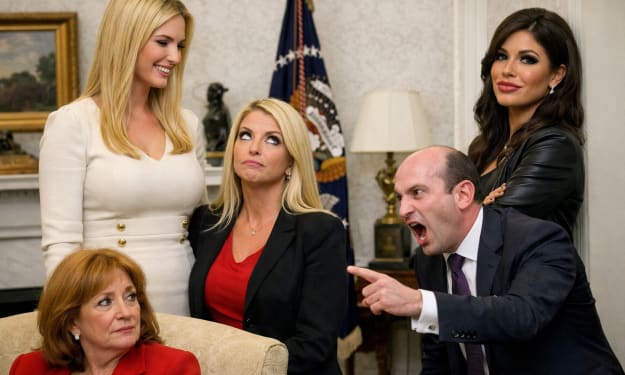
“I’m the queen of chin jutting while I smooth my hair, attacking, insulting, and deflecting to protect my appointer.” “Oh, please, Blondi, my hair is curled, highlighted, and longer than yours. I feature television commercials telling immigrants that we will give them a free plane ride home, and if they voluntarily turn themselves in, they will be allowed to legally apply for re-entry. It runs everywhere, and I look good in it! You can’t compete because of your blond hair. Mine is nicer, and my lips are prettier than yours.”
By Andrea Corwin 11 days ago in The Swamp
Here is a unique, 800-word Vocal Media–style article based on your keyword and the verified news context:
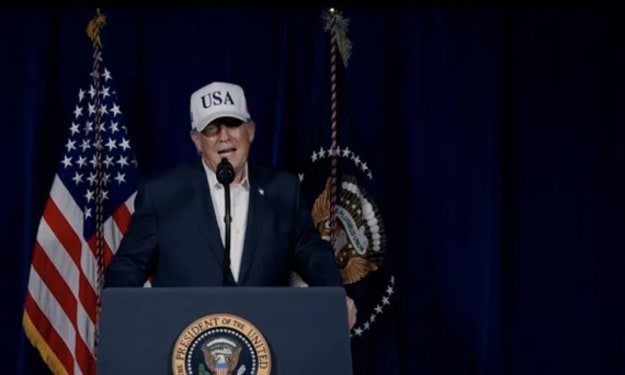
A Screen Grab, A Statement, and a Signal to the World: Trump’s Truth Social Video Marks a Defining Moment On February 28, a screen grab from a video released on Donald Trump’s Truth Social account captured more than just a presidential address—it froze a moment of profound global consequence. In the still image, Trump appears composed, deliberate, and direct, delivering remarks that would quickly echo across political institutions, media channels, and international borders. The message accompanying the video was unmistakable: the United States had entered what Trump described as “major combat operations in Iran.”
By Jameel Jamaliabout 16 hours ago in The Swamp
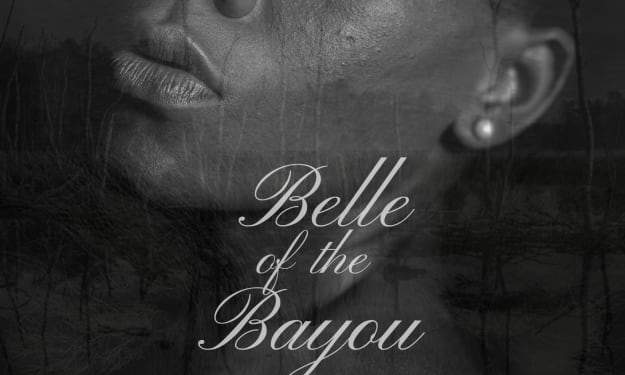
Belle of the Bayou
Bad move, cher. Not just the slip of her kitten heel on the rainy February cobblestones in the Fourth Ward. She got caught snooping. Detective Deleon clucked and strutted like a rooster in his rush to clear her from the scene, waving cigar smoke to and fro as he gesticulated amid the thick air of the speak easy. An experienced crime reporter, Marie knew better than to let the coppers catch her on the wrong side of the line, but curiosity had gotten the better of her.
By Maia Gadwall the metAlchemist7 days ago in Fiction

Comments
There are no comments for this story
Be the first to respond and start the conversation.