
Diversify or Darken your campus, what's the difference?
The way we view diversity and inclusion changes its genuineness and purpose


Someone famous and important and most likely white once said, 'A crowd is the main place you can simultaneously be surrounded by people and yet, feel utterly alone.' I hate using quotes to spread a point, but sometimes another person's words are just better than your own and you have a less likely chance of sticking your foot in your mouth in front of your peers. By no means am I a master communicator either, so quotes are the way to go. As a black, low-income student at my predominantly white university, feeling alone in a large crowd is one of the struggles we have to deal with in our educational system.
The educational system in our country baffles me. Administrators, well versed and highly accomplished in their field (and some a little racist, but that's beside the point), dedicate their goals every year to recruit more students of color. Whether it's to "increase diversity" or the real reason — to get the federal government off their backs — these white males look you dead in your eyes in their overly expensive office (because all university deans and presidents and vice presidents need offices with large glass windows and a personal assistant, right?) and pretend they are happy and honored that you've decided to darken their university. I mean, attend their university.
Same difference, right?
The worst part is that I fell for it. I thought that my university wanted students that looked like me just because. No ulterior motive, no quota to meet. Just me and my merit. The United States boasts about being a meritocracy— a society that rewards those with merit and leaves those without it behind.
But, if it were all that simple, surely more of my black brothers and sisters would be part of that esteemed 1% that my generation — both black and white alike — like to silently flip the bird to every now and again, right? And even for the black Americans that have made it to the 1% — bravo, by the way, and I don't mean that sarcastically — it's not as if the white 1% majority is welcoming them with opening arms. As Shelia Johnson, founder of Black Entertainment Television, said in a 2016 CNN article, "There is a loneliness that very wealthy African-Americans do feel in their lives. No matter how much money you have as an African-American, you're still an African-American."
The educational system reflects the 1% — there are few blacks who have the opportunity to go to at least a two-year university, and I doubt it has anything to do with merit. With only 40% of black Americans having at least a two-year Associates degree in 2019, compared to 56% of white Americans in the same year, African Americans only represent 13.4% of the total population, compared to white American's 76.5%. Similarly, 1 in 7 white families were millionaires in 2017, while 1 in 50 black families could say the same.
To just blame the educational system and call it quits would be ill-advised. However, the educational system that rewards colleges and universities for taking 5 seconds longer to look at a black student's application perpetuate the racial divide between our white millionaires and our low-income blacks.
Diversity shouldn't be a number to reach towards.
Having that ideal lacks the welcoming environment that black students and other minority students need when stepping onto a predominantly white campus. But instead, diversity should be an idea, a culture, a feeling. Our educational system shouldn't have to brag about being diverse. There's no reason to wave a banner that says 'Send you kids here, we aren't racist usually' if it's a natural environment of diversity.
Aside from using racial identities to further financial goals for a university, let's try to act like black students matter longer than Welcome Week. It's quite interesting how much the words 'diversity and 'minority' get thrown around in Welcome Week and during admissions, only for racists comments from key players in the university's administration to come out days later.
Walk it as you talk it.
In a society that isn't built for those who don't have fair skin, the last thing a black young adult needs is to feel threatened at their own university. It's not like the police are already killing us, we're statistically poor, we suffer from microaggressions every day, we're less likely to have health care despite a global pandemic, and, coincidentally, of course, our racial pride month is the shortest month of the calendar. I digress.
My intention when I stepped foot at my university wasn't to 'darken' the university. I shouldn't have 4 different courses in a week, taking 3 different buses and going into 4 different buildings and not see more than 5 people who look like me. Was it that my peers didn't have the "merit" qualifications for admission, or did you meet your quota for black or brown students in a given academic year?
Wouldn't want to overpopulate the campus with students of color and risk exposing the racism that perpetuates a campus where the black and brown students are only there to meet national statistical standards? But, once again, I digress.
My question is why? Why does faking diversity offer financial and status incentives? Why can't an admissions representative sit down with a white senior's and a black senior's college application and pick the one that represents the most merit without having a racial indicator on top? Is it because our society has shaped and formed biases against students of color that they cannot achieve a college degree or even a college acceptance letter without some form of affirmative action? Does the educational system think we're that stupid or have they put the inescapable obstacles in place that deter us from creating a better life for ourselves on our own merit?
Many will say that race is not a deciding factor in college applications. Granted, things like SAT score — an unfair measure of how well you remember things under a time limit — or GPA — an unfair measure of how well you memorize and recite the information that gets you an A in the course, regardless of whether or not you actually remember it for the next semester or year —,or even extracurricular activities — the most unfair measure of how much you can stretch yourself thin to build a resume or how much extra money your parents are able to throw into a sport or activity you may not even like for the sole purpose of it "looking good on your resume" (I can't tell you how many times I've heard that phrase) are important factors.
But if race wasn't a determining factor, why put it on the application? To promote diversity? So you can choose the black applicant over the white applicant not because he or she has more merit, but because they will "darken" your campus? So race ultimately was the deciding factor?
I believe a diverse campus is important. All of my friends aren't black nor low-income nor heterosexual nor cis-gender nor female. They shouldn't all be just like me.
But it's the way we view diversity that changes its genuineness and purpose.
Instead of striving to meet race quotas, acknowledge students of color as people who are surviving in a system that punishes them for the color of their skin. Realize that diversity doesn't just mean race, but sexuality, gender, class, geographic origins, and countless other identities. Do better, universities. Don't use me or my black sisters and brothers or anyone else to further your financial goals.
We are people, not a statistic.
Originally published on Mini Alternate Realities.
About the Creator
SaMya Overall
Fiction, poetry, and creative non-fiction writer with a love for cliche tropes reimagined in a new way.
For more works: https://www.minialternaterealities.com
Keep reading
More stories from SaMya Overall and writers in The Swamp and other communities.
I Can't Breathe
Content Warning: Includes descriptive accounts of police brutality, like our world does today. My reflection stared back at me, my brown eyes cold and empty. I tilted my head, observing my reflection, trying to understand what they saw. What made me different? What made him different? My questions were vague, my tongue not wanting to use the words they described us with. Threat. Thug. Delinquent. Other. Where did they see it? I glanced down at the red liquid on my palms and the waist area of my white dress. It was hard to refer to it as blood. Blood meant death. Death meant mourning. Mourning would turn into anger and right now, I just wanted to be blank. There would be time for anger and mourning.
By SaMya Overall 5 years ago in The Swamp
“Escape from Siberia: A Journey of Courage and Survival”
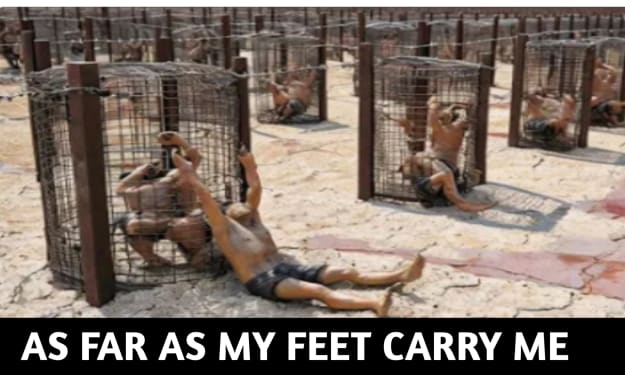
At the beginning of the story, we see a prison in Siberia, where many German soldiers are lined up. In fact, after the end of World War II, Russia captured a large number of German soldiers and forced them to work day and night in coal mines. Although the security of this prison was quite low, no one ever tried to escape from it. The reason was that the prison was surrounded by nothing but endless snow, and it was located about 14,000 kilometers away from any human settlement. So even if a prisoner managed to escape from this prison, his death in the freezing cold of Siberia was certain. This prison was built in the middle of snow stretching thousands of kilometers in every direction, which is why no prisoner could even imagine escaping from here. However, among these prisoners, there was one man who was extremely intelligent and wanted to escape from this prison to return to his wife and daughter. This prisoner’s name was Clemens Feirl. He had been sentenced to 25 years in this prison, and Clemens did not want half of his life to pass inside these prison walls. Clemens wanted to escape from this prison at any cost. Fortunately, one day Clemens got a chance to escape, and he fled the prison by hiding inside a freight train carrying coal. When he came out of the prison and saw the stars in the open sky, he felt overwhelmed with happiness. But this happiness was short-lived. After traveling some distance, the freight train was stopped. When Clemens looked outside, he saw a Russian soldier standing in front of him with a gun aimed at him. Unfortunately, Clemens was caught, and for the crime of escaping, he was locked inside an open-air cell. The cold was extreme, and the rain during the night worsened Clemens’s condition. He was not kept in that cell for a few hours, but for a full two days. After two full days, the next morning, the prison warden came to him and took him out of the cell, but did not torture him. He only said, “Your companions are waiting for you impatiently.” When Clemens reached his fellow prisoners, they were waiting for him with sticks and clubs in their hands. They were extremely angry with Clemens because, due to his escape attempt, all of them had been kept hungry for the past two days. Now Clemens understood why the warden had said that his companions were waiting for him. As soon as the other prisoners saw Clemens, they attacked him and beat him very badly. During this beating, Clemens was injured so severely that he had to be admitted to the prison hospital. The doctor of this prison was also a German prisoner. When Clemens regained consciousness, he said to the doctor, “I want to escape from this prison once again, and I need your help.” The doctor was astonished by Clemens’s courage. Even after enduring so much suffering, he was still not ready to give up. The doctor explained to him that escaping alive from this prison was impossible, and even if he did escape, he would die in the freezing cold outside. But the truth was that even if he did not escape, his death was still certain. The coal mines where they worked had extremely high levels of carbon, which entered their bodies through the air and caused deadly diseases like cancer. That is why the doctor said to Clemens, “You must try to escape from this prison one last time.”
By Filmon Ke Raaz | Movie Mysteries Explained3 days ago in The Swamp



Comments
There are no comments for this story
Be the first to respond and start the conversation.