
Digital Payment Market Size and Forecast 2025–2033
How the Cashless Revolution Is Reshaping Global Commerce, Finance, and Daily Life

Introduction
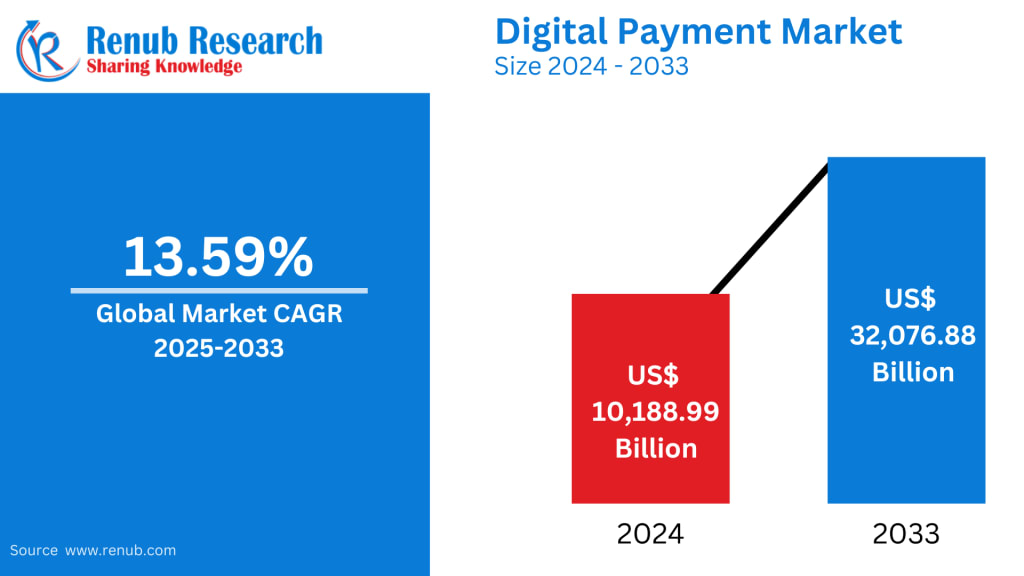
The global shift toward digital payments has accelerated at an unprecedented pace, transforming how consumers, businesses, and governments transact. What was once a supplementary payment method is now becoming the dominant financial ecosystem across economies. According to Renub Research, the Digital Payment Market is projected to reach US$ 32,076.88 billion by 2033, rising from US$ 10,188.99 billion in 2024, at a remarkable CAGR of 13.59% during 2025–2033.
This explosive growth reflects a convergence of powerful forces—mobile penetration, government-led digitalization efforts, increased financial inclusion, regulatory modernization, and a massive behavioral shift toward convenience-driven financial solutions. From mobile wallets and UPI-based instant transfers to contactless cards and QR-based payments, digital payment systems today enable frictionless, fast, and secure transactions that fit seamlessly into modern digital lifestyles.
As e-commerce surges globally and more consumers choose speed, transparency, and security over traditional cash systems, digital payments have emerged as a foundation for the global financial ecosystem.
Global Digital Payment Market Overview
The digital payment landscape has undergone a dramatic transformation over the past decade. Now embedded into the daily lives of billions, digital payment systems support a wide spectrum of transactions—online banking, mobile wallets, P2P transfers, contactless payments, and cross-border remittances.
This industry’s rise can be attributed to:
Growing smartphone penetration
Rapid expansion of e-commerce
Financial inclusion initiatives
Government policies supporting cashless ecosystems
Advancements in security, encryption, and authentication
Adoption of instant, real-time payment networks
Digital payments offer greater speed, transparency, and accuracy compared to traditional methods. They also enable seamless integrations with budgeting tools, loyalty programs, and e-commerce platforms, creating powerful digital ecosystems.
Governments worldwide play a leading role in accelerating this transition. They are digitizing public benefit transfers, promoting online banking, and implementing consumer protection policies—ultimately fostering trust and enabling broader adoption.
The rise of blockchain and digital currencies is creating a new frontier in payment technology, offering strengthened transaction transparency, cross-border speed, and the potential for decentralized financial systems.
Still, concerns around fraud, cybersecurity, and data privacy continue to challenge industry players. Major companies like Apple Pay, Google Pay, Visa, Mastercard, and PayPal are heavily investing in fortified security frameworks, AI-driven fraud detection, and seamless cross-channel experiences.
The trajectory is clear: digital payments are not just an alternative—they are becoming the backbone of global economic infrastructure.
Key Growth Drivers of the Digital Payment Market
1. Government Policies and National Digitalization Strategies
Governments have emerged as powerful catalysts for mainstreaming digital payments. Across the world, policymakers are digitizing public services, encouraging electronic transactions, and regulating digital finance ecosystems.
Key initiatives include:
Cashless infrastructure development
Direct benefit transfers via digital channels
Digital ID integration with banking
National real-time payment systems (e.g., UPI in India, FedNow in the U.S.)
Tax incentives for digital transactions
These actions reduce cash handling costs, enhance transparency, and improve access to financial services—creating an environment where digital payments can scale rapidly.
2. Evolving Consumer Preferences for Speed, Convenience, and Security
Consumers today prioritize fast, frictionless, and reliable payment experiences. Digital payments offer instant processing, round-the-clock accessibility, automated bill payments, and real-time notifications.
Features such as biometric authentication, easy spending tracking, seamless recurring payments, and app integrations make digital payment platforms attractive to a wide user base—from tech-savvy consumers to first-time digital adopters.
The growth of e-commerce has further fueled this shift. For online shopping, digital payments have become the default mode, providing secure and quick checkout experiences.
3. Surging Internet and Smartphone Penetration
Internet connectivity and mobile adoption are the backbone of digital payment growth. Billions of users worldwide now have access to smartphones capable of hosting mobile wallets, QR payment apps, and banking platforms.
This accessibility benefits:
Small and medium enterprises
Rural populations
Gig and freelance workers
Cross-border workers
First-time digital users
Integration of payments into social media platforms and lifestyle apps is further normalizing digital transactions as part of everyday routines.
Major Market Challenges
1. Cybersecurity Threats and Fraud Risks
As digital payments scale, so do risks related to:
Identity theft
Account takeover fraud
Phishing attacks
Data breaches
Payment fraud
These threats can erode customer trust and impose significant financial costs on providers. Companies must continuously strengthen:
Multi-factor authentication
End-to-end encryption
Advanced fraud detection using AI
Tokenization and biometric verification
Maintaining robust security is essential for maintaining long-term adoption.
2. Technological Integration Barriers
Many small and medium-sized businesses still rely on outdated financial systems that are incompatible with modern digital payment infrastructures. The transition often requires:
Hardware upgrades
Software integration
Employee training
Maintenance investments
These costs may discourage SMEs from adopting digital payment options. Additionally, the lack of trained IT personnel in smaller businesses creates operational bottlenecks.
Regional Market Insights
United States
The U.S. hosts one of the world’s largest and most mature digital payment markets. High internet penetration, contactless adoption, and widespread use of mobile wallets have created a robust cashless ecosystem. Major players like Visa, Mastercard, PayPal, and Apple Pay dominate the space.
The U.S. Census Bureau reported that e-commerce accounted for 14.7% of total retail sales in Q4 2022. Wallets—led by Apple Pay, Google Pay, Amazon Pay, and PayPal—are expected to capture nearly one-third of e-commerce spending in the next three years.
However, growing cybersecurity threats and complex regulatory frameworks remain significant challenges.
United Kingdom
The UK’s digital payment market is expanding rapidly with strong adoption of contactless payments, mobile wallets, and online banking. The government supports this transition with initiatives that promote financial inclusion and safeguard digital transactions.
Despite regulatory uncertainties and cybersecurity concerns, the UK's digital infrastructure and tech-savvy consumers ensure consistent market growth.
India
India is one of the fastest-growing digital payment markets globally. Government-led initiatives such as Digital India and the UPI ecosystem have transformed the country’s payment dynamics.
According to RBI’s Digital Payments Index, India recorded a score of 304.06 in September, up from 270.59 in March, highlighting the meteoric rise of digital transactions.
Popular methods include:
UPI transfers
QR code payments
Mobile wallets
Contactless cards
Major players such as PhonePe, Google Pay, and Paytm dominate the ecosystem. Though challenges like cybersecurity vulnerabilities and infrastructure gaps persist, India’s digital payment revolution is expected to continue its rapid expansion.
United Arab Emirates
The UAE’s advanced digital infrastructure and ambitious smart city initiatives have accelerated the adoption of cashless payments. High mobile penetration and government-led digital transformation efforts make the UAE one of the most progressive digital payment markets in the Middle East.
Mobile wallets, contactless payments, and super apps dominate the ecosystem, with major providers including Apple Pay, Samsung Pay, Payit, and Beam.
Market Segmentation
By Type
Digital Commerce
Digital Remittances
Mobile POS Payments
By Offering
Cards
ACH Transfer
Digital Wallet
Other Payment Modes
By End User
BFSI
Retail & E-Commerce
Transportation & Logistics
Healthcare
Telecom & IT
Media & Entertainment
Others
By Region
North America: United States, Canada
Europe: France, Germany, Italy, Spain, UK, Belgium, Netherlands, Turkey
Asia-Pacific: China, Japan, India, Australia, South Korea, Thailand, Malaysia, Indonesia, New Zealand
Latin America: Brazil, Mexico, Argentina
Middle East & Africa: South Africa, Saudi Arabia, UAE
Key Companies Covered
ACI Worldwide Inc.
Aliant Payment Systems Inc.
Amazon.com Inc.
American Express Company
Apple Inc.
Fiserv Inc.
Mastercard Incorporated
Novetti Group Limited
PayPal Holdings Inc.
Visa Inc.
Each company is analyzed by:
Overview
Key Persons
Recent Developments & Strategies
Product Portfolio
Financial Insights
Final Thoughts
As the world marches toward a digital-first financial reality, the Digital Payment Market stands at the forefront of global economic transformation. The next decade will bring deeper integration of AI, blockchain, biometric security, and instant payment technologies. With governments championing digital ecosystems and consumers embracing faster, safer alternatives, the cashless era is not just approaching—it is here.
The projected US$ 32 trillion market size by 2033 underscores a powerful truth: digital payments are redefining how economies function, how businesses operate, and how individuals manage money. Whether in bustling metropolitan centers or remote rural villages, digital payments are creating a more connected, inclusive, and efficient financial world.
About the Creator
Janine Root
Janine Root is a skilled content writer with a passion for creating engaging, informative, and SEO-optimized content. She excels in crafting compelling narratives that resonate with audiences and drive results.
Keep reading
More stories from Janine Root and writers in The Swamp and other communities.
Global Water Purifier Market Size and Forecast 2025–2033
Introduction: Why the World Is Turning to Water Purifiers The global need for safe, clean, and contaminant-free drinking water has never been more urgent. As environmental degradation accelerates, water contamination rises, and populations expand, households and businesses worldwide are prioritizing access to purified water. According to Renub Research, the Global Water Purifier Market is projected to grow from US$ 57.48 billion in 2024 to US$ 113.19 billion by 2033, expanding at a CAGR of 7.82% during the forecast period.
By Janine Root 2 months ago in The Swamp
50 Inspiring Travel Ideas for 2026 Chosen by Readers
Travel in 2026 is all about meaning, balance, and personal connection. Readers from around the world have shared their most inspiring travel ideas for the year ahead—destinations that promise relaxation, culture, adventure, and unforgettable memories. From classic beach holidays to emerging cities, family-friendly escapes to once-in-a-lifetime journeys, this list reflects how travelers want to explore the world now: more thoughtfully, more sustainably, and with deeper curiosity. Here are 50 inspiring travel ideas for 2026, chosen by readers and grouped by travel style to help you plan your next unforgettable journey. Beach Escapes That Never Go Out of Style Maldives – Overwater villas and crystal-clear lagoons remain a dream escape. Bali, Indonesia – Surf, spirituality, and slow living in one island paradise. Amalfi Coast, Italy – Dramatic cliffs, pastel villages, and Mediterranean charm. Seychelles – Unspoiled beaches and rare wildlife for nature lovers. Phuket, Thailand – Affordable luxury, vibrant nightlife, and island hopping. Zanzibar, Tanzania – White sands mixed with rich Swahili culture. Maui, Hawaii – Volcanoes, beaches, and road trips rolled into one. Ibiza (quiet side) – Beyond parties, readers love its hidden coves and retreats. Gold Coast, Australia – Surf culture meets family-friendly beaches. Algarve, Portugal – Golden cliffs, sea caves, and relaxed coastal towns. City Breaks Full of Culture and Energy Paris, France – Timeless romance with new cultural districts emerging. Tokyo, Japan – Tradition and technology in perfect harmony. New York City, USA – Always evolving, always inspiring. Barcelona, Spain – Architecture, beaches, and food in one city. Istanbul, Türkiye – Where continents and cultures collide. Seoul, South Korea – K-culture, history, and futuristic vibes. Rome, Italy – Ancient ruins with modern Italian life. Dubai, UAE – Luxury, innovation, and desert adventures. Lisbon, Portugal – Colorful streets and soulful music scenes. Prague, Czech Republic – Fairytale charm at affordable prices. Family-Friendly Holidays for All Ages Orlando, Florida – Theme parks remain a top family favorite. Lapland, Finland – Meet Santa and chase the Northern Lights. Singapore – Clean, safe, and packed with attractions for kids. Cornwall, England – Beaches, coastal walks, and simple pleasures. Vancouver, Canada – Nature and city life in perfect balance. Japan (family rail travel) – Efficient transport and cultural learning. Tenerife, Canary Islands – Year-round sunshine and resorts. Denmark – Legoland and bike-friendly cities delight families. New Zealand – Safe, scenic, and adventure-ready. Scotland – Castles, wildlife, and storytelling landscapes. Adventure and Nature-Focused Journeys Patagonia (Chile & Argentina) – Epic landscapes for hikers. Iceland – Glaciers, waterfalls, and volcanic wonders. Nepal – Trekking routes and spiritual experiences. Peru – Machu Picchu and Andean culture. Namibia – Desert safaris and star-filled skies. Norway – Fjords and Arctic exploration. Slovenia – Green tourism and alpine lakes. Costa Rica – Rainforests, wildlife, and eco-adventures. Canadian Rockies – Mountain drives and turquoise lakes. Bhutan – High-value, low-impact travel with deep meaning. Slow Travel and Unique Experiences Greek Islands (lesser-known) – Naxos, Paros, and Milos over crowds. Morocco – Riads, souks, and desert camps. Vietnam – From Hanoi to Hoi An at a relaxed pace. Georgia (the country) – Food, wine, and mountain culture. Sicily, Italy – History, volcanoes, and bold flavors. Uzbekistan – Silk Road cities rich in heritage. Sri Lanka – Tea plantations and coastal trains. Ireland (road trip) – Wild Atlantic Way adventures. Japan countryside – Ryokans, onsens, and rural calm. Staycations with purpose – Exploring your own country in depth. Why These Destinations Matter in 2026 What stands out from readers’ choices is a clear shift in travel priorities. People are no longer just chasing photos—they want stories, connections, and balance. Sustainability, cultural respect, and slower travel have become central themes. Whether it’s choosing lesser-known destinations, traveling off-season, or spending more time in one place, 2026 travel is about quality over quantity. Final Thoughts These 50 inspiring travel ideas for 2026 reflect a world eager to explore again—thoughtfully and passionately. Whether you’re planning a beach escape, a family holiday, a city break, or an adventurous journey into nature, the year ahead offers endless possibilities. Let these reader-chosen destinations spark your imagination and guide your next great adventure. Where will 2026 take you?
By Muhammad Hassan4 days ago in The Swamp
The Ritual of Winter Challenge Winners
Welcome to the Winners Announcement for The Ritual of Winter challenge. This prompt focused on winter rituals and the meaning that settles into them over time. The top pieces stay grounded in ordinary acts and repeated routines, letting winter shape the work through pace, attention, and restraint.
By Vocal Curation Team5 days ago in Resources


Comments
There are no comments for this story
Be the first to respond and start the conversation.