
Digital Consent or Jail Time: Trump Signs Landmark Law to Combat Revenge Porn and Deepfake Abuse”
The new ‘Take It Down Act’ ushers in sweeping criminal penalties for sharing explicit content without consent — including AI-generated images. Here’s what it means for privacy, online safety, and the future of tech accountability.

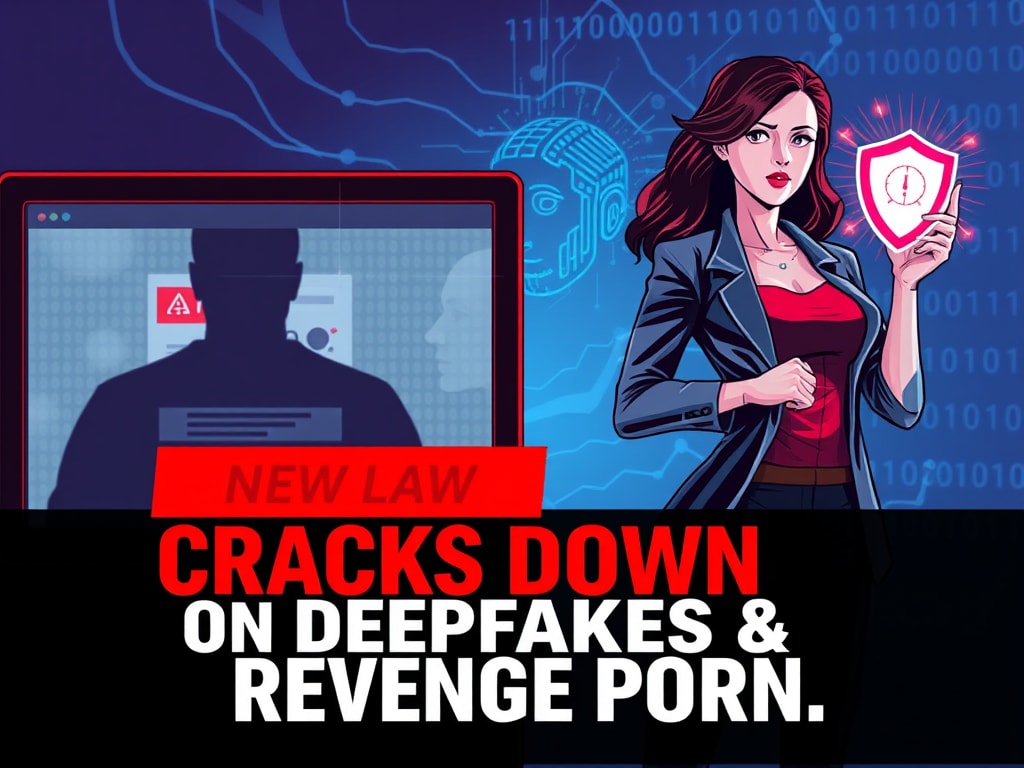
The new ‘Take It Down Act’ ushers in sweeping criminal penalties for sharing explicit content without consent — including AI-generated images. Here’s what it means for privacy, online safety, and the future of tech accountability.
In a bold move aimed at curbing the spread of explicit digital abuse, former President Donald Trump has signed into law a groundbreaking piece of legislation — the Take It Down Act — which criminalizes the nonconsensual online distribution of sexually explicit images and videos. This includes not only real, authentic media but also increasingly realistic, AI-generated deepfakes.
As technology advances, so too do the methods by which people can be harmed online. The rise of artificial intelligence and image manipulation tools has made it easier than ever to create realistic fake images and videos of individuals without their consent — often placing them in compromising, sexually explicit, or humiliating situations. The new legislation directly addresses this growing threat to privacy and dignity in the digital age.
The passage of the Take It Down Act marks a significant milestone in the ongoing struggle to protect individuals — particularly women and minors — from digital exploitation, revenge porn, and AI-fueled harassment. It sends a powerful message: your body, your image, and your identity are not for others to exploit — online or offline.
Understanding the Take It Down Act: A New Era of Digital Accountability
At its core, the Take It Down Act criminalizes the publication — or even threats to publish — sexually explicit images and videos of individuals without their consent. Whether the content is authentic or artificially generated, its distribution without the subject’s approval is now a federal crime.
Violators face mandatory restitution, meaning they will be legally required to compensate their victims. In addition, they can be sentenced to significant prison terms, fined heavily, or face a combination of both. The law also cracks down on threats to release such materials, treating them as serious offenses even if the content is never actually shared.
What makes this law especially timely is its acknowledgment of a modern digital menace: deepfake technology. With AI tools more accessible than ever, people can now generate hyper-realistic photos or videos of someone’s face superimposed on another’s body — often in pornographic or violent contexts. The Take It Down Act doesn’t differentiate between “real” and “fake” when it comes to the impact on victims. If the content is sexual and nonconsensual, it’s punishable.
The Rise of Deepfake Pornography: A Growing Threat
Deepfake pornography has exploded in recent years. These synthetic images and videos use artificial intelligence to map a person’s face onto another’s body with frightening accuracy. In many cases, victims have no idea such material exists until it’s already been viewed, shared, or even used to blackmail them.
Women — particularly public figures like actors, athletes, and social media influencers — have been disproportionately targeted. But everyday people, including minors and private citizens, are also victims. Some have seen their reputations shattered, relationships destroyed, and mental health deeply impacted.
Before the Take It Down Act, legal recourse for these individuals was limited. Many state laws covered revenge porn, but there was a lack of federal consistency and jurisdiction, especially for AI-generated content that existed in legal gray areas.
Now, with the Act in place, federal law clearly states: Creating, sharing, or threatening to share intimate visual depictions without consent is a serious crime, no matter how the content was made.
Why the Law Was Necessary: Bridging Legal Gaps
Prior to this legislation, victims of digital sexual abuse often faced an uphill battle in seeking justice. While many states had laws against revenge porn, enforcement was inconsistent. AI-generated content was frequently not covered, as it didn’t involve real images of the victim’s body — only their likeness. That created a loophole for perpetrators to exploit.
Federal law enforcement agencies also lacked clear authority to intervene in cases involving deepfakes or cross-state violations. Victims were frequently told that nothing could be done because the image “wasn’t real,” even though the emotional and reputational harm certainly was.
The Take It Down Act closes these gaps. It recognizes that consent — not authenticity — is the key issue. Whether an image was taken with a hidden camera, stolen from a phone, or generated with AI, the trauma inflicted is the same. And now, the legal consequences are equally serious.
What the Law Covers: Key Provisions Explained
Here are the major elements of the Take It Down Act:
1. Nonconsensual Sharing is a Federal Crime
Sharing sexually explicit images or videos of someone without their consent — whether real or computer-generated — is now illegal under U.S. federal law.
2. Threats to Share Also Criminalized
Even if the material isn’t ultimately posted, threatening to release such content is enough to warrant criminal charges.
3. Covers AI and Deepfake Content
The law explicitly includes content created using artificial intelligence or other computer-generated means.
4. Mandatory Restitution to Victims
Offenders must compensate victims for emotional distress, financial loss, and other damages.
5. Fines and Prison Time
Depending on the severity and intent, offenders can face significant fines, prison sentences, or both.
Implications for Tech Platforms and Users
This law also puts pressure on tech platforms to improve their monitoring, reporting, and removal mechanisms. While the bill doesn’t directly impose liability on social media companies, it encourages them to act swiftly when such content is reported — or risk backlash and further regulation.
Victims are now more empowered to demand action from platforms and law enforcement. With the federal government taking a clear stance, tech companies can no longer claim confusion or inaction due to a lack of legal clarity.
The average internet user, too, must be more cautious. Sharing an explicit meme, altered image, or even threatening someone with fake nudes — actions some might have once considered “jokes” — can now carry very real legal consequences.
Bipartisan Support and Public Reaction
Interestingly, the Take It Down Act received bipartisan support, a rare feat in today’s highly polarized political climate. Lawmakers from both parties recognized that digital exploitation is a nonpartisan issue that affects millions of Americans regardless of ideology, gender, or social status.
Civil rights advocates, women’s groups, and child protection organizations have largely praised the bill. Many see it as a crucial step toward restoring agency and safety in the online space.
However, free speech advocates have raised concerns about potential overreach, especially regarding the vague definition of “explicit” and fears of censorship. Supporters of the bill argue that it has been carefully crafted to balance free expression with necessary protection from abuse.
Looking Ahead: A Step Toward Safer Online Spaces
The Take It Down Act represents a paradigm shift in how we think about digital privacy, consent, and justice. It recognizes the real emotional and reputational damage caused by digital sexual abuse — and takes firm, tangible steps to combat it.
In an era where AI can manipulate images and destroy lives in seconds, legislation like this is not just timely — it’s essential. The digital world is evolving rapidly, and so must our legal frameworks.
President Trump’s signing of this bill may mark a turning point. Victims now have federal protection. Perpetrators face serious consequences. And society moves one step closer to a future where personal dignity is safeguarded — whether in the physical world or the digital one.
Because in the end, the message is clear: your image is yours. And if someone tries to exploit it, the law is ready to take them down.
About the Creator
kb daily
Covering today’s trends, tomorrow’s conversations. I publish daily stories on the hottest topics in entertainment, culture, and the internet—one scroll-worthy headline at a time
The Forsyth House Fire
Since 1851, Forsyth House has stood on the corner of Union Street and Gordon Street in the heart of Glasgow. Its iconic, or was... because on Sunday 8th of March, 2026, a fire broke out in a small, seemingly un-named shop in the building and tore all that history down. As I write, the rubble is still unsettled and the street is still blocked off. Central Station is quiet on the upper level, and around 30 small businesses have quite literally gone up in smoke.
By S. A. Crawford3 days ago in The Swamp


Comments
There are no comments for this story
Be the first to respond and start the conversation.