
Cory Booker’s Filibuster-Style Protest: Taking a Stand Against Trump’s Policies
Though the impact of his marathon speech remains uncertain, it underscores a strategic tool available to minority parties in Congress seeking to make their voices heard.
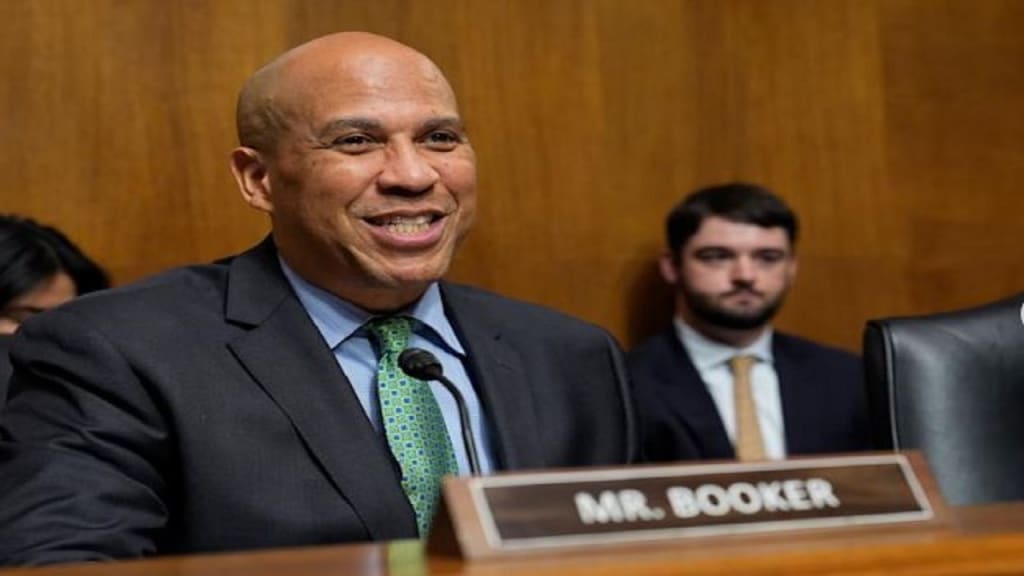
Senator Cory Booker took control of the Senate floor Monday night, holding it well into Tuesday as he delivered a passionate critique of former President Donald Trump’s Republican agenda. While his current stance is one of fierce opposition, Booker once found areas of agreement with Trump during his early years in office.
The New Jersey Democrat, who made an unsuccessful bid for the presidency in 2020, expressed mounting frustration over various Trump-era policies during his extended speech. He railed against controversial proposals such as the potential annexation of Greenland and Canada, cuts to social programs, and tax reductions favoring the wealthy.
Throughout his speech, Booker paused occasionally, allowing fellow Democrats to interject with questions—moments he used to catch his breath before continuing his fervent address. Though the impact of his marathon speech remains uncertain, it underscores a strategic tool available to minority parties in Congress seeking to make their voices heard.
Who is Cory Booker?
Born in Washington, D.C., Booker, now 55, moved to northern New Jersey as a child. He has often spoken about his experiences growing up in a Black family in a predominantly white neighborhood and the discrimination his parents faced when trying to buy a home.
A Stanford University football player turned Yale Law School graduate, Booker began his legal career by working with nonprofit organizations, providing legal aid to underprivileged families. His political career took off when he was elected to the Newark City Council, later serving as mayor of the state’s largest city.
During his tenure, Facebook founder Mark Zuckerberg made a landmark $100 million donation to Newark’s public schools, a move that catapulted Booker into the national spotlight as a rising Democratic figure.
In 2013, Booker won a special election to the U.S. Senate following the passing of incumbent Frank Lautenberg. He secured a full term in 2014 and was reelected in 2020. His 2020 presidential campaign, launched from the front yard of his Newark home, was defined by themes of love and unity but ultimately failed to gain traction in a crowded Democratic primary.
What Did Booker Say in His Senate Speech?
Beginning at approximately 7 p.m. on Monday, Booker’s speech extended through the night and into the following morning. As the hours passed, his voice occasionally wavered with emotion, particularly when recognizing colleagues who asked him questions, offering him brief respites from speaking.
Booker read letters from constituents, referenced literary figures like Langston Hughes, and delved into foreign policy and domestic economic concerns. He criticized the Republican budget plan, arguing that it prioritized tax cuts for the wealthy at the expense of essential healthcare programs for Americans, warning that such policies would worsen the national deficit.
He also accused the U.S. of relinquishing its leadership on the global stage, citing Trump’s past proposals to annex Greenland and Canada while simultaneously straining relationships with key allies.
A hallmark of Booker’s rhetoric is his focus on unity, which he emphasized in his speech.
“We are a union in trouble compared to our global peers,” he stated. “Yet we are a nation of utter abundance, and we’ve proven in the past to be a nation of incredible vision.”
He did not hesitate to take jabs at billionaire Elon Musk, now an advisor to Trump and the head of the Department of Government Efficiency. Booker condemned Trump’s push to extend tax cuts that disproportionately benefit affluent Americans, including Musk.
“I wish he would say the truth—I don’t need a tax cut,” Booker remarked pointedly.
Booker’s Congressional Impact
Despite his criticisms of Trump, Booker was instrumental in a bipartisan effort in 2018 to reform federal sentencing laws. The initiative, which ultimately passed, resulted from an unlikely alliance between Black ministers, political leaders, and lawmakers, including Trump. The legislation created opportunities for the release of hundreds of Black and Latino inmates.
Among his legislative achievements, Booker sponsored a 2019 bill allowing states to transfer funds from clean water programs to drinking water programs to address pressing public health concerns. Additionally, as chair of the Democratic Strategic Communications Committee, he has played a key role in messaging efforts and highlights his work in defending the Affordable Care Act from repeal in his Senate biography.
Booker’s latest speech reaffirms his position as one of the Senate’s most vocal Democrats, unafraid to challenge Republican policies while continuing to advocate for progressive reforms.
About the Creator
arafat chowdhury
I am a web content writer and a freelancer i love to write and learn.
Keep reading
More stories from arafat chowdhury and writers in The Swamp and other communities.
Florida’s Political Showdown: A Race That Could Shift the GOP
The political scene in Florida's 6th Congressional Locale has been pushed into the national highlight as a furiously challenged race unfurls to fill the situate cleared by Mike Waltz, who surrendered to accept the part of National Security Advisor in President Donald Trump's organization. This advancement has lighted a competitive fight that has both energized and unsettled the Republican Party, given the district's verifiable centrality and its potential affect on the GOP's contract larger part within the U.S. House of Agents.
By arafat chowdhury10 months ago in The Swamp
Time to Dump Trump? Europeans Whisper Last-Resort Options to Save Greenland
For years, the idea of the United States “buying” Greenland sounded like political theater — a headline-grabbing curiosity that few took seriously. But as global power dynamics shift and the Arctic becomes a strategic hotspot, Europe is no longer laughing. Behind closed doors in Brussels, Copenhagen, Paris, and Berlin, uncomfortable conversations are taking place. The question no one wants to say aloud — but many are thinking — is this: Is it time for Europe to distance itself from Donald Trump to save Greenland?
By Aqib Hussain3 days ago in The Swamp
Center Stage with Paul Stewart
*** I'm keen to republish the interviews I did for my series with Vocal creators. It's been a few years and I thought it might be nice to revisit these wonderful conversations. I'll be releasing them one at a time for a few weeks/months.
By Heather Hubler4 days ago in Interview



Comments
There are no comments for this story
Be the first to respond and start the conversation.