
China Turns Fragile Reefs into Concrete Fortresses and the World Lets It Happen
China’s Artificial Islands in the South China Sea Combine Strategic Might with Environmental Devastation, While Global Response Remains Limited"

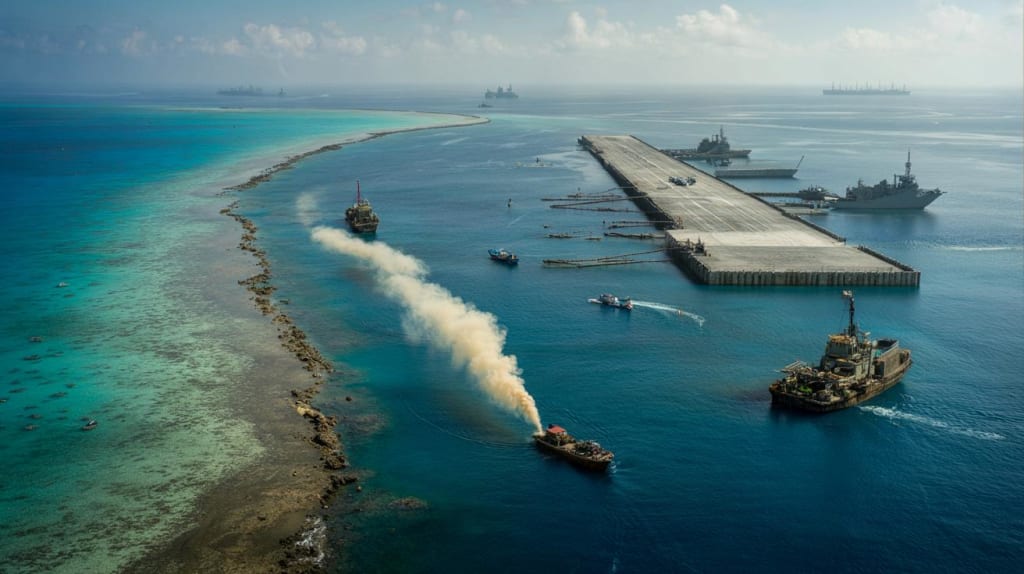
In the South China Sea, a region fraught with geopolitical tensions and strategic importance, China has embarked on an unprecedented campaign of transformation. Over the past decade, the country has turned fragile coral reefs and low-lying atolls into massive, fortified islands, complete with runways, military facilities, and concrete structures that would seem more at home in a bustling metropolis than in an ecologically sensitive marine ecosystem. While this ambitious engineering feat has drawn widespread attention, the world has largely allowed it to unfold with minimal intervention.
The transformation of these reefs into concrete fortresses is a testament to China’s capabilities in large-scale land reclamation. Using a combination of dredging, sand dumping, and heavy construction, China has expanded the surface area of natural formations, creating islands capable of supporting military installations, airstrips, and harbors. Satellite imagery over the years has revealed a stark contrast between the natural reefs and the artificial islands now dominating the waters, highlighting the scope and scale of the operation.
One of the most remarkable aspects of this process is the sheer speed at which it has occurred. Some reefs that were mere specks above sea level a decade ago now host multi-story buildings, radar facilities, and missile sites. These developments have given China a strategic advantage, allowing it to extend its reach across the South China Sea and control vital shipping lanes, which carry a significant portion of the world’s trade. The artificial islands also serve as a deterrent, projecting power and influencing the behavior of neighboring countries.
Yet, this strategic triumph comes at a severe environmental cost. Coral reefs, long considered the “rainforests of the sea,” are delicate ecosystems that support thousands of marine species. The dredging and construction processes have destroyed vast areas of reef, disrupted fish populations, and altered water currents. Marine biologists warn that the ecological damage is likely irreversible, with implications not just for biodiversity but also for the livelihoods of coastal communities that depend on fishing and tourism.
The international response has been muted, despite widespread condemnation from environmental groups and concerned nations. Part of the challenge lies in the legal framework governing the South China Sea. While the United Nations Convention on the Law of the Sea (UNCLOS) sets out rules for territorial waters and exclusive economic zones, enforcement is weak, and China’s actions often exploit legal ambiguities. Attempts by other countries to challenge the reclamation and militarization of these islands have largely failed, leaving the status quo intact.
Geopolitically, the world’s reluctance to intervene reflects a combination of caution and pragmatism. China is a global economic powerhouse, and many nations are hesitant to risk confrontation over a maritime dispute. Diplomatic efforts have mostly focused on negotiations and freedom-of-navigation patrols rather than direct interference. Meanwhile, the artificial islands have become symbols of China’s growing assertiveness, testing the resolve of neighboring countries like the Philippines, Vietnam, and Malaysia, who also claim parts of the contested waters.
The militarization of these reclaimed islands adds another layer of concern. Some installations are equipped with radar systems capable of monitoring air and maritime traffic across the region. Others host missile batteries that can target ships and aircraft hundreds of kilometers away. These fortresses not only enhance China’s defensive posture but also complicate the strategic calculus for the United States and its allies, who conduct naval operations and patrols in the South China Sea.
Despite the warnings, China shows no signs of slowing down. Plans are reportedly underway to expand existing islands and even construct new ones, solidifying its hold on the region. This situation presents a broader question for the international community: how should the world respond when engineering marvels clash with environmental preservation and global security norms?
Environmentalists argue that immediate action is necessary to protect remaining reefs, enforce stricter regulations on land reclamation, and hold countries accountable for ecological destruction. Policymakers, on the other hand, are caught between the imperatives of maintaining peace, upholding international law, and addressing environmental crises. The South China Sea, therefore, has become a microcosm of global challenges—where ambition, national interest, and ecological responsibility collide.
China’s creation of concrete fortresses from fragile reefs represents a bold combination of ingenuity and assertiveness. But the world’s muted response raises questions about the balance between strategic interests and environmental stewardship. Unless the international community develops new mechanisms to address such transformations, the South China Sea may serve as a warning of what happens when ambition overshadows accountability.
The reefs that once teemed with life now stand as stark monuments to human determination, but also as cautionary tales. The consequences of these actions extend far beyond territorial control—they touch on global environmental health, regional stability, and the rules that govern shared spaces in an interconnected world.
About the Creator
Fiaz Ahmed Brohi
I am a passionate writer with a love for exploring and creating content on trending topics. Always curious, always sharing stories that engage and inspire.
Keep reading
More stories from Fiaz Ahmed Brohi and writers in The Swamp and other communities.
Ukraine War Briefing: Czechs Offer Drone-Hunting Jets as Zelenskyy Flags Air Defence Shortages
Ukraine’s war against Russia continues to highlight the urgent need for modern air defence systems, with President Volodymyr Zelenskyy warning that his country faces growing gaps in protecting its skies. In response to these concerns, the Czech Republic has stepped forward, offering specialized drone-hunting jets to assist Ukraine in countering the increasing threat of unmanned aerial vehicles (UAVs) deployed by Russian forces. This development underscores the evolving nature of warfare in Ukraine and the critical role of international support. Zelenskyy, speaking in a recent briefing, emphasized that Ukrainian air defence capabilities are stretched thin. Russian forces have increasingly relied on drones for reconnaissance, precision strikes, and artillery targeting, creating challenges for Ukraine’s existing radar and missile systems. “Our air defence is performing heroically, but the threats are growing, and we need support,” Zelenskyy said, highlighting the urgent need for modern equipment to counter small, fast-moving UAVs that are difficult to track and intercept. The Czech Republic’s offer comes amid rising European concern over the sustainability of Ukraine’s defence posture. Czech officials have proposed sending specialized fighter jets designed to intercept and neutralize drones, sometimes called “drone-hunting” aircraft. These jets are equipped with advanced radar, electronic warfare systems, and air-to-air missile capabilities tailored to target UAVs. Analysts believe that such systems could provide Ukraine with a crucial layer of defence, particularly around critical infrastructure, military bases, and supply hubs. The Ukrainian conflict has shown that drones have become a central component of modern warfare. Russia’s use of swarm drones, small surveillance UAVs, and weaponized drones has forced Kyiv to adapt rapidly. Traditional air defence systems, while effective against larger aircraft and missiles, often struggle to detect and destroy smaller drones at low altitudes. The introduction of specialized drone-hunting jets could help Ukraine close this technological gap, giving its forces greater confidence in defending vital positions. However, integrating new aircraft into Ukraine’s military is not without challenges. Training pilots, establishing logistics support, and maintaining high operational readiness are all critical. Experts warn that simply delivering advanced equipment is insufficient unless it is paired with effective operational planning and maintenance infrastructure. Ukraine’s military has faced similar hurdles in the past when receiving Western fighter jets, underscoring the importance of comprehensive support packages alongside hardware. International reactions to the Czech proposal have been broadly positive. European nations have increasingly recognized that supporting Ukraine requires not just ground weapons, but a multi-dimensional approach that addresses air, sea, and cyber threats. Countries such as Poland and Germany have indicated interest in bolstering Ukraine’s air defence, while the United States continues to supply missile systems and radar technology. The Czech initiative is seen as a timely step that complements these broader efforts. Experts also point out that the drone threat is not merely tactical—it has strategic implications. Drones allow Russian forces to bypass traditional defensive lines, gather intelligence, and strike high-value targets with relative impunity. By enhancing Ukraine’s ability to counter drones, the Czech Republic is helping level the playing field, giving Kyiv the ability to protect critical infrastructure, maintain supply chains, and conduct counteroffensive operations with reduced vulnerability from aerial surveillance and strikes. Beyond immediate military considerations, the offer also sends a symbolic message of solidarity. The Czech Republic, a NATO member, is signaling that European partners are willing to provide innovative solutions to emerging threats, even as the conflict enters its extended phase. For Ukraine, receiving such support reinforces the perception that its struggle has broader geopolitical significance and that allies remain committed to ensuring its territorial integrity. While the introduction of drone-hunting jets will not solve all of Ukraine’s air defence challenges, it represents a meaningful step in addressing one of the conflict’s most pressing vulnerabilities. Zelenskyy has made clear that his country requires continued international assistance, not only to survive the current offensive but to modernize its armed forces and prepare for the long-term implications of high-tech warfare. As the war continues, Ukraine’s evolving defence strategy highlights the importance of technological adaptation, international cooperation, and proactive planning. With Czech support and broader Western aid, Kyiv aims to close critical gaps in its air defence, protect its population, and maintain operational resilience against Russian aggression. The deployment of drone-hunting jets may well mark a turning point in Ukraine’s aerial defence capabilities, offering hope that emerging threats can be countered with innovation and collaboration.
By Fiaz Ahmed Brohia day ago in The Swamp


Comments
There are no comments for this story
Be the first to respond and start the conversation.