
Astronomers Detected a Strong Signal from Space Lasting Seven Hours. Now They May Have Worked Out What It Was
What initially appeared to be a mysterious cosmic transmission now seems to have a surprising and scientific explanation.

Introduction: A Signal That Wouldn’t Stop
In the vast silence of space, signals from distant objects usually appear as brief flashes — milliseconds of light or radio waves that vanish almost as soon as they arrive. That is why astronomers were stunned when a powerful signal detected by radio telescopes persisted for nearly seven continuous hours.
The event puzzled researchers across the globe. Was it an unknown cosmic phenomenon? A new type of star behavior? Or something entirely unexpected?
Now, after months of analysis, scientists believe they have identified the source of this unusual signal — and the answer is just as fascinating as the mystery itself.
The Discovery That Sparked Confusion
The signal was first detected by a network of radio telescopes designed to scan the sky for fast radio bursts (FRBs) and other energetic cosmic events. These instruments are sensitive enough to pick up emissions from billions of light-years away.
What made this detection unique was its duration.
Most known cosmic signals fall into two categories:
Fast Radio Bursts: extremely powerful but lasting only milliseconds
Pulsars: rhythmic pulses repeating every few seconds
This signal did neither. It was strong, steady, and persisted for hours without fading — something astronomers had never observed before.
Researchers initially worried the data could be flawed. Equipment malfunction, satellite interference, or even Earth-based radio pollution had to be ruled out. After careful checks, scientists confirmed the signal truly came from space.
Early Theories: From Neutron Stars to the Unexpected
When the discovery was announced, speculation exploded within the scientific community. Some early ideas included:
A highly unusual neutron star emitting continuous radiation
A magnetar undergoing an extended burst
A previously unknown class of cosmic object
Or an interaction between stellar winds and magnetic fields
More imaginative theories circulated online, including suggestions of extraterrestrial communication. Scientists, however, emphasized that extraordinary claims require extraordinary evidence, and no signs pointed toward intelligent origin.
The challenge was explaining how any known object could remain so bright for so long without collapsing or exhausting its energy source.
The Breakthrough: A Cosmic Alignment
After detailed modeling and follow-up observations, astronomers now believe the signal was produced by a rare alignment between a rotating neutron star and a dense cloud of plasma.
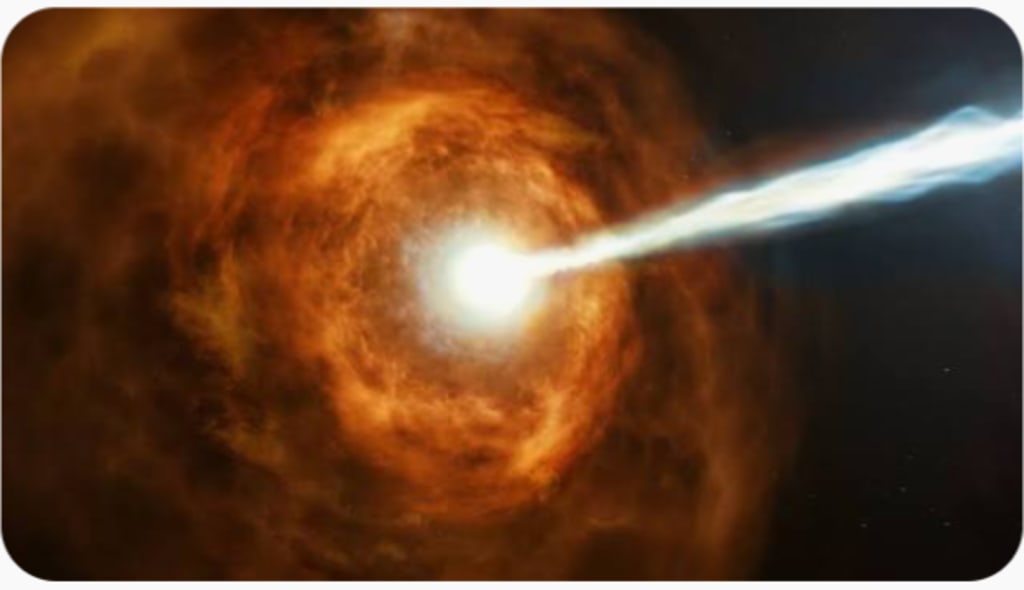
In simple terms, a neutron star — one of the densest objects in the universe — was emitting radiation in a narrow beam. As it rotated, that beam passed through a region of ionized gas. The interaction amplified and sustained the radio emission, making it appear continuous from Earth’s perspective.
This created the illusion of a seven-hour-long signal when, in reality, it was a repeating pulse strengthened by environmental conditions.
Scientists describe it as similar to a cosmic lighthouse shining through fog, where the fog itself makes the light appear brighter and more persistent.
Why This Matters to Astronomy
This discovery does more than solve a mystery — it opens a new window into understanding extreme environments in space.
Neutron stars already push the limits of physics. A teaspoon of their material would weigh billions of tons. Observing how their radiation interacts with surrounding plasma helps researchers study:
Magnetic field behavior
Particle acceleration
Energy transfer in extreme gravity
How cosmic radiation travels through space
It also challenges existing classifications of cosmic signals. Astronomers may now need to rethink how long-duration radio emissions are defined and cataloged.
Rethinking Fast Radio Bursts
The event also raises new questions about fast radio bursts, which remain one of astronomy’s biggest puzzles.
If environmental conditions can stretch or amplify signals, some events previously thought to be short-lived explosions might actually be part of longer processes masked by cosmic interference.
This could mean:
Some FRBs may originate from repeating sources
Certain signals might be misinterpreted due to plasma effects
There may be many more such long-duration events waiting to be discovered
Future telescopes will be designed to monitor the same region of sky for extended periods, rather than just scanning for quick flashes.
A Reminder of How Much We Don’t Know
Perhaps the most important lesson from this event is how much remains unknown about the universe.
Even with powerful observatories and advanced computer models, nature continues to surprise scientists. A seven-hour signal forces astronomers to confront assumptions about how cosmic objects behave and how signals travel across enormous distances.
What seemed impossible under existing theories turned out to be a rare but explainable phenomenon — proof that the universe is still full of surprises.
Technology Makes the Difference
This discovery was only possible because of modern radio telescope arrays capable of:
Continuous sky monitoring
High-resolution frequency analysis
Cross-checking data from multiple observatories
Filtering out Earth-based interference
As technology improves, scientists expect to find more unusual events like this one — signals that blur the lines between known categories and demand new explanations.
Next-generation observatories such as the Square Kilometre Array (SKA) will dramatically increase detection sensitivity and may uncover thousands of similar events each year.
Public Fascination and Scientific Responsibility
Whenever a mysterious space signal makes headlines, public curiosity spikes. Social media quickly fills with theories about alien contact and hidden messages.
Astronomers stress that while curiosity is natural, scientific conclusions must be based on evidence. In this case, no pattern, structure, or modulation consistent with artificial origin was found. The signal behaved exactly as physics predicts under extreme cosmic conditions.
Still, the excitement surrounding such discoveries plays an important role in inspiring interest in space science and encouraging public support for astronomical research.
Looking Ahead
Scientists plan to continue observing the region where the signal originated to see if it repeats. If it does, it will further confirm the neutron star and plasma interaction theory.
They also hope to detect more long-duration signals to determine whether this was truly rare or simply overlooked due to limitations in past instruments.
Each new detection will refine models of how matter and energy behave in the most extreme corners of the cosmos.
Conclusion: Mystery Solved, Wonder Renewed
What began as a baffling seven-hour signal from deep space has turned into a breakthrough in understanding how radiation travels through cosmic environments. Far from being an alien message, the signal appears to be the result of a rare alignment between a neutron star and surrounding plasma.
Yet even with an explanation in hand, the event highlights how dynamic and unpredictable the universe remains.
In solving one mystery, astronomers have uncovered new questions — and reminded humanity that the cosmos still holds countless secrets waiting to be discovered.
About the Creator
Sajida Sikandar
Hi, I’m Sajida Sikandar, a passionate blogger with 3 years of experience in crafting engaging and insightful content. Join me as I share my thoughts, stories, and ideas on a variety of topics that matter to you.
Keep reading
More stories from Sajida Sikandar and writers in The Swamp and other communities.
Morocco Joins Nigeria, Egypt, Ghana, Algeria, Senegal, and Others in Facing a Travel Setback to the US as the Government Cracks Down on Economic Stability by Freezing Visa Processing for Nationals of Over Twenty-Six African Countries Starting This Month
In a move that has sparked concern across the African continent, the United States government has announced a temporary freeze on visa processing for nationals of more than twenty-six African countries, including Morocco, Nigeria, Egypt, Ghana, Algeria, and Senegal. Beginning this month, applicants from these nations are facing new delays and uncertainty as U.S. authorities tighten immigration controls in response to what officials describe as concerns over economic stability and immigration compliance.
By Sajida Sikandarabout 11 hours ago in The Swamp
Why Black History Matters in America?
The United States of America is celebrating their 250th anniversary in 2026. I'm proud to be an American and as someone who was born here, I wouldn't imagine myself living anywhere else. This is a country where opportunities are possible. Where anyone can be successful in anything they desire to do. Equality, community, and togetherness are the backbones of what America is and should be about. However, we have an administration who wants to erase and disregard those who have made positive, meaningful impacts in our country, specifically Black figures, such as Martin Luther King, Jr., Rosa Parks, and Maya Angelou. President Trump and his administration have been constantly complaining and fighting against what they call the "Woke agenda". They use this excuse as a distraction from other issues they refuse to address, such as the high cost of living, climate change, and inflation. That equality is dividing America, when in reality, it's bringing us together. Being woke is not tied to a specific political party. No matter where you stand on the political spectrum, you can still care about other people and their plights. Compassion and empathy for others isn't tied to a political party, either. We were taught as children to treat others the way we want to be treated and not judge others because they're different from us. Caring about others isn't a personal attack on your beliefs. It doesn't make you any less of a person. People who are easily offended over African American figures, past or present, or anything related to it, are grasping at straws. Current and future generations need to know who people like Harriet Tubman and Shirley Chisholm were, especially in the classroom. Black History is part of American History. It should be recognized, not hidden or forgotten. Besides, you can't shield children from everything, just because your feelings are easily hurt.
By Mark Wesley Pritchard 8 days ago in The Swamp
Gold and Silver Rebound After Historic Wipeout as Analysts Say Thematic Drivers Stay Intact
After one of the most brutal sell-offs in recent memory, gold and silver have staged a notable rebound, easing fears that the long-standing bull case for precious metals had been permanently damaged. While the recent “wipeout” sent shockwaves through commodity markets and rattled investor confidence, analysts argue that the underlying thematic drivers supporting gold and silver remain firmly intact.
By Ayesha Lashari7 days ago in The Swamp
The Lesions of Devotion
Every day I set myself down on the freshly cut lawn and strip myself bare. I take my guitar and finger the frets and pick at the strings, listening for dissonance. My life is dissonance. I twist the tuning pegs until each string sounds bright. Then I kneel, calves pointing behind me, kneecaps facing forward. All exposed to the breeze. I close my eyes and play the melody.
By Paul Stewart3 days ago in Fiction




Comments
There are no comments for this story
Be the first to respond and start the conversation.