
Astronomers Detect Seven‑Hour Space Signal — Scientists May Finally Understand What It Was
Record‑breaking gamma‑ray burst GRB 250702B challenges current astrophysics and offers new clues about extreme cosmic explosions.
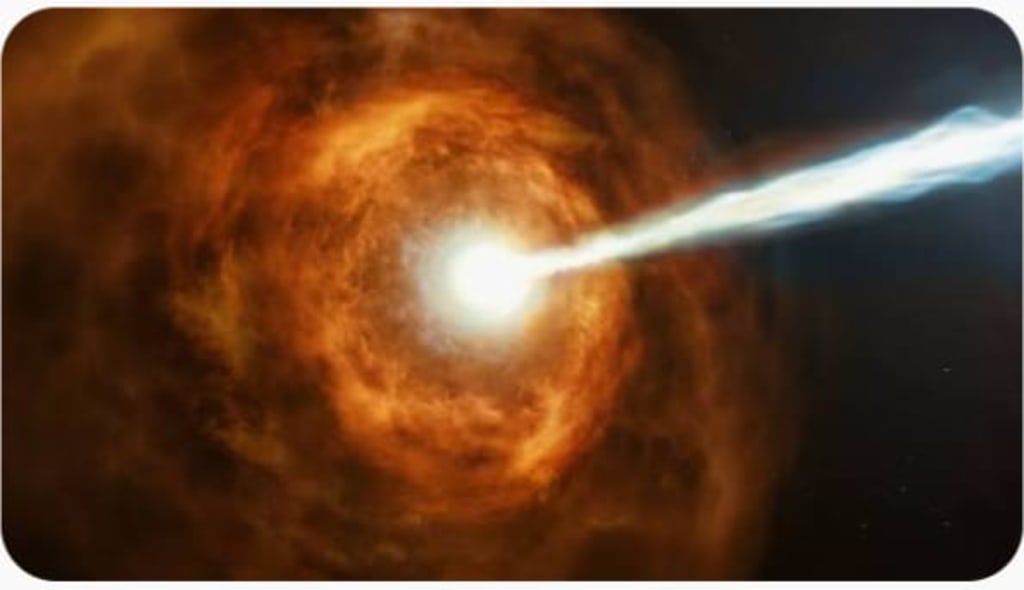
In a discovery that has left astronomers both stunned and excited, scientists recently detected a signal from deep space that lasted an incredible seven hours. This is not just any ordinary blip in the universe—it's potentially the longest gamma-ray burst ever recorded. Researchers are now working hard to understand what could have caused this unprecedented cosmic event.
For decades, gamma-ray bursts (GRBs) have fascinated astronomers. These are powerful explosions in the universe, often signaling the death of massive stars or collisions between stellar remnants. Yet, most GRBs last only a few seconds or minutes. So when a burst continues for hours, scientists know they are observing something truly extraordinary.
What Was Detected?
On July 2, 2025, NASA’s Fermi Gamma-ray Space Telescope picked up an unusual surge of gamma-ray radiation coming from a distant galaxy about 8 billion light-years away. Unlike typical bursts that flash and fade quickly, this signal persisted for 25,000 seconds—or nearly seven hours.
The burst, now officially named GRB 250702B, immediately triggered a global observation campaign. Telescopes worldwide, both in space and on the ground, began tracking its afterglow across multiple wavelengths. Astronomers scrambled to gather as much data as possible, as the event was unlike anything seen before.
Why This Signal Is Extraordinary
To understand the significance of this discovery, it helps to know a bit about GRBs:
Gamma-ray bursts are bursts of high-energy light caused by extreme cosmic events.
They are usually associated with the collapse of massive stars into black holes or the merger of neutron stars.
Most GRBs last seconds to a few minutes, followed by an afterglow that can be detected in X-rays, optical, and radio wavelengths.
GRB 250702B, however, lasted seven hours, far beyond any previously observed burst. Its extraordinary duration challenges existing models of stellar death and gamma-ray emission. Scientists believe the event could point to a rare type of stellar explosion or even a new class of cosmic phenomena.
Possible Explanations for a Seven-Hour Burst
So what could have caused such an ultra-long burst? Researchers have proposed several exciting possibilities:
1. A Helium Star Falling Into a Black Hole
One theory suggests that a massive helium star may have spiraled into a nearby black hole. As the star’s outer layers are gradually pulled into the black hole, enormous amounts of energy could be released continuously, producing a long-lasting gamma-ray jet. This gradual feeding could explain why the burst persisted for hours.
2. A Star Being Torn Apart by a Black Hole
Another idea is that a black hole may have actively torn apart a companion star. Instead of a quick collapse, the star could have been slowly consumed, releasing gamma rays over an extended period. This process is known as a tidal disruption event, and while rare, it can generate extremely energetic emissions.
3. A New Type of Cosmic Explosion
Some scientists suggest that GRB 250702B does not fit into any existing category. If this is true, the burst may represent an entirely new type of cosmic event, revealing processes in the universe that astronomers have never observed before.
Why This Discovery Matters
The detection of such a long gamma-ray burst is more than just a scientific curiosity—it could change our understanding of the universe:
It challenges conventional models of how stars die and how black holes consume matter.
It shows that some cosmic explosions can sustain massive energy output for much longer than previously thought.
It provides a rare opportunity to study the physics of extreme environments billions of light-years away.
GRBs act like cosmic lighthouses, illuminating regions of space that are otherwise hidden. By studying them, scientists can learn more about star formation, galaxy evolution, and the behavior of matter under extreme conditions.
What Astronomers Are Doing Next
The discovery of GRB 250702B has set off an intense period of study:
Afterglow Observations: Scientists are tracking the burst’s fading light across X-ray, optical, and radio wavelengths to understand the environment around the explosion.
Preparing for Future Missions: Upcoming telescopes, like the Compton Spectrometer and Imager (COSI), will provide higher sensitivity to detect similar events in the future.
Searching for Similar Events: Researchers are combing through past data to find other ultra-long bursts, helping determine whether GRB 250702B is a rare anomaly or part of a larger population of extreme cosmic events.
This event is expected to inspire new models of stellar death and gamma-ray physics, potentially rewriting textbooks about how massive stars end their lives.
The Human Side of the Discovery
While this event is billions of light-years away, the discovery excites not only scientists but also anyone fascinated by the universe. It reminds us that space is full of surprises and that even the most extreme phenomena can be observed and studied from Earth.
For astronomy enthusiasts, GRB 250702B is a testament to the power of human curiosity and technological achievement. It shows that our telescopes and detectors are now sensitive enough to pick up events that last hours and happen billions of light-years away.
Conclusion
The seven-hour gamma-ray burst GRB 250702B is a record-breaking cosmic event that challenges everything astronomers thought they knew about gamma-ray bursts. Whether caused by a star falling into a black hole, a tidal disruption event, or a new kind of cosmic explosion, it opens exciting avenues for research.
As scientists continue to analyze the data and observe the afterglow, we may soon learn how such extreme events occur and what they reveal about the universe’s most powerful forces. For now, GRB 250702B stands as a reminder of the astonishing mysteries waiting to be discovered in space.
About the Creator
Keep reading
More stories from Ayesha Lashari and writers in The Swamp and other communities.
Morocco and Dozens of African Nations Face Major U.S. Travel Setback as Immigrant Visa Processing is Frozen
The United States government has recently made a surprising and impactful decision: halting immigrant visa processing for nationals from over 26 African countries, including Morocco, Nigeria, Egypt, Ghana, Algeria, and Senegal. This policy, which took effect in February 2026, is part of a broader effort to ensure economic stability and reassess visa applicants’ ability to financially support themselves in the U.S. While non-immigrant visas like tourist or student visas are not directly affected, this move has caused widespread uncertainty among families, professionals, and students hoping to start a new chapter in the United States.
By Ayesha Lashariabout 9 hours ago in The Swamp
Why Black History Matters in America?
The United States of America is celebrating their 250th anniversary in 2026. I'm proud to be an American and as someone who was born here, I wouldn't imagine myself living anywhere else. This is a country where opportunities are possible. Where anyone can be successful in anything they desire to do. Equality, community, and togetherness are the backbones of what America is and should be about. However, we have an administration who wants to erase and disregard those who have made positive, meaningful impacts in our country, specifically Black figures, such as Martin Luther King, Jr., Rosa Parks, and Maya Angelou. President Trump and his administration have been constantly complaining and fighting against what they call the "Woke agenda". They use this excuse as a distraction from other issues they refuse to address, such as the high cost of living, climate change, and inflation. That equality is dividing America, when in reality, it's bringing us together. Being woke is not tied to a specific political party. No matter where you stand on the political spectrum, you can still care about other people and their plights. Compassion and empathy for others isn't tied to a political party, either. We were taught as children to treat others the way we want to be treated and not judge others because they're different from us. Caring about others isn't a personal attack on your beliefs. It doesn't make you any less of a person. People who are easily offended over African American figures, past or present, or anything related to it, are grasping at straws. Current and future generations need to know who people like Harriet Tubman and Shirley Chisholm were, especially in the classroom. Black History is part of American History. It should be recognized, not hidden or forgotten. Besides, you can't shield children from everything, just because your feelings are easily hurt.
By Mark Wesley Pritchard 8 days ago in The Swamp
Starmer to Meet Labour MPs After McSweeney Quits as Chief of Staff Over Mandelson Appointment
Keir Starmer is facing one of the most delicate internal moments of his leadership after his chief of staff, Morgan McSweeney, resigned following the controversial appointment of Peter Mandelson to a senior advisory role. The move has triggered unease across Labour’s parliamentary party, prompting Starmer to convene a meeting with MPs in an effort to steady nerves, reassert authority, and prevent the situation from escalating into a broader crisis. While Labour remains strong in the polls and firmly positioned as a government-in-waiting, this episode exposes the persistent tension between the party’s modern leadership and the unresolved legacy of New Labour-era power brokers. Who Is Morgan McSweeney — and Why His Exit Matters Morgan McSweeney was not just another senior aide. He was widely viewed as: One of Starmer’s closest political strategists A key architect of Labour’s electoral discipline A central figure in rebuilding Labour’s credibility after years of internal chaos McSweeney’s role went beyond logistics. He helped shape messaging, manage internal dissent, and enforce the “no distractions” approach that has defined Starmer’s leadership style. His resignation, therefore, is not merely administrative — it is symbolic. When a chief of staff walks out, it usually signals a serious breakdown in trust at the very top. The Mandelson Factor: Why This Appointment Is So Divisive Peter Mandelson remains one of the most polarizing figures in Labour politics. To supporters, he is: A master strategist A proven election winner A figure with global political experience To critics, he represents: The excesses of New Labour An era associated with spin, elite politics, and corporate closeness A step backward rather than forward Mandelson’s appointment — particularly without broader consultation — reignited old anxieties within Labour ranks about who truly holds influence around Starmer. For McSweeney, the issue was reportedly not personal animosity, but direction: what Mandelson’s return signaled about Labour’s future power structure. Why Timing Makes This Worse This dispute comes at a particularly sensitive time. Labour is: Leading in national polls Preparing for the realities of government Under increased media scrutiny At this stage, unity is not just desirable — it is essential. Voters who are open to Labour are looking for stability, professionalism, and reassurance. Internal resignations risk reviving memories of Labour’s past disunity — something Starmer has spent years trying to bury. Starmer’s Meeting With MPs: Damage Control or Reset? Starmer’s decision to meet Labour MPs directly is a calculated move. The objectives are clear: Contain the fallout before speculation grows Reassure MPs that decision-making remains disciplined Demonstrate leadership, not defensiveness Such meetings are rarely about policy. They are about tone, confidence, and trust. Starmer will need to explain: Why Mandelson was brought in What boundaries exist around his role How internal voices will continue to be respected Failure to address these concerns openly could deepen internal skepticism. A Clash of Political Cultures At the heart of this episode is a deeper cultural clash within Labour. On one side: A modernized party focused on discipline and electability Younger strategists shaped by post-Brexit politics A leadership trying to appear technocratic and steady On the other: Veterans of New Labour who believe experience wins elections A comfort with centralized power A belief that politics is ultimately about hard-nosed strategy McSweeney’s resignation suggests that these two cultures are colliding — and not quietly. What This Means for Starmer’s Authority Leadership is often tested not during elections, but during internal conflict. Starmer now faces a choice: Reassert control and clarify the chain of command Or risk appearing overly influenced by political heavyweights Even if Mandelson’s role is limited, perception matters. If MPs believe that decisions are being shaped behind closed doors by figures associated with the past, confidence in leadership cohesion may erode. That erosion doesn’t need to be dramatic to be dangerous — it can be slow and subtle. Reaction Inside the Parliamentary Party Initial reactions among Labour MPs have reportedly been mixed. Some argue: Mandelson’s experience could be valuable Labour cannot afford amateurism if it wants to govern Elections are won by strategy, not sentiment Others worry: This move undermines the “new politics” image It alienates younger voters and activists It sends the wrong signal about accountability Starmer’s meeting will likely expose how deep these divisions run. Public Perception: Does the Voter Care? For most voters, the names McSweeney and Mandelson mean little. But what voters do notice is: Headlines about resignations Stories about internal tension Suggestions of behind-the-scenes power struggles These narratives matter because they shape emotional impressions — competence, unity, readiness. If Labour looks distracted by internal drama, even briefly, it risks weakening its core pitch: that it is ready to govern responsibly. Lessons From Labour’s Past Labour history is filled with cautionary tales. Internal battles have: Derailed campaigns Undermined leaders Distracted from public-facing priorities Starmer’s leadership was built in reaction to that history. His promise was simple: no more chaos. McSweeney’s resignation challenges that promise — not fatally, but visibly. What Happens Next Several outcomes are possible: Containment The issue fades after clarification and reassurance. Structural Change Starmer tightens advisory roles and formalizes boundaries. Lingering Unease MPs remain uneasy, even if publicly silent. Which path emerges depends on how convincingly Starmer handles the next few days. Conclusion: A Warning, Not a Crisis — Yet This episode is not a catastrophe for Labour. But it is a warning light. McSweeney’s resignation highlights unresolved questions about: Influence Direction The balance between experience and renewal Starmer’s response will matter more than the resignation itself. If he can reassure MPs, clarify leadership structure, and keep Labour focused outward rather than inward, the party will move on quickly. If not, this moment may be remembered as the first visible crack in Labour’s carefully constructed image of unity.
By Zahid Hussainabout 16 hours ago in The Swamp
Foot Bindings
I asked my grandmother how she knew she'd fallen in love. I am not sure I ever did love him, she said. This was before I met my husband. I was naive, a naked spring, a raw nerve of a thing. That cannot ever be me, I knew. Sadness swept in gently like a Moscow thaw. It is no simple thing, looking into a woman's vast soul and seeing its foot bindings. Now, in Italy divorced with my skin singed off, when I say I don't love him mean: I have succeeded at feeling nothing most days and it mostly works. Do you want the comfort of Nothing? Do you want Nothing, too? Be warned: you'll never be free, even when you are nothing. Here is what doesn't work: Accepting the stages of grief. Talking about it. Sitting with the feeling. Missing him—no, the person you were when you believed in death do us part. Writing poetry. That, too. When I say I don't love him I mean: I feel capsized in an endless, starved tide. What sometimes works: selective memory. You must forget ripe tomatoes and his beard and feeling perfectly sheltered in a big blue world. Forget coffee in bed, laughter watching TV, blowing out the candles on the birthday cake and the quiet all-encompassing knowledge that you are chosen. Remember only how love turned to a banal everyday survival act, a trapeze act unsure whether he will catch you, how the warmth stagnated and became sour, remember the foot bindings and remember the resentment boiling in your veins as you stick it out for the kids. Six-hour Netflix binges help, too. A man's fingers tracing your spine. Frozen pizza at 2 a.m. Random trips to the museum just to stand near things that last a while. The realization that crying won’t change anything. Seeing that life is just a dream, and refusing to participate in your own suffering. Bite your fist. Walk on eggshells around joy. When I say I don't love him, I mean he didn’t break my heart, he just stopped touching it and it forgot how to beat right.
By Ella Bogdanovaa day ago in Poets


Comments
There are no comments for this story
Be the first to respond and start the conversation.