
As Spain Mourns Train Crash Victims, Investigators Focus on Track
High-speed rail tragedy near Córdoba leaves dozens dead, as authorities focus on infrastructure and safety oversight.
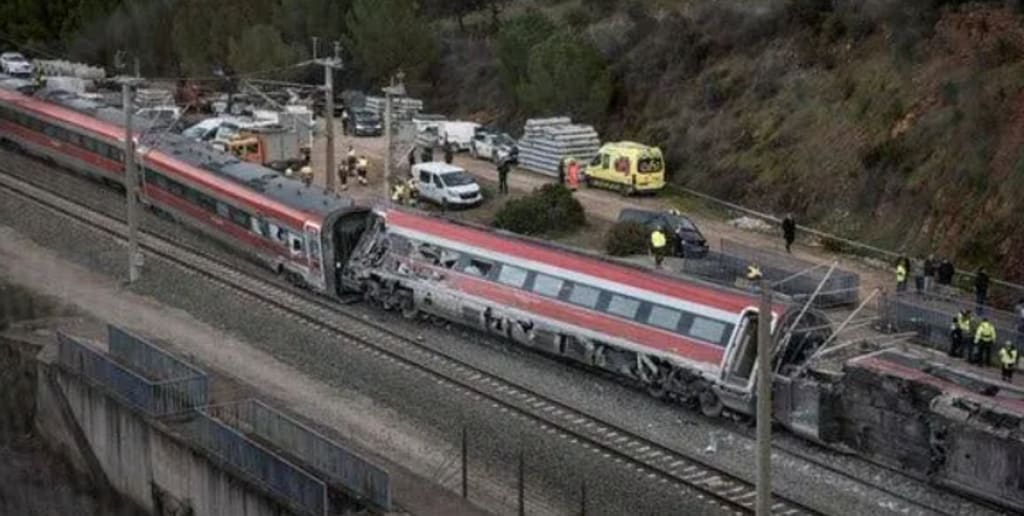
Spain is in shock. A high-speed train collision near Adamuz, Córdoba has claimed at least 40 lives and injured over 120 people, marking one of the deadliest rail disasters in recent European history. Families, communities, and an entire nation are grappling with grief, while investigators scramble to find answers.
The crash involved two high-speed trains: one operated by Iryo, traveling from Málaga to Madrid, and an Alvia train from Renfe heading to Huelva. The rear carriages of the Iryo train derailed, crossed onto the opposite track, and collided with the Alvia train. The result: carriages overturned and people trapped inside, creating scenes of chaos and heartbreak.
Harrowing Moments on the Tracks
Survivors describe the moment in terrifying detail. One passenger said, “All I heard was screams… then the world flipped.” Others were thrown across seats and metal debris, emerging with injuries but alive. Local residents rushed to help, forming human chains to lift people from the wreckage and provide first aid.
Emergency crews worked through the night, navigating overturned carriages and unstable terrain. Unfortunately, the death toll may rise as authorities continue searching the wreckage for missing passengers.
Turning Eyes Toward the Tracks
Early investigations suggest track conditions may have played a key role in the derailment. Preliminary reports point to a broken rail joint that could have caused the train to derail. Experts say that minor defects in high-speed rail tracks, especially on straight stretches, can lead to catastrophic accidents when trains travel at more than 200 km/h.
The Commission of Investigation of Rail Accidents (CIAF) stated that the focus is on how the track and vehicle interacted during the derailment. Investigators found signs that the joint may have shown wear for months, raising questions about maintenance and oversight.
This discovery adds to growing public concern. Spain’s high-speed rail network, once a symbol of innovation and safety, has rarely experienced deadly accidents. The crash highlights that even small infrastructure issues can have disastrous consequences if not addressed.
A Nation in Mourning
Spain has declared three days of national mourning. Flags fly at half-mast, and tributes pour in from across the country. Families of victims are gathering for funerals, holding vigils, and waiting anxiously for updates about loved ones still unaccounted for.
Prime Minister Pedro Sánchez described the incident as a “day of sorrow” and promised a transparent and rigorous investigation. Authorities are establishing hotlines and support centers to help families navigate the aftermath.
Historical Context and Safety Concerns
Spain’s high-speed rail system has been celebrated worldwide for its safety record. But experts caution that high-speed trains are sensitive to even minor track imperfections. Previous warnings from train operators about unusual vibrations or noises in the area may point to longer-standing maintenance issues.
Unions representing railway workers confirmed that concerns about track wear and tear had been raised months before the crash, suggesting that infrastructure problems may have gone unaddressed.
What Happens Next?
Investigators are collecting evidence from the crash site, examining rail conditions, and analyzing train black boxes. While human error seems unlikely, officials are carefully considering all possible factors to understand what went wrong.
The focus now is not only on accountability but also on preventing future tragedies. Spain faces the challenge of restoring public confidence in its high-speed rail network, while providing support to the families affected by this heartbreaking accident.
Remembering the Victims
As rescue operations wind down, the nation continues to mourn. Communities in Córdoba and beyond are coming together to support victims’ families, share grief, and honor those lost. This tragedy has reminded Spain—and the world—how fragile life can be and how crucial infrastructure maintenance is for public safety.
In the coming weeks, investigators’ findings on the track and other possible causes will be closely watched. For now, Spain pauses in grief, reflecting on the lives lost and the lessons that must be learned.
This version is more readable as a blog, with shorter paragraphs, human stories, clear headings, and emotional connection.
About the Creator
Keep reading
More stories from Aqib Hussain and writers in The Swamp and other communities.
The List of World Leaders Invited to Trump’s Board of Peace for Gaza
In January 2026, former U.S. President Donald Trump announced an ambitious — and controversial — global initiative aimed at bringing peace and reconstruction to the Gaza Strip. He called it the “Board of Peace”, a multinational body meant to help govern, stabilize, and rebuild Gaza after years of conflict. The plan has stirred reactions worldwide. Some leaders are cautiously supportive, some have declined, and others are still deciding. Let’s take a closer look at the leaders and nations involved in this controversial project. What Is the Board of Peace? The Board of Peace is intended to be a multilateral forum overseeing the next phase of Gaza’s peace process. Its mission covers governance reform, security stabilization, economic development, and reconstruction. While the initiative focuses on Gaza, its charter hints at broader global influence — which has raised eyebrows among diplomats and international institutions, including the United Nations. Membership works a bit differently than traditional diplomatic organizations. Countries can serve three-year terms, but if they contribute $1 billion toward the board, they earn a permanent seat. Who’s Leading the Board? The executive leadership includes former and current U.S. officials, financial figures, and international diplomats. Key members are: Donald Trump – Chair Marco Rubio – U.S. Secretary of State Steve Witkoff – U.S. Special Envoy to the Middle East Jared Kushner – Former Senior Advisor Tony Blair – Former U.K. Prime Minister Marc Rowan – U.S. Financier Ajay Banga – President of the World Bank This core group will oversee the board’s operations and guide Gaza’s peace and reconstruction efforts. Heads of State and Government Invited According to multiple news reports and diplomatic sources, a wide range of world leaders received invitations. Confirmed Invitations / Acceptances Hungary – Prime Minister Viktor Orbán (accepted) Vietnam – Government (accepted) Argentina – President Javier Milei (invited/accepted) Canada – Prime Minister Mark Carney (agreed in principle) Morocco – King Mohammed VI (accepted) Turkey, Egypt, Jordan, India – Invitations sent, responses pending Other Nations Reportedly Invited Media reports suggest that leaders from countries including Australia, Brazil, Germany, Greece, Italy, Japan, Saudi Arabia, Singapore, South Korea, Spain, Sweden, Switzerland, UAE, United Kingdom, and Ukraine also received invitations. Some of these invitations are officially unconfirmed, but sources indicate outreach was made. Responses from Leaders Acceptances Hungary and Vietnam have officially accepted the invitations. Canada and Morocco have indicated willingness to participate in principle. Hesitations France has formally declined, expressing concern about the board’s legitimacy and overlap with the UN. Many European countries have been cautious, concerned about a lifetime chairmanship by Trump and financial obligations. Russia and China Russia is reviewing the invitation. China confirmed it received the invitation but hasn’t committed yet. Controversy Surrounding the Board The Board of Peace has stirred debate. Critics argue it may undermine the UN and established peace efforts. The $1 billion contribution requirement has also drawn scrutiny for potentially privileging wealthy nations and private interests over humanitarian needs. Even Israel has raised objections, worrying that the board could influence Gaza without proper coordination with its own security strategy. What’s Next? The full list of participants and the board’s powers are expected to be officially announced at an upcoming ceremony alongside the World Economic Forum in Davos. With some key players hesitating, questions of legitimacy, and potential overlap with international institutions, the board’s real-world impact remains uncertain. Final Thoughts Trump’s Board of Peace for Gaza has created a complex diplomatic landscape. While some leaders are stepping forward to participate, others are watching carefully. Whether this initiative becomes a groundbreaking effort for Gaza’s reconstruction or a controversial footnote in global diplomacy will depend on the next few months. One thing is clear: the world will be watching.
By Aqib Hussainabout 15 hours ago in The Swamp
Japanese Mayor Apologises After Calling Staff ‘Human Scum’
Japanese mayor has issued a public apology after allegedly referring to city employees as “human scum,” a remark that has triggered widespread outrage across the country. The incident has reignited national discussions around workplace harassment, power dynamics in politics, and the responsibilities of public officials in Japan’s traditionally hierarchical society.
By Ayesha Lashari4 days ago in The Swamp
Trump Slams UK’s Chagos Islands Deal as an “Act of Great Stupidity”
In a sharp diplomatic critique, former U.S. President Donald Trump has described the United Kingdom’s decision to transfer sovereignty of the Chagos Islands to Mauritius as an “act of great stupidity.” His comments have stirred global attention, highlighting tensions over military strategy, historical claims, and international diplomacy.
By Aarif Lashariabout 17 hours ago in The Swamp


Comments
There are no comments for this story
Be the first to respond and start the conversation.