
Andrew Mountbatten-Windsor Could Relocate Abroad After Public Downfall, Reports Suggest
Speculation grows that the Duke of York may consider a move overseas as scrutiny in the UK continues

Speculation is growing that Prince Andrew, formally known as Andrew Mountbatten-Windsor, could consider relocating outside the United Kingdom following years of public scrutiny and reduced royal responsibilities.
Reports circulating in British media suggest that the Duke of York may explore options abroad as his public profile at home remains limited. While there has been no official confirmation from Buckingham Palace, discussion about his future has intensified in recent weeks.
This article outlines the context behind the speculation, the factors influencing such a decision, and what it could mean for the British royal family.
Background: A Reduced Public Role
Prince Andrew stepped back from official royal duties in 2019 following controversy surrounding his association with convicted offender Jeffrey Epstein. His televised interview that year drew criticism and led to further questions about his judgment and public standing.
In 2022, he reached a civil settlement in a case brought against him in the United States. The settlement included no admission of wrongdoing. Following that development, he lost several military affiliations and royal patronages.
Since then, his participation in official royal events has been limited. He no longer represents the monarchy in public engagements and does not carry out duties on behalf of the Crown.
His residence remains in the UK, but his visibility in public life has significantly declined.
Reports of a Possible Move
Recent reports suggest that Prince Andrew could consider relocating to another country. Media outlets have referenced unnamed sources claiming that he may seek a quieter environment outside the United Kingdom.
The country mentioned in speculation varies across reports, with some pointing to nations where he has previously held diplomatic or charitable connections. However, no official statement has been issued confirming any relocation plans.
It is important to note that at this stage, these claims remain unverified and based on media reporting rather than formal announcements.
Why a Move Might Be Considered
Several factors could influence such a decision.
First, public perception in the United Kingdom remains complex. Polling over the past few years has indicated that Prince Andrew’s approval ratings are low compared to other senior royals.
Second, his reduced role within the royal family limits his public responsibilities. Without official duties, there may be fewer practical reasons to remain closely tied to royal operations.
Third, a move abroad could offer greater privacy. Media attention in the UK remains strong, and relocating could potentially reduce day-to-day public scrutiny.
That said, relocating would not necessarily eliminate international media coverage.
Financial and Practical Considerations
Any relocation would involve practical questions.
Prince Andrew currently resides at Royal Lodge in Windsor, under arrangements connected to the Crown Estate. A move overseas would require new housing arrangements and potential adjustments to security provisions.
As a non-working royal, he does not receive public funding for official duties. Security matters have previously been the subject of legal proceedings, with debates about how protection is funded.
A relocation would likely require coordination with British authorities and the host country’s government.
Impact on the Royal Family
The British royal family has worked in recent years to focus on core working members.
Under the leadership of King Charles III, the monarchy has emphasized a streamlined structure, concentrating public duties among a smaller group of senior royals.
Prince Andrew’s absence from official engagements aligns with that approach.
If he were to relocate permanently, it would likely reinforce the separation between his personal life and the monarchy’s public functions.
Royal observers note that any move would be framed as a private decision rather than an institutional shift.
Public and Political Reaction
The Duke of York’s public standing remains a topic of debate in the UK.
Some members of the public believe he should maintain a low profile. Others argue that as a member of the royal family, his personal decisions continue to reflect on the institution.
Political leaders have generally avoided direct commentary on his status, emphasizing that it is a matter for the royal household.
If relocation plans were confirmed, responses would likely vary. Supporters may view it as a practical step toward privacy. Critics may see it as avoidance of scrutiny.
International Implications
Should Prince Andrew move abroad, diplomatic and security considerations would come into play.
Members of the royal family often have long-standing relationships with other nations through trade missions and charitable work. Prince Andrew previously served as a UK trade envoy before stepping down from that role.
Any permanent relocation would require coordination to ensure that his status as a royal family member is understood within the host country.
However, without official duties, his international role would remain personal rather than diplomatic.
Media Coverage and Privacy
The British press continues to report on Prince Andrew’s circumstances.
Media attention intensified following his interview and subsequent legal proceedings. Even after stepping back from duties, coverage has not entirely subsided.
Relocating abroad might reduce immediate public appearances but would not necessarily prevent coverage from international outlets.
Public figures, especially those connected to the monarchy, often remain subjects of ongoing reporting regardless of location.
A Pattern of Royal Adjustments
The British monarchy has faced several transitions in recent years.
Changes in leadership, generational shifts, and evolving public expectations have influenced how royal roles are defined.
Prince Andrew’s withdrawal from public duties fits within a broader pattern of adjustment.
If relocation occurs, it would represent a continuation of that distancing process rather than a sudden break.
What Has Been Officially Said
As of now, no formal announcement has been made by Buckingham Palace regarding relocation plans.
Without confirmation, reports should be treated as speculation.
Historically, the palace has issued statements when significant changes to royal living arrangements occur. Until such communication is released, any move remains uncertain.
The Road Ahead
If Prince Andrew chooses to remain in the United Kingdom, his role is likely to stay limited to private family events.
If he relocates abroad, the transition would mark another stage in his reduced public presence.
Either way, the monarchy’s public-facing operations are expected to continue focusing on senior working members.
The institution has emphasized continuity and service amid internal and external challenges.
Conclusion
Reports that Prince Andrew could leave the UK for another country reflect ongoing interest in his future after years of controversy and reduced royal duties.
While speculation continues, no official confirmation has been provided.
The decision, if it comes, would be personal rather than constitutional. It would not alter the line of succession or the structure of the monarchy.
For now, the situation remains fluid. Observers await any formal statement clarifying whether relocation is under serious consideration.
Until then, discussions about Andrew Mountbatten-Windsor’s future reflect broader conversations about accountability, privacy, and the evolving role of public figures within modern institutions.
About the Creator
Saad
I’m Saad. I’m a passionate writer who loves exploring trending news topics, sharing insights, and keeping readers updated on what’s happening around the world.
Why Black History Matters in America?
The United States of America is celebrating their 250th anniversary in 2026. I'm proud to be an American and as someone who was born here, I wouldn't imagine myself living anywhere else. This is a country where opportunities are possible. Where anyone can be successful in anything they desire to do. Equality, community, and togetherness are the backbones of what America is and should be about. However, we have an administration who wants to erase and disregard those who have made positive, meaningful impacts in our country, specifically Black figures, such as Martin Luther King, Jr., Rosa Parks, and Maya Angelou. President Trump and his administration have been constantly complaining and fighting against what they call the "Woke agenda". They use this excuse as a distraction from other issues they refuse to address, such as the high cost of living, climate change, and inflation. That equality is dividing America, when in reality, it's bringing us together. Being woke is not tied to a specific political party. No matter where you stand on the political spectrum, you can still care about other people and their plights. Compassion and empathy for others isn't tied to a political party, either. We were taught as children to treat others the way we want to be treated and not judge others because they're different from us. Caring about others isn't a personal attack on your beliefs. It doesn't make you any less of a person. People who are easily offended over African American figures, past or present, or anything related to it, are grasping at straws. Current and future generations need to know who people like Harriet Tubman and Shirley Chisholm were, especially in the classroom. Black History is part of American History. It should be recognized, not hidden or forgotten. Besides, you can't shield children from everything, just because your feelings are easily hurt.
By Mark Wesley Pritchard 26 days ago in The Swamp
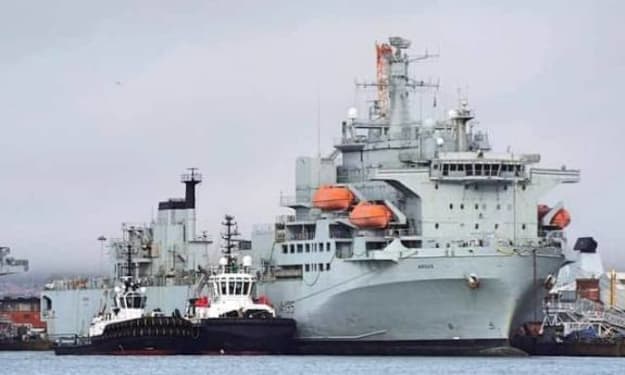
RFA Argus Set to be Towed Away as Royal Navy Confirms Scrapping Plan
Britain’s venerable support ship, RFA Argus, is set to be towed away for scrapping after the Royal Navy confirmed plans to retire one of its longest-serving vessels. The decision marks the end of more than four decades of service for a ship that played notable roles in humanitarian missions, training operations, and global deployments. The Ministry of Defence (MoD) issued a statement acknowledging Argus’s contribution to the UK’s maritime capabilities while noting that evolving operational requirements and budgetary constraints have made continued service untenable. “After careful review, the decision has been made to withdraw RFA Argus from service and dispose of the vessel through scrapping,” the statement said, adding that the ship will be decommissioned and prepared for recycling later this year. A Storied Career Comes to a Close Commissioned in 1981, Argus served initially as a civilian container ship before being acquired and converted by the Royal Fleet Auxiliary into a multi-role aviation training and casualty reception platform. The ship was later fitted with a full hospital suite, operating theatres, and medical wards, enabling it to provide vital support in humanitarian crises as well as military operations. Over the decades, Argus saw action in numerous theatres, including the Falklands War, where it contributed critical support functions. In 2014, it deployed to West Africa as part of the international response to the Ebola outbreak, acting as a floating treatment and training facility. In 2020, Argus served as a hospital and logistics hub during the COVID-19 pandemic, reinforcing its reputation as a flexible asset in times of need. Naval analysts described Argus as “a workhorse of capability,” capable of bridging gaps in operational capacity when conventional warships were otherwise committed. Its retirement, many experts say, reflects broader shifts in defence priorities — with emphasis moving toward high-end combat platforms and unmanned systems rather than traditional auxiliary vessels. Strategic and Budgetary Pressures The decision to scrap the ship comes amid ongoing budgetary pressures on the UK defence establishment. Fiscal constraints have forced the MoD to reassess the composition of its fleet as it strives to invest in next-generation submarines, destroyers, and carrier strike capabilities. While these investments are seen as essential for future conflict deterrence, the retirement of Argus highlights the challenges of balancing high-end combat needs with softer power capabilities such as humanitarian response. In parliamentary testimony earlier this month, Defence Secretary Grant Shapps defended the decision, saying the Royal Navy must “focus on platforms that meet the strategic threats of the future.” He added that lessons learned from Argus’s deployments would inform the design of future support capabilities, including potential partnerships with allied navies. However, some critics — including former naval officers and defence commentators — have voiced concern that scrapping Argus could leave a capability gap. “It was unique in its combination of aviation training, casualty reception, and humanitarian assistance,” said retired Rear Admiral Jonathan Sharpe. “Losing that platform without a ready replacement risks diminishing the UK’s ability to respond to crises where soft power is needed most.” Navigating Decommissioning and Disposal The decommissioning process, scheduled to begin in coming months, will see Argus stripped of all sensitive equipment, with usable systems transferred to other platforms where possible. The hull and remaining structure are expected to be sold to a recycling yard specializing in environmentally compliant scrapping, in line with international regulations on ship disposal. MoD officials stressed that scrapping choice was guided by environmental and safety standards, ensuring that hazardous materials such as asbestos and fuel residues are handled responsibly. Plans also include support for former crew members impacted by the ship’s retirement, with transition assistance and reassignment opportunities within the Royal Navy and RFA where available. Legacy and Future Prospects For many servicemembers who sailed aboard Argus, the ship holds deep personal and professional significance. Veteran crews remember its versatility, camaraderie, and the sense of purpose in missions that ranged from warfighting exercises to pandemic response. As Argus heads toward dismantling, discussions are already underway about how to preserve its history, with proposals for museum exhibits, oral history projects, and archival materials to ensure the ship’s legacy is not lost. The end of RFA Argus’s operational life underscores the evolving nature of naval power in the 21st century. While the Royal Navy moves toward modernization and transformation, the retirement of a vessel that served both in war and humanitarian relief is a reminder of the multifaceted roles that navies play — and the difficult choices that come with transitioning to the next generation of maritime capability.
By Fiaz Ahmed 3 days ago in The Swamp


Comments
There are no comments for this story
Be the first to respond and start the conversation.