
An Accident-Prone Navy: India’s Troubled Waters and the Cost of Ambition
India’s naval ambitions have long been touted as emblematic of its rise as a global power.

India’s naval ambitions have long been touted as emblematic of its rise as a global power. However, this rise has been marred by a troubling pattern of accidents, system failures, and lapses in safety protocols, exposing glaring vulnerabilities in the Indian Navy’s operational readiness and safety culture. Over the past decade, 15 major incidents, including fires, system malfunctions, and mishandling of radioactive materials, have cast a shadow over India’s maritime aspirations and raised critical questions about the sustainability of its nuclear submarine program.
A Troubled History of Accidents
The string of mishaps begins with high-profile incidents like the INS Sindhuratna fire in 2014, which tragically claimed the lives of two officers, and extends to the INS Arihant, India’s first nuclear-powered submarine, which was rendered inoperative for 10 months due to an accidental flooding of its propulsion compartment. Such accidents highlight systemic failures in adherence to standard operating procedures (SOPs) and an alarming disregard for safety protocols.
Most recently, the commissioning of the INS Arighaat, India’s second strategic strike submarine, has reignited concerns about the sustainability and safety of its nuclear submarine fleet. The Arighaat’s construction delays—three years behind schedule—reflect deeper inefficiencies in India’s ability to produce and maintain high-tech military platforms.
The Nuclear Dilemma
India’s reliance on underdeveloped and untested nuclear technology adds a layer of risk that cannot be overlooked. The potential for radioactive contamination, underscored by past mishandling of nuclear materials, poses a significant threat not just to naval personnel but also to the marine ecosystems of the Indian Ocean. Moreover, the use of substandard materials in nuclear systems raises the specter of underwater nuclear accidents, which could have catastrophic consequences for the region’s environment and security.
Adding to these challenges is the specter of corruption in the defense procurement process. Scandals like the 2006 arms procurement kickbacks and the 2019 irregularities in indigenous weapon system acquisitions have further undermined the credibility of India’s naval modernization efforts. These procurement lapses compromise the quality of vital equipment, directly impacting operational safety and effectiveness.
An Ethical Quandary
India’s aggressive push for a blue-water navy comes at a significant cost. The country is investing billions into its nuclear submarine fleet while 140 million of its citizens continue to live below the poverty line. This stark disparity raises ethical questions about resource allocation in a country grappling with pressing social and environmental challenges.
The prioritization of military expansion over the well-being of its population reflects a troubling disconnect between national security objectives and human security needs. In a region already fraught with geopolitical tensions, India’s naval accidents and nuclear vulnerabilities risk triggering an environmental and humanitarian crisis.
A Call for Regional and Global Oversight
To address these challenges, India must adopt a more transparent and accountable approach to its naval operations. South Asian nations should establish a cooperative framework focusing on maritime safety, environmental protection, and conflict de-escalation. Regular audits and accountability mechanisms are essential to ensure adherence to international safety standards.
Engaging global bodies like the International Maritime Organization (IMO) and the International Atomic Energy Agency (IAEA) is equally crucial. These organizations can provide technical expertise, independent oversight, and a platform for regional dialogue on nuclear and maritime safety.
The Way Forward
India’s ambition to project power through a robust navy must be matched by a commitment to operational excellence, environmental stewardship, and ethical governance. Without addressing the systemic flaws that have plagued its naval operations, India risks undermining its credibility as a responsible maritime power.
The time has come for India to navigate these troubled waters with caution and foresight, ensuring that its naval pursuits do not come at the cost of safety, sustainability, and the well-being of its people and the planet.
About the Creator
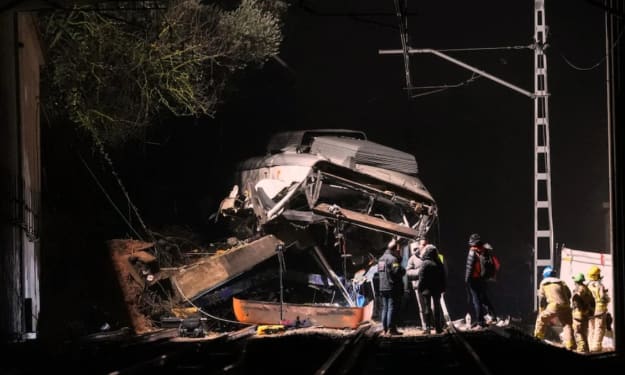
Train Driver Killed and Dozens Injured After Train Derails in Spain
A tragic train derailment in Spain has left the nation in shock after a train driver was killed and dozens of passengers were injured in a serious rail accident. The incident has once again raised urgent questions about railway safety, infrastructure maintenance, and emergency response preparedness in one of Europe’s busiest rail networks.
By Aarif Lasharia day ago in The Swamp
WEF: Donald Trump Set to Dominate Davos 2026
When world leaders, billionaires, CEOs, and policy architects gather in the Swiss Alps for the World Economic Forum (WEF) in Davos, they usually arrive with carefully balanced messages about cooperation, stability, and long-term planning. But in 2026, one figure is expected to overshadow all others—Donald J. Trump. According to analysts and political observers, Trump’s influence is set to dominate Davos 2026, whether he appears in person or not. His policies, rhetoric, and potential return to the White House are already shaping conversations about trade, security, globalization, and the future of Western democracies. For an event traditionally associated with liberal internationalism, Trump’s looming presence marks a dramatic shift. Why Trump Matters at Davos The World Economic Forum has long been a symbol of elite global consensus—an annual meeting where governments, multinational corporations, and international institutions attempt to align their visions. Donald Trump, by contrast, has consistently positioned himself as an outsider to that system. During his previous presidency, Trump openly criticized global institutions, questioned NATO commitments, challenged free-trade agreements, and promoted a fiercely nationalist “America First” agenda. Those policies reshaped global markets and alliances, making Trump impossible to ignore—even for the very elites he often criticized. As Davos 2026 approaches, Trump’s political comeback has forced attendees to confront an uncomfortable reality: global decision-making may once again revolve around a leader who rejects many of the forum’s foundational ideas. A Forum Forced to Adapt Unlike past years, Davos 2026 is expected to focus less on long-term climate targets and more on immediate geopolitical uncertainty. Trump’s potential return to power has triggered renewed debate over tariffs, defense spending, and global supply chains. Executives attending the forum are reportedly recalculating investment strategies in anticipation of stricter U.S. trade policies. Trump’s past willingness to impose tariffs—even on allies—has made corporations wary of overreliance on globalized production networks. At the same time, European leaders are preparing for the possibility of reduced U.S. commitment to multilateral agreements. Trump’s skepticism toward institutions like the World Trade Organization and the Paris Climate Agreement remains a central concern at Davos. Trade, Tariffs, and Economic Nationalism Few topics are expected to dominate Davos discussions more than trade protectionism. Trump’s previous presidency saw aggressive tariff policies aimed at China, the European Union, and even Canada. Those moves disrupted global markets but also appealed to voters who felt left behind by globalization. At Davos 2026, business leaders are expected to debate whether the era of unrestricted global trade is permanently over. Trump’s influence has legitimized economic nationalism in ways that many global elites once dismissed. For emerging economies, this shift raises difficult questions. Should they continue betting on export-driven growth, or pivot toward regional self-sufficiency? Trump’s worldview has forced Davos attendees to reconsider assumptions that defined the post-Cold War global economy. Security and NATO Back on the Agenda Trump’s approach to security alliances is another reason his presence looms so large. His past criticism of NATO—especially his insistence that European allies increase defense spending—changed the alliance’s internal dynamics. At Davos 2026, security experts are expected to openly discuss whether the U.S. would remain a reliable security guarantor under another Trump administration. This uncertainty has already pushed European nations to rethink military budgets and strategic autonomy. For global investors, geopolitical instability is no longer an abstract risk. Trump’s unpredictability, supporters argue, brings leverage; critics say it introduces dangerous volatility. Either way, Davos cannot ignore the impact. Climate Policy in Trump’s Shadow Climate change has traditionally been a centerpiece of the World Economic Forum. However, Trump’s skepticism toward international climate agreements has complicated that narrative. While global corporations continue to promote sustainability goals, there is growing concern that political momentum may shift away from aggressive climate regulation if Trump regains power. At Davos 2026, climate discussions are expected to reflect a more cautious tone—focused on market-driven solutions rather than binding international commitments. This represents a significant shift for a forum that once championed ambitious global climate action as inevitable. Why Trump Dominates Even Without Attending What makes Trump’s influence unique is that he doesn’t need to attend Davos to dominate it. His policies, rhetoric, and political movement have reshaped the global conversation. Panels discussing China, supply chains, AI regulation, defense spending, and even democracy itself are all framed by a single question: How would a Trump-led America respond? In many ways, Trump has forced the World Economic Forum to confront its own limitations. The assumption that global elites can guide the world toward consensus no longer holds. Political polarization, nationalist movements, and voter backlash against globalization have changed the rules. A Divided Reaction Among Davos Attendees Reactions to Trump’s looming dominance are deeply divided. Some executives privately welcome his transactional approach, arguing that it brings clarity and decisive action. Others fear that his unpredictability undermines stability and long-term planning. For policymakers, Trump represents both a challenge and a reality check. His rise exposed a disconnect between elite institutions and large segments of the global population—an issue Davos has struggled to address convincingly. What Davos 2026 Represents Davos 2026 may go down as a turning point—not because of any single announcement, but because of what it symbolizes. The forum is no longer setting the global agenda; it is reacting to political forces it once underestimated. Donald Trump’s dominance of the conversation reflects a broader transformation in global politics. Power is shifting away from consensus-driven institutions toward leaders who thrive on disruption and national interest. Whether one views Trump as a destabilizing force or a corrective to global overreach, his shadow over Davos 2026 is undeniable. Conclusion The World Economic Forum was designed as a place where the world’s most powerful actors could shape the future together. In 2026, that future is being shaped elsewhere—by elections, populist movements, and leaders like Donald Trump. Davos 2026 will still host speeches, panels, and promises. But the most influential presence may be the one challenging its very foundations.
By Muhammad Hassan5 days ago in The Swamp



Comments
There are no comments for this story
Be the first to respond and start the conversation.