
America’s Great Stalemate: Ignorance, Power, and the Struggle for Change
Why America is stuck

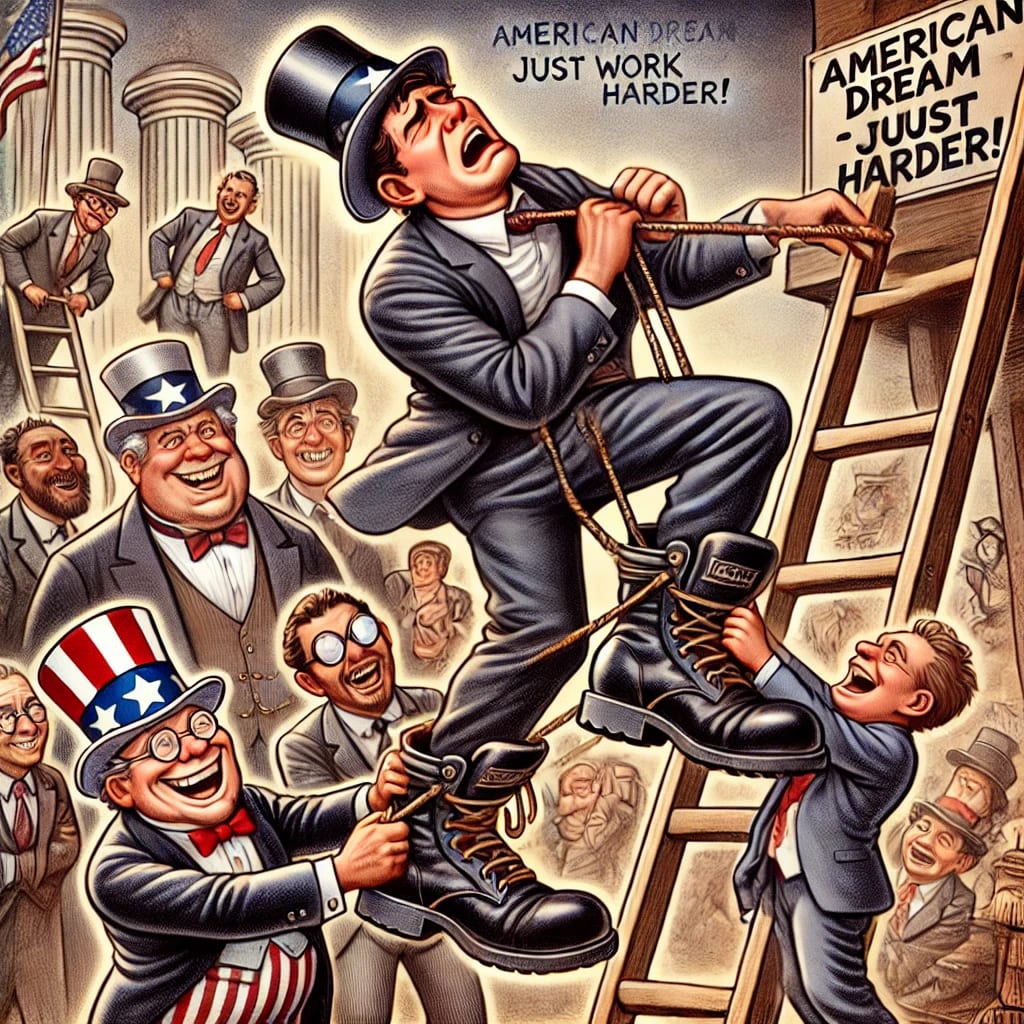
The United States is stuck. On issue after issue—healthcare, wealth inequality, climate policy, voting rights—the country remains locked in a cycle of dysfunction, where real solutions seem perpetually out of reach. Why? Why is it that while other first-world nations manage to provide universal healthcare, protect worker rights, and regulate corporate power, America remains a battleground where even the most basic social advancements are met with fierce resistance?
Two fundamental obstacles stand in the way of real progress: widespread ignorance and an entrenched elite class that thrives on maintaining the status quo.
A Nation Kept in the Dark
How many Americans truly understand the policies that shape their daily lives? How many can explain how tax breaks for billionaires widen income inequality, how healthcare in the U.S. is more expensive yet delivers worse outcomes than in other developed nations, or how corporate money quietly dictates legislation behind closed doors?
The unfortunate reality is that many Americans lack the necessary tools to critically analyze these issues, and that is by design.
Consider our education system. Civics, media literacy, and economic policy are either underemphasized or completely absent in many schools. Students graduate without the ability to navigate the complexities of government, finance, or corporate influence—a vacuum that is easily filled by cable news soundbites, social media conspiracies, and political propaganda.
The media, once an institution meant to inform and hold power accountable, has largely abandoned that role in favor of profit. Corporate-owned news networks prioritize sensationalism and partisanship over substance, while social media algorithms boost outrage and misinformation. The result? A public that is misinformed, divided, and easily manipulated.
And then there’s the cultural factor. In America, expertise is often distrusted, and anti-intellectualism thrives. Political and corporate leaders exploit this distrust, selling the idea that complex issues have simple solutions or, worse, that they aren’t worth questioning at all.
The Bootstrap Illusion: A Convenient Lie
In no other developed country is the idea of “pulling yourself up by your bootstraps” taken as seriously as in the United States. This phrase, originally intended to mock the impossibility of lifting oneself up by their own footwear, has somehow become a cornerstone of American ideology.
The idea that anyone, regardless of circumstance, can succeed with enough hard work completely ignores systemic barriers—generational poverty, racial discrimination, lack of healthcare, skyrocketing education costs, and corporate monopolies that crush small businesses.
How do you “pull yourself up” when wages have stagnated for decades while the cost of living has exploded? How do you “just work harder” when billionaires hoard wealth, corporations slash jobs, and medical bills force families into bankruptcy?
The myth of the self-made millionaire is a convenient fairy tale, repeated endlessly by those who benefit from a system that keeps people poor, desperate, and overworked. It convinces struggling Americans to blame themselves for their hardship instead of questioning why a handful of people control more wealth than the bottom 90% of the country combined.
The Power Behind the Curtain
If ignorance is the kindling, the ruling elite provide the spark that keeps the fire burning.
There is a reason why billionaires fund political campaigns and super PACs. There is a reason why corporate interests spend billions lobbying Congress. There is a reason why wealth inequality has skyrocketed while wages have remained stagnant. Those at the top benefit from a system that keeps most Americans struggling, distracted, and disengaged.
For decades, politicians have promised to address the nation’s biggest crises—affordable healthcare, tax fairness, workers’ rights—yet little changes. Why? Because solving these problems would threaten the profits and influence of those who fund their campaigns.
Instead, we get divide-and-conquer politics. Working-class Americans are pitted against each other over race, gender, religion, and culture while the true power brokers—corporations, banks, and political dynasties—consolidate wealth and control behind the scenes.
Meanwhile, any attempt at reform is met with fear-mongering and misinformation. Universal healthcare is painted as a government takeover. Wealth taxes are framed as an attack on hardworking Americans rather than an attempt to restore fairness. Voting rights protections are twisted into accusations of election fraud. The strategy is simple: keep the public fighting amongst themselves so they never unite against the real problem.
Is Change Even Possible?
Some will say that the system is too broken to fix. That the forces at play are too powerful. That Americans are too divided. But history tells us otherwise.
The labor movement of the early 20th century forced corporations to recognize workers’ rights. The civil rights movement overcame institutional racism through relentless activism. Even in the face of corporate opposition, Social Security and Medicare became cornerstones of American society. Change is possible—but only when people demand it.
So, where do we start?
1. Educate and Inform
• Schools must prioritize civics, media literacy, and economic education to empower future generations.
• Independent journalism must be supported and funded to counter corporate-controlled media narratives.
• Social media platforms must be held accountable for spreading disinformation.
2. Challenge Corporate Control Over Politics
• Overturn Citizens United to remove unlimited corporate money from elections.
• Implement publicly funded elections to reduce the influence of billionaires.
• Break up media monopolies to ensure a free and independent press.
3. Strengthen Workers and Economic Fairness
• Support stronger unions to rebalance power between corporations and employees.
• Implement a wealth tax to address the growing divide between the ultra-rich and everyone else.
• Ensure universal healthcare so that access to medical care is not dictated by wealth.
4. Reform the Electoral System
• Adopt ranked-choice voting to weaken the two-party monopoly.
• End gerrymandering and voter suppression tactics designed to manipulate elections.
The Time for Action Is Now
The biggest challenge isn’t just fighting against the elite—it’s convincing everyday Americans that they are being manipulated and exploited.
The powerful are not going to willingly surrender their control. They will continue to lie, distract, and divide. But the truth remains: this system does not serve the people.
The real question is: How much worse does it have to get before Americans demand something better?
About the Creator
Jeff Olen
Husband and father living (currently) in California. As a software engineer I spent most of my career in Telecom and Healthcare. Then I found my calling in the video game industry. Still want to write sci-fi but we’ll see.
The Forsyth House Fire
Since 1851, Forsyth House has stood on the corner of Union Street and Gordon Street in the heart of Glasgow. Its iconic, or was... because on Sunday 8th of March, 2026, a fire broke out in a small, seemingly un-named shop in the building and tore all that history down. As I write, the rubble is still unsettled and the street is still blocked off. Central Station is quiet on the upper level, and around 30 small businesses have quite literally gone up in smoke.
By S. A. Crawford3 days ago in The Swamp
First Nations Leaders Head to England to Raise Treaty Concerns with King Charles
A delegation of First Nations leaders from Canada has traveled to England to meet with King Charles III, raising concerns over unresolved treaty obligations and the historical impact of colonial policies. The visit represents a rare opportunity for Indigenous leaders to engage directly with the British monarchy, which has long been viewed as a symbolic authority connected to treaties signed during the colonial era. The delegation includes chiefs and elders from multiple First Nations communities across Canada, representing a diverse range of regions and interests. Their mission is to secure recognition for longstanding grievances related to land rights, resource extraction, and the implementation of treaties originally negotiated between Indigenous communities and the Crown. The leaders emphasize that these treaties are still legally binding under Canadian law and that acknowledgment from the monarchy carries both symbolic and political weight. During preliminary discussions in London, the delegation highlighted concerns that many treaties have been inadequately honored over the past century. Chief Shawn Atleo of the Assembly of First Nations explained, “These agreements were made with the Crown, and yet, too often, their promises have been ignored or inadequately implemented. We come to England not to challenge the monarchy personally, but to seek recognition and a commitment to dialogue that respects the original intentions of these treaties.” King Charles, who has publicly expressed interest in reconciliation and environmental stewardship, reportedly welcomed the delegation and listened to their concerns during a formal audience. While the meeting did not produce immediate policy changes, it was described as a significant step toward acknowledging the historical obligations of the Crown and creating channels for continued discussion. The visit also underscores the complex role of the monarchy in contemporary Canada. Although political authority is vested in the Canadian government, the Crown remains a central figure in treaty law and Indigenous governance structures. Experts note that while King Charles cannot unilaterally enforce treaty obligations, recognition from the monarchy can strengthen Indigenous claims and encourage Canadian authorities to address outstanding issues more seriously. Beyond legal recognition, the delegation emphasized the social and cultural dimensions of their visit. Indigenous leaders brought artifacts, documents, and oral histories to illustrate the historical context of treaties and the impact of colonial policies on their communities. These presentations serve not only to educate British officials and the monarchy but also to reinforce the ongoing cultural and spiritual significance of these agreements for First Nations people. In addition to meetings with King Charles, the delegation has scheduled engagements with members of the British Parliament, legal experts, and historians specializing in colonial law. These discussions aim to foster broader understanding of the treaties and explore avenues for collaboration in addressing contemporary challenges related to Indigenous rights, land stewardship, and community development. The timing of the visit is particularly noteworthy, coming amid ongoing debates in Canada over reconciliation and Indigenous sovereignty. Recent legal rulings have emphasized the binding nature of treaties and the duty of the government to consult and accommodate First Nations communities in matters affecting their lands. Leaders in London hope that raising awareness internationally will complement domestic efforts and create additional pressure for meaningful action. Observers note that the visit carries symbolic significance for both the monarchy and Indigenous communities. For King Charles, it represents an opportunity to reinforce his public image as a monarch engaged with global issues and committed to dialogue and reconciliation. For the First Nations delegation, it demonstrates a proactive approach to asserting treaty rights and preserving cultural heritage in an international context. Reactions from Canadian officials have been cautiously supportive. While the federal government remains the primary authority responsible for treaty implementation, Indigenous Affairs Minister Penny Collenette praised the delegation for taking a diplomatic approach. “Engagement at all levels is important, and raising these issues in London complements ongoing efforts at home,” she said. The delegation plans to return to Canada later this month, with follow-up meetings expected to continue both domestically and internationally. Advocates stress that the visit should be viewed as part of a broader movement to ensure that historical treaties are honored, Indigenous voices are heard, and the principles of justice and fairness guide ongoing governance decisions. As the delegation concludes its visit, leaders expressed hope that the dialogue will mark the beginning of sustained engagement with the monarchy, the UK government, and Canadian authorities. “Our goal is not confrontation, but recognition, understanding, and meaningful action,” said Chief Atleo. “By raising these issues here in England, we hope to reaffirm the commitments made generations ago and ensure that future generations inherit the respect and rights promised to our people.”
By Fiaz Ahmed 6 days ago in The Swamp
The First Rainbow Baby
Pitter-patter, pitter-patter. The rain fell in rhythmic splatters, slowly slowing, but still constant. Mira rolled onto her side pulling the blanket tight against her ears, but still she could hear chitter-chatter and scurrying feet of the creatures that refused to sleep in the lower decks.
By A. J. Schoenfeld2 days ago in Fiction


Comments
There are no comments for this story
Be the first to respond and start the conversation.