
Alhamdulillah Pakistan Launches Fresh Military Action Claiming India Hit Its Military Bases
"Rising Tensions in South Asia as Pakistan Retaliates Against Alleged Indian Missile Strikes on Key Airbases

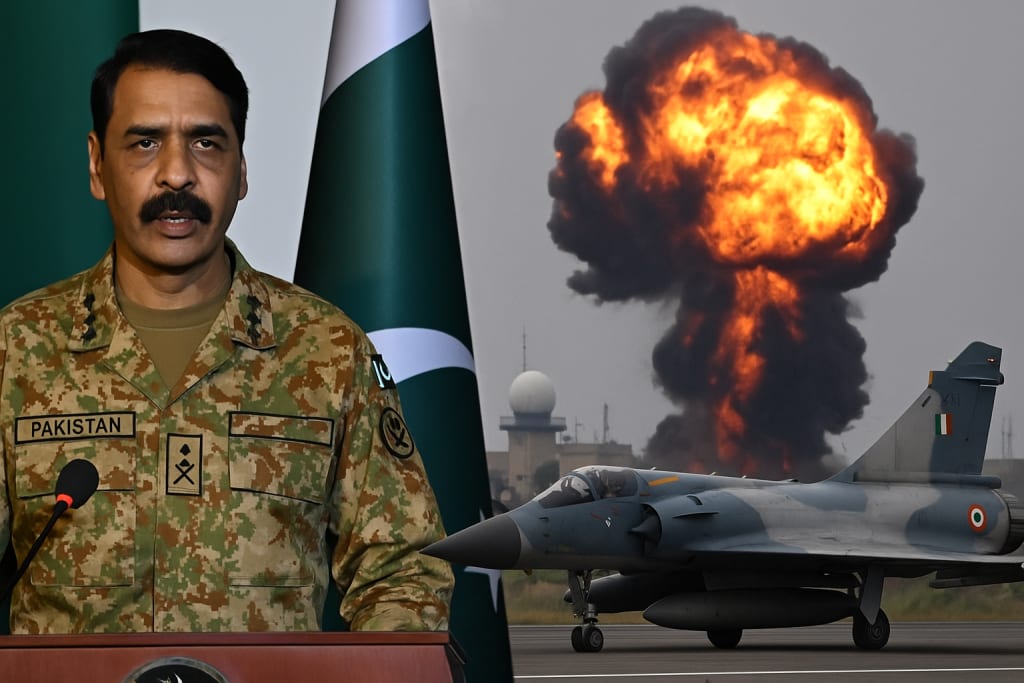
Alhamdulillah Pakistan Launches Fresh Military Action Claiming India Hit Its Military Bases
May 11, 2025 — Tensions between nuclear-armed neighbors Pakistan and India have reached alarming levels after Pakistan launched a large-scale retaliatory military operation in response to what it claims was a series of missile strikes by India on its military airbases. This marks one of the most serious escalations between the two nations in recent years.
The Catalyst for Escalation
The crisis was triggered by a deadly terrorist attack on April 22 in Indian-administered Kashmir, in which 28 civilians, mostly tourists, were killed in a suicide bombing in Pahalgam. India swiftly blamed Pakistan-based terror outfit Lashkar-e-Taiba for orchestrating the attack — a charge Pakistan vehemently denied, insisting it had no involvement and condemning the violence.
India’s military response came on May 6, when it carried out what it termed “precision strikes” on terror training camps located in Pakistani-controlled territory. Indian officials described these strikes as a necessary and targeted response to neutralize terror threats. However, Pakistan accused India of violating its sovereignty and claimed that Indian missiles hit civilian areas and active military installations, including the Noor Airbase near Rawalpindi.
Pakistan Responds: Operation Bunyan al-Marsus
In the early hours of May 10, Pakistan’s military announced the launch of “Operation Bunyan al-Marsus,” aimed at Indian military assets in the Punjab region. According to the Inter-Services Public Relations (ISPR), Pakistan struck the Adampur Air Force Station in Indian Punjab using precision-guided hypersonic missiles. The operation, the statement said, was "in direct response to Indian aggression on Pakistan’s airbases."
Pakistan’s Defense Minister Khawaja Asif said, “We had no choice but to respond. India’s reckless strike on our airbases endangered national security. This operation was conducted in self-defense and in line with international law.”
India, meanwhile, claimed that it successfully intercepted several Pakistani missiles using its S-400 air defense systems and downplayed the damage. Indian Defense Ministry sources labeled Pakistan’s operation as “an act of provocation” and reiterated India’s right to defend itself.
Civilian Fallout and Airspace Lockdown
Both sides reported civilian casualties resulting from the military action. Pakistan confirmed that 11 civilians had been killed and at least 56 injured in border villages near the Line of Control. India reported 19 civilian deaths, particularly in areas close to the international border.
In anticipation of further conflict, both nations shut down parts of their airspace. India closed over 30 airports in the northern and western states, while Pakistan completely suspended commercial air traffic until further notice. Residents in border areas have been advised to take shelter, and emergency services are on high alert.
International Reactions
The international community has reacted with deep concern. The United Nations, the G7 nations, China, and the United States have all issued urgent calls for restraint.
U.S. Secretary of State Marco Rubio said, “Both India and Pakistan must step back from the brink. The use of military force will only worsen the suffering of their people and increase the risk of a broader conflict.”
China, a close ally of Pakistan and a strategic rival to India, urged both countries to resolve their disputes diplomatically and offered to mediate. Russia also expressed concern, emphasizing the importance of regional stability in South Asia.
Prospects of Further Escalation
Both countries have placed their armed forces on high alert, though no formal declaration of war has been made. While fears of a nuclear confrontation loom large, Pakistani officials have downplayed such speculation, assuring the world that their nuclear assets are secure and that no preemptive steps are being taken in that regard.
In a late-night statement, India’s Prime Minister Narendra Modi said, “India desires peace, but not at the cost of national security. We are prepared for any eventuality but remain open to dialogue.”
Similarly, Pakistan’s Foreign Ministry stated that the country remains committed to regional peace and is willing to engage in de-escalatory talks, provided India halts its "aggressive posture."
Conclusion
The coming days are critical for South Asia. With tensions running high, any misstep could have disastrous consequences not just for the two countries, but for the entire region. The world now watches closely, hoping that diplomacy and restraint will prevail over aggression and rhetoric.
About the Creator
Adnan Rasheed
Author & Creator | Writing News , Science Fiction, and Worldwide Update| Digital Product Designer | Sharing life-changing strategies for success.
Keep reading
More stories from Adnan Rasheed and writers in The Swamp and other communities.
China’s Military Tech Investments Face Real-World Test Amid India-Pakistan Tensions
China’s Military Tech Investments Face Real-World Test Amid India-Pakistan Tensions In the past two decades, China has poured billions of dollars into upgrading its military might. With ambitions to match or even surpass the United States in global influence, Beijing has heavily invested in advanced weaponry, artificial intelligence, satellite systems, hypersonic missiles, cyberwarfare tools, and unmanned combat systems. However, much of this military technology remains untested in a real-world battlefield scenario. That could change dramatically if tensions between its two South Asian neighbors — India and Pakistan — erupt into full-scale conflict.
By Adnan Rasheed9 months ago in The Swamp
Suppliers: The Backbone of Global Trade, Communities, and Modern Economies
Suppliers are the often unseen backbone of modern economies, connecting raw materials to finished products and linking local communities to global markets. From small family-owned businesses to multinational corporations, suppliers play a critical role in ensuring that goods and services reach consumers efficiently and reliably.
By Aarif Lashari4 days ago in The Swamp
My New Book is Finally Here
My poetry collection Beautiful and Brutal Things is done. It's actually done and finally published over 270 pages. Over a year of my life went into this book. More than a year, really. Long days at my computer, sometimes seven days a week because I couldn't stop even when I probably should have. Then two months of editing that felt harder than the writing itself. But it's finished, and I'm still standing, and the book is real.
By Tim Carmichael2 days ago in BookClub



Comments
There are no comments for this story
Be the first to respond and start the conversation.