

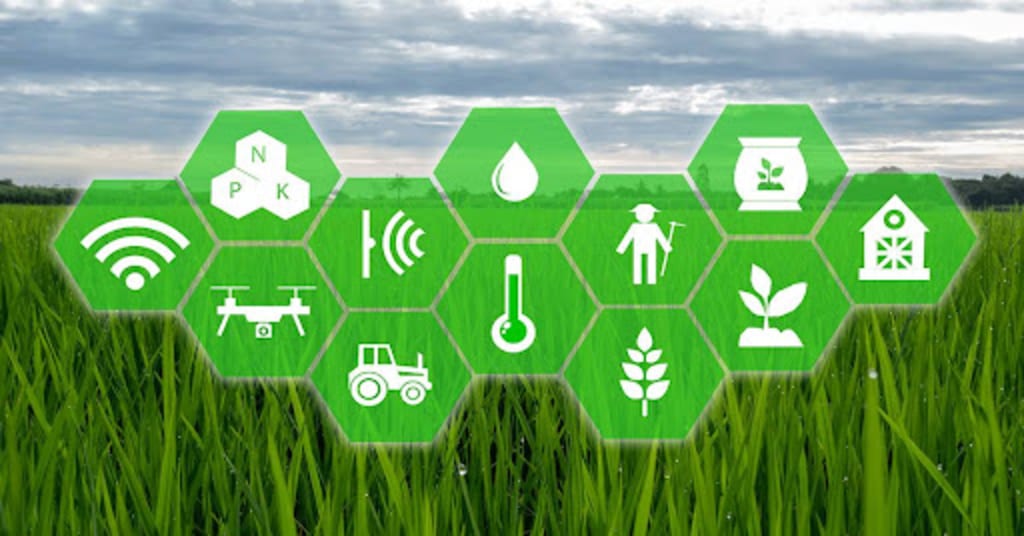
AI in Agriculture stands for Artificial intelligence in Agriculture. It refers to the use of advanced technologies like drones, machine learning, computer vision, and data analytics. It analyzes the data on soil, weather, and crops. AI helps enhance various aspects of farming, like optimal irrigation and yield prediction.
Modern agriculture faces a lot of challenges like limited land, labor shortage, and climate change. So, finding solutions for this led to innovative developments in agriculture. The technologies keep evolving each season, yet agribusiness needs to catch up on the benefits of Artificial intelligence. Let's discuss the benefits of artificial intelligence in farming and how it is transforming traditional agriculture practices.
Important Role of AI in Modern Agriculture
AI is improving agriculture by helping in data-driven decision-making, improving productivity, and gaining profitability, all of which empower farmers. The use of modern tools and techniques is a success for the agriculture sphere in India. Here are some advantages of AI in agriculture.
Data-Driven Decisions: AI-based algorithms analyze market trends, consumer preferences, and actionable insights to market their produce effectively. Artificial intelligence-based assessments help farmers assess the risk of weather events, market fluctuations, and financial planning for the future.
Improved Soil Health: AI-based applications help people make better choices about irrigation and fertilization. They also help farmers check the pH level of the soil and fertility rate.
Water Conservation: Farmers use AI to analyze data on weather patterns and schedule irrigation practices accordingly. It helps save water and ensures that crops receive the appropriate amount of water.
Less Use of Chemical Fertilizers: Farmers use Artificial intelligence to detect the early signs of pests in crops. This helps them plan the use of organic pesticides to fertilize the farm according to need.
Managing Livestock: AI can monitor animal health, track movements, and even predict potential health issues in livestock.
Automated Machinery: Artificial Intelligence-powered tractors and harvesters navigate fields with precision and efficiency. It helps in reducing labor costs and improves operational accuracy in modern farming.
AI also plays a critical role in crop monitoring. Using computer vision and machine learning algorithms, AI systems can process images captured by drones to identify crop diseases, nutrient deficiencies, and overall crop health. This real-time monitoring allows farmers to take immediate action, reducing crop losses and improving yield quality.
Furthermore, AI can assist in precision farming. By using sensors and data analytics, AI provides farmers with detailed insights into their fields, enabling them to apply fertilizers, pesticides, and water precisely where and when needed. This targeted approach not only increases efficiency but also minimizes environmental impact, promoting sustainable farming practices.
Another significant benefit of AI in agriculture is predictive analytics. AI models can forecast crop yields based on various factors such as weather conditions, soil health, and historical data. These predictions help farmers in planning their harvests, managing resources efficiently, and making informed decisions about selling their produce in the market.
Supply chain optimization is another area where AI is making a difference. AI systems can track produce from farm to market, ensuring freshness and reducing waste. They can also predict demand patterns, helping farmers and retailers manage inventory better and reduce losses.
In addition to these advantages, AI is fostering innovation in agricultural research. AI-driven simulations and models enable researchers to experiment with different farming techniques and crop varieties virtually, accelerating the development of resilient and high-yield crops.
The integration of AI in agriculture is not just limited to large-scale farms. Small and medium-sized farms also benefit from affordable AI solutions tailored to their needs. This democratization of technology ensures that farmers of all scales can enhance their productivity and profitability.
Conclusion
The future of AI in agriculture is bright. AI companies are developing robots that can easily perform multiple tasks on farms. AI robots will be there to check the quality of the crops, pick weeds, and harvest crops. Farmers can create a productive and sustainable agricultural sphere by using AI and investing in its development.
If you want to learn more about it, you can check out the full blog at Tractor Junction.
About the Creator
Rajendra_Singh
I'm a agriculture blogger, who loves sharing my knowledge about growing things. On my blog, you'll find practical tips and interesting stories to help you get started!
Keep reading
More stories from Rajendra_Singh and writers in The Swamp and other communities.
Soybean Farming In India
Soybean is also known as golden bean or Miracle crop because of its high protein and oil content. The origin of the legume is from China. It was brought to India many years ago across the Himalayan Mountains. Soybean planting is favourable to agro-climatic conditions. The states that are majorly growing soybeans are Madhya Pradesh, Maharashtra, Andhra Pradesh, Uttar Pradesh, and Rajasthan.
By Rajendra_Singh2 years ago in The Swamp
A Gathering of Evil Bosses
“I’m the queen of chin jutting while I smooth my hair, attacking, insulting, and deflecting to protect my appointer.” “Oh, please, Blondi, my hair is curled, highlighted, and longer than yours. I feature television commercials telling immigrants that we will give them a free plane ride home, and if they voluntarily turn themselves in, they will be allowed to legally apply for re-entry. It runs everywhere, and I look good in it! You can’t compete because of your blond hair. Mine is nicer, and my lips are prettier than yours.”
By Andrea Corwin 16 days ago in The Swamp
I used to report from the West Bank. Twenty years after my last visit, I was shocked by how much worse it is today – podcast
Two decades ago, I walked the streets of the West Bank as a young journalist, trying to make sense of a conflict that has long defied easy solutions. At that time, I witnessed checkpoints, tensions, and uncertainty, but there was also a sense that dialogue, however fragile, was still possible. Returning twenty years later for a recent visit, I found a landscape and a reality that was far more severe, starkly illustrating how the conflict has deepened over time. The first thing that struck me was the sheer scale of militarization. Israeli checkpoints, once sporadic, now dominate much of the West Bank’s main thoroughfares. Soldiers in armored vehicles and heavily fortified positions are a constant presence. Roads are divided, access restricted, and Palestinian towns and villages are encircled by fences and barriers. What had been a tense but navigable environment in the early 2000s now feels like a territory under occupation in full lockdown. Settlement expansion is another transformation impossible to ignore. Over the past twenty years, Israeli settlements have grown both in number and size, cutting through the Palestinian landscape. Once-contiguous Palestinian communities are now separated by walls, roads reserved for settlers, and security zones, fragmenting society and severely limiting freedom of movement. Farmers I spoke to lamented that land they had cultivated for generations is now inaccessible, reducing both livelihood and morale. The human dimension of these changes is heartbreaking. Palestinians I met spoke of frustration, fear, and despair, and many feel trapped in a system that restricts education, healthcare, and economic opportunity. Youth, in particular, face a future clouded by uncertainty. I heard accounts of families struggling just to move between cities, access hospitals, or attend school. Even basic daily life is complicated by bureaucracy, permit requirements, and the constant threat of military intervention. Violence remains a pervasive and destructive element. I encountered neighborhoods where buildings bore scars from clashes, shootings, or tear gas. Communities are haunted by the memory of lost loved ones, and the cycle of retaliation and suppression continues. Two decades ago, there was still a cautious optimism in some quarters that negotiations and international intervention might stabilize the region. Today, that optimism seems increasingly elusive. One of the most profound changes is the psychological toll. Twenty years ago, I saw resilience, hope, and determination. Now, I saw fatigue, cynicism, and resignation among people who have lived under repeated waves of restriction and conflict. Children have grown up knowing little else than checkpoints and military presence. The pervasive sense of entrapment and lack of agency is palpable, and it is reshaping society in ways that will have long-term consequences. Technology and media have amplified awareness of the situation. Social media now allows Palestinians to document daily hardships, human rights violations, and violent incidents in real time. International attention has increased, yet meaningful political change remains limited. Global actors often respond with statements rather than substantive action, leaving the local population to endure the day-to-day hardships largely on their own. As a journalist, returning to the West Bank has been both sobering and deeply instructive. It reminded me of the human cost behind the headlines, the slow erosion of rights, and the impact of entrenched political structures on ordinary lives. The contrast between my experiences twenty years ago and today illustrates that, despite international diplomacy and countless initiatives, the reality on the ground has worsened. This visit reinforced a vital truth: understanding the West Bank is not merely about politics or borders—it is about people, communities, and their lived experiences under persistent conflict. For anyone interested in the future of the region, it is crucial to recognize that without tangible changes in policy, protection of human rights, and genuine engagement, the West Bank will continue to face escalating hardship. The urgency to act has never been greater.
By Fiaz Ahmed 5 days ago in The Swamp




Comments
There are no comments for this story
Be the first to respond and start the conversation.