
A Women’s Hockey Game and the Fight Over Social Progress
A night at the hockey arena becomes a meditation on progress, backlash, and hope.


“Progress is never permanent, will always be threatened, must be redoubled, restated, and reimagined if it is to survive.”
– Zadie Smith
PROGRESS
Until just three months before I was born, states were allowed to ban interracial couples from marrying. In the decades since, ancient taboos have fallen away, allowing people who fall in love with someone of the same gender to marry legally.
This wave of social progress has reshaped the role of women in American life. No longer expected to be subservient homemakers, women have climbed to the highest reaches of power, including the office of the Vice President. Though they did not win the presidency, Hillary Clinton and Kamala Harris cracked the glass ceiling, helping pave the way for what will eventually be the first female president.
In sports, women athletes have made significant strides toward parity with their male counterparts, largely due to Title IX. With schools forced to fund programs equally, female athletes have greater opportunities to showcase their talents.
The WNBA will celebrate its 30th season this year. Female members of the national women’s soccer team are more firmly ingrained in American culture than their male counterparts. Now in its third season, the Women’s Professional Hockey League has expanded by two teams, including the Seattle Torrent.
RETRENCHMENT
The ascent of Trump is in many ways a reaction to this progress. The disruption of the status quo has been a threat to those with privilege, and many will do anything possible to keep what they have left. The easiest way to do that is to convince other victims of economic inequity that Diversity, Equity, and Inclusion (DEI) is to blame for their struggles, redirecting anger away from entrenched power and toward those fighting for a share of it.
Using presidential powers, both real and imagined, Trump has systematically dismantled programs implemented during the past six decades to bring us closer to the promise that “all men are created equal.” Colleges have been pressured to end programs designed to give all deserving students an opportunity for higher education, even as economic barriers to entry continue to rise. The National Park Service has removed exhibits that were critical of the ownership of slaves.
The Justice Department has distorted Civil Rights laws to investigate imagined discrimination against white, straight, Christian men and punish programs inclusive of the trans community.
Trump’s appointments to the Supreme Court during his first term had already set up the eventual rollback of the rights of women to control when and if they would procreate. The subsequent overturn of Roe v. Wade has left women in many states with virtually no access to abortion services. As part of his concurring opinion on Dobbs, Justice Clarence Thomas also urged the Court to reconsider Griswold v. Connecticut, the 1965 ruling that prevented states from outlawing contraception.
Cuts to the Department of Education, which is responsible for ensuring equal athletic opportunities for women, threaten to narrow Title IX protections. With less accountability, women’s sports programs may face fewer resources, reducing opportunities for female athletes. Additional disruptions are also likely due to Trump’s focus on transgender athletes, who represent somewhere less than 0.01% of all NCAA competitors, a fixation that has caused legal confusion for those administering these programs.
HOPE
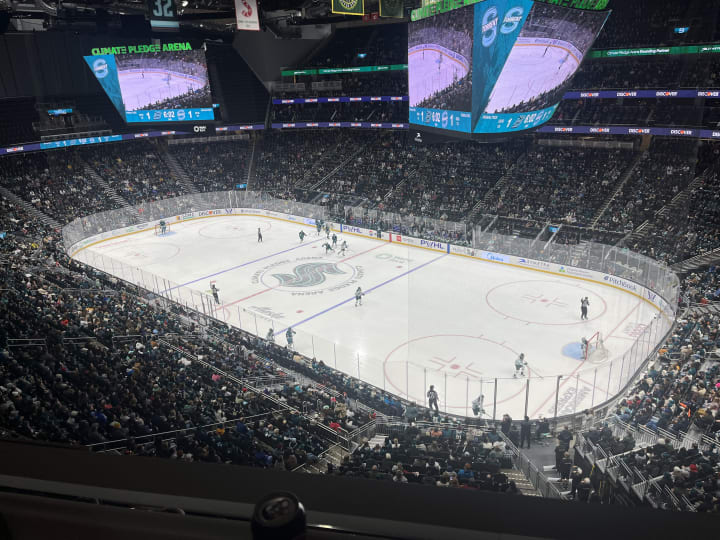
My eldest daughter played baseball with the boys until just before she started high school. Competing against boys who were physically stronger than her built up an intensity that served her well when she was forced to transition to girls' softball. It also had a positive effect on her self-esteem, which has benefited her to this day.
The memories from days spent cheering on my daughter came flooding back while attending a Torrent game last weekend. The atmosphere felt celebratory as I entered the Climate Pledge Arena. Particularly noticeable was the large number of dads attending with their daughters. Many groups of girls appeared to be from youth teams, there to soak in the inspiration of women athletes competing in one of the most physical team sports.
The appreciation for having female athletes competing at the highest professional level was on display when images of Megan Rapinoe, a World Cup–winning U.S. soccer icon, and Sue Bird, a four-time WNBA champion and Olympic gold medalist, appeared on the arena’s video screens. This prompted the crowd to erupt into sustained cheers. However, these were not the loudest applause of the night.
Also in attendance at the game was Malala Yousafzai, the Nobel Peace Prize laureate whom the Pakistani Taliban once tried to assassinate to silence her advocacy for girls' education. On the two occasions when her image appeared on the video boards, the crowd erupted into wild applause. Throughout the night, cameras caught fans holding up supportive messages to the hero; a testament to the enduring power of courage in the face of oppression.

Another highlight of the evening came during a brief presentation between the first two periods. In recognition of the upcoming Martin Luther King Jr. holiday, a local student performed a spoken-word piece she had written about the Black experience. Her delivery began tentatively, and she appeared understandably nervous standing before a crowd of several thousand hockey fans.
A smile finally spread across her face when the crowd applauded one of her lines. This happened several more times throughout her presentation, and each time her confidence grew. By the end of her performance, there was fire in her voice. She no longer looked like a nervous student, but like a seasoned professional who had been commanding stages for years.
There is no doubt that we are living in difficult times, with immigrant communities on edge, protestors being violently assaulted, and the gains of the past decades at risk. However, for one night, it felt reassuring to be in an arena full of people celebrating DEI rather than condemning it. Hope may have been buried under an avalanche of hate, but it still exists.
_____
Carl Petersen is a former Green Party candidate for the LAUSD School Board and a longtime advocate for public education and special needs families. Now based in Washington State, he writes about politics, culture, and their intersections at TheDifrntDrmr.
About the Creator
Carl J. Petersen
Carl Petersen is a parent advocate for students with SpEd needs and public education. As a Green Party candidate in LAUSD’s District 2 School Board race, he was endorsed by Network for Public Education (NPE) Action. Opinions are his own.
Keep reading
More stories from Carl J. Petersen and writers in The Swamp and other communities.
More Shades of Gray: What Are We Really Doing in Venezuela?
“We will, in fact, be greeted as liberators” – Dick Cheney We cannot even agree on what to call the military’s forced extraction of Nicolás Maduro, the man acting as Venezuela’s leader. Was it an act of war—or a law-enforcement action carried out abroad?
By Carl J. Petersen12 days ago in The Swamp
Popular Shampoo and Conditioner Recalled Over ‘Serious Chemical Risk’
The Recall Announcement A major consumer goods company has issued a recall of its popular shampoo and conditioner products following reports of potentially harmful chemical contamination. The products were sold across supermarkets, pharmacies, and online retailers, affecting thousands of consumers nationwide.
By Aarif Lashariabout 20 hours ago in The Swamp
AI-Induced Cultural Stagnation Is No Longer Speculation — It’s Already Happening
For years, concerns about artificial intelligence harming creativity were dismissed as hypothetical or alarmist. AI, we were told, would be a tool — not a replacement — enhancing human imagination rather than flattening it. But today, that optimism is fading. AI-induced cultural stagnation is no longer a theory. It is already unfolding in real time, reshaping art, writing, music, film, and even public discourse in subtle but deeply consequential ways.
By Muhammad Hassan7 days ago in The Swamp
One Unchecked Box
"Republished" because it was the only way to add the embed for the newly recorded audio version of this story due to the Top Story badge. Plus it serves as a nice, informal announcement of the podcast's revival for another season (go subscribe!):
By Stephen A. Roddewig2 days ago in Fiction




Comments
There are no comments for this story
Be the first to respond and start the conversation.