
A Symbol and a Strain: The USS Harry S. Truman’s Return and the Navy’s Future Dilemma
As Warfare Evolves Toward Drones and AI, the Navy’s Dependence on Massive Carriers Like the Truman Sparks Debate Over Strategy and Relevance.”

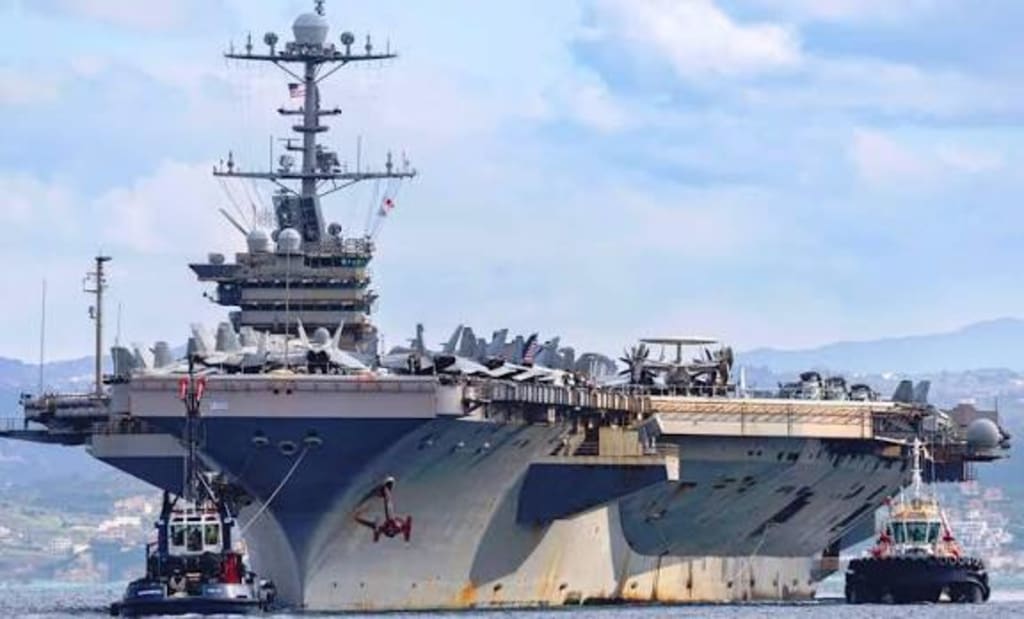
The recent return of the Nimitz-class aircraft carrier USS Harry S. Truman to U.S. waters following an extended deployment has stirred debate in naval strategy circles. Far from a celebratory homecoming, for many in the fleet it’s become a reminder of the mismatch between Cold War-era force structures and the demands of 21st-century warfare. In that sense, the carrier’s return is being seen—by some—as an affront to the navy of the future.
Deployment Intensity and the Return
After sailing more than 20,000 nautical miles on a deployment that spanned operations in the Mediterranean, the Red Sea and beyond, the Truman returned to Norfolk on June 1, 2025. During its tour the carrier logged thousands of flight hours, launched heavy strikes and endured a string of mishaps—from a collision with a merchant vessel in February to the loss of multiple fighter jets. On one level, the Truman’s return is a success story of forward deployment and naval presence. On another, it raises stark questions: at what cost was that presence sustained, and does it reflect the right model for future conflicts?
The Legacy Carrier in a Changing Warfighting Landscape
Carriers like the Truman were designed for large-scale power projection—air wings launching from vast decks, fighter sorties, dominance of the skies. Yet critics argue this model increasingly runs counter to a future defined by long-range missiles, unmanned systems, contested logistics, and anti-access/area-denial (A2/AD) environments. For example, a commentary from the Heritage Foundation noted that with the early retirement of carriers and shrinking availability, the U.S. Navy may struggle to provide sufficient carrier presence when and where needed.
Thus, when the Truman limped home after a punishing deployment, it symbolised more than wear-and-tear. It represented a force structure essentially built for yesterday’s wars—and, by its dilemma, challenged the narrative of “carrier first” for future peer or near-peer conflicts.
Why the Return Feels Like an Affront
1. Resource strain: The Truman’s deployment was extended, it suffered mishaps during its tour, and the maintenance demands on the ship post-return are significant. This places heavy burdens on sailors, logistics chains and budgets. The question then: is this sustainable across the fleet?
2. Capability vs risk: Operating a giant carrier in contested zones invites high‐stakes hazards—not just from conventional threats (missiles, submarines) but from asymmetric attacks, drones and logistics disruption. Some analyses interpret the Truman’s return as a “narrative marker” of the vulnerability inherent in the model.
3. Signal problem: For some within the navy, seeing the carrier return battered and bruised raises a morale and strategic optics issue—rather than projecting invincibility, it projects fragility. That can feel like an affront to the institution that prizes deterrence through strength.
4. Mismatch of strategic demand: With emergent threats focused on long-range precision, cyber warfare, unmanned assets and distributed lethality, the large one-platform-dominant carrier strike group begins to look like a relic. The Truman’s return may serve as a real-world case study that the model is under stress.
The Silver Linings—And Why It’s Not All Doom
It would be unjust to present this as purely negative. The Truman’s return came after what many consider one of the U.S. Navy’s most combat-intensive carrier deployments in decades—including the largest airstrike launched from a carrier. This demonstrates the enduring relevance of carriers in certain contexts—especially when integrated with allies, air power and logistics. Moreover, the deployment’s challenges also serve as lessons for modernization efforts—for damage control, for forward-deployed maintenance and for resiliency in adverse conditions.
Thus, the return isn’t a death knell for carriers—but it is a wake-up call: the navy must either adapt the carrier model significantly or risk operating a force structure misaligned with future war demands.
What Comes Next for the Navy?
Looking ahead, the U.S. Navy faces several key choices:
Distributed platforms: Can the carrier strike group concept evolve into a more distributed network of smaller, dispersed platforms (e.g., unmanned vessels, drone carriers, missile-armed surface ships) that reduce concentration risk?
Enhanced survivability: Should carriers be upgraded with advanced defenses—hard to detect, hard to target—or operate in a lower profile manner?
Role re-definition: Accepting that carriers may not face peer opponents in linear ways, the navy might redefine how and where carriers are used—focusing on littoral operations, network support, command nodes.
Resource reallocation: Some analysts argue capital expenditures might shift toward submarines, missile-launch submarines, unmanned air and sea systems, reducing carrier reliance.
Final Thought: Return as Reflection
In the end, the return of the USS Harry S. Truman is more than a homecoming—it’s a mirror held up to the navy. The ship is a marvel of maritime engineering, its sailors courageous and resilient. Yet the battered state in which it returned and the many risks it encountered reflect a force structure under strain. For a Navy preparing for the war of the future, that matters deeply. If it remains tied to yesterday’s model simply because it is familiar, the carrier return may become not a badge of honour but a cautionary symbol.
Whether the navy embraces the lessons, adapts its model and transforms—that will determine if the carrier is still “queen of the seas” in the next era, or simply a snapshot of what once was.
About the Creator
Fiaz Ahmed
I am Fiaz Ahmed. I am a passionate writer. I love covering trending topics and breaking news. With a sharp eye for what’s happening around the world, and crafts timely and engaging stories that keep readers informed and updated.
Keep reading
More stories from Fiaz Ahmed and writers in The Swamp and other communities.
Pakistan’s Constitutional Reset: The Rise of Field Marshal Asim Munir and the After-math of Operation Sindoor
In a dramatic shift within Pakistan’s governance and military architecture, the federal government has introduced the 27th Constitutional Amendment, which fundamentally rewrites the chain of command of the country’s armed forces and elevates Asim Munir to a constitutionally entrenched apex position. This move follows the shockwaves triggered by India’s Operation Sindoor in May, during which Pakistan’s military faced a debilitating blow that has instigated sweeping reform.
By Fiaz Ahmed 2 months ago in The Swamp
A Russian City Gets a Taste of the Cold Devastation to Ukraine’s Power Grid
As winter tightens its icy grip across Eastern Europe, a stark reminder of the vulnerability of modern infrastructure has emerged—not in Ukraine, where the focus has long been, but in a Russian city now feeling the ripple effects of the conflict next door. Residents in this unnamed city are experiencing firsthand the cold devastation that Ukraine’s power grid has endured during ongoing military hostilities, as blackouts and rolling power cuts disrupt daily life and strain public services.
By Fiaz Ahmed Brohi5 days ago in The Swamp



Comments
There are no comments for this story
Be the first to respond and start the conversation.