
A Pitfall of American Liberalism
From Beer Gardens to Hitler, Trump, and History.

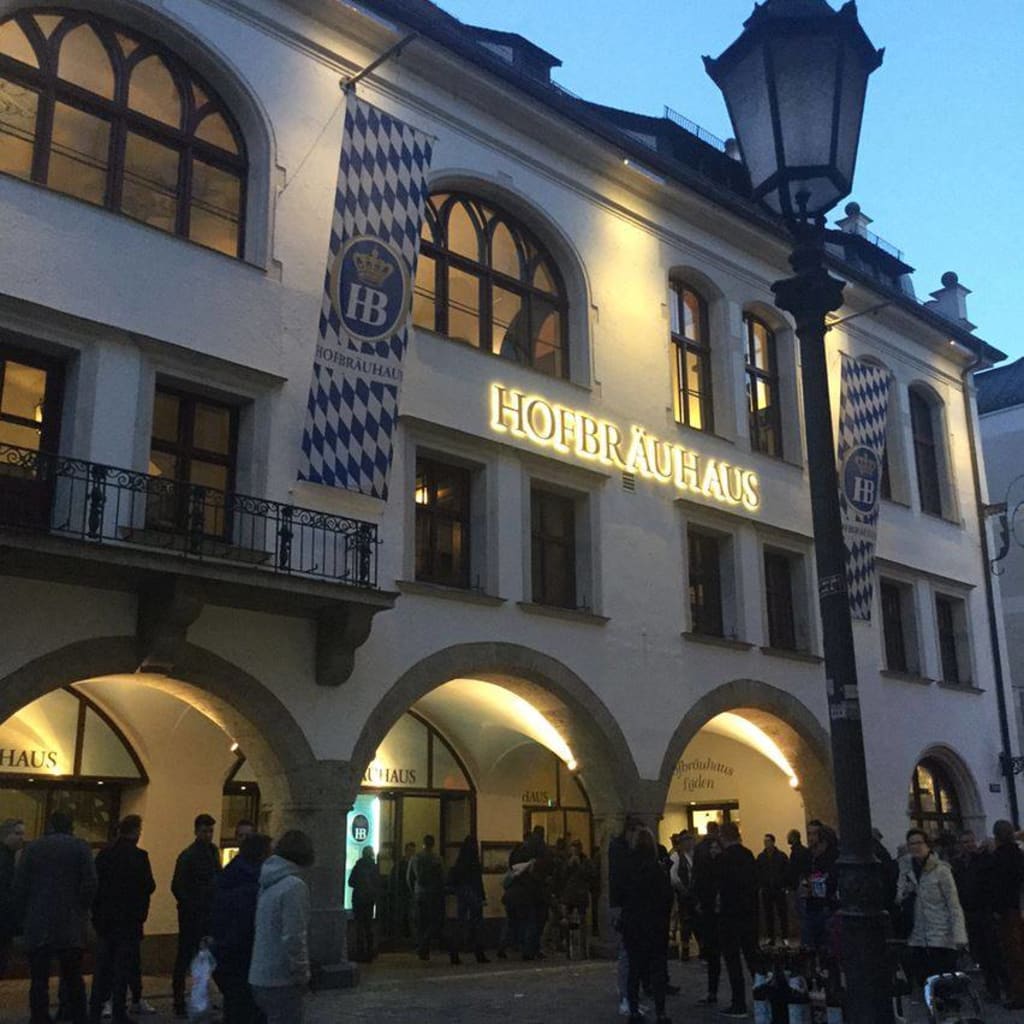
When I first was thinking up this piece, I thought I was going to write about places and memories attached to those places.
While traveling Germany, my family and I stopped in Munich, where we went to one of their oldest beer gardens. At the time, I had just read a recent substantive biography of Adolph Hitler’s early life and political career which, as many may or may not know, began with rousing speeches of nationalist fervor in Munich’s beer gardens. As I drank from the largest beer stein I’ve ever seen, listening to a live Bavarian band play, I could imagine - and in fact desired - debating politics in this cobble stoned courtyard. Mine would be of the leftist variety, but nonetheless, the place held that kind of haunting memory. It wasn’t until after we had left Munich that my wife researched the beer garden (Hofbrauhaus) and discovered it had been the actual location where Hitler gave his most significant early speeches and became the founding center of the Nazi party. Most of the original building was bombed out during the war, but a large metal plaque commemorating his most famous speech there remained standing, and can still be found on the second floor. I understand it as a testament of the German people to recognize their history – the good and the bad – and take back ownership of historical places, instead of suppressing a past and letting it maintain control of their identity.
This was the original topic I wanted to write about.
However, as I was thinking through this article, I was reminded as to what I had taken away from Hitler’s biography. I remembered how, in the last months of Trump’s presidential campaign, and early months of his presidency, many Americans were turning to reading Mein Kampf or similar texts to understand the psyche of our new “great” leader. My belief though, which was also present in the biography, is that while the individual is responsible for their behaviors, it is also up to circumstance that determines who that person will become to history. Both leaders play to the fears of their constituents, but as individuals, they were very different: Hitler being a shrewd politician who listened carefully before tearing apart his opponents with the logic of his ideology (however unjustified it is), and Trump whose lack of political prowess has continued to make itself more and more apparent as his presidency continues (just see analyses of Trump as a “lonely figure” at 2017 G20 Summit). Beyond tallying differences and similarities between their personalities though, I find it much more fruitful to think about the historical conditions that allowed them to prey on people’s emotions and promote political agendas that run counter to almost all conceptions of progress.
Many Americans simply think of World War I as the war before World War II. We learn how the Treaty of Versailles bummed out the Germans, laying the ground for the Nazi party and WWII. What’s not discussed as much is how WWI was the end of empires: Austro-Hungarian, Ottoman, Russian and German, as well as the first hints at decolonization with the League of Nations Mandates, which would eventually end the British and French colonial empires. It was the victory of western style sovereign nation states. This was a time of turmoil, distrust in failing old systems, and fear of unknowable outcomes from new systems. Even though Hitler’s National Socialism was innovative in its use of technological and ideological tools of the time (audio and visual propaganda), its ultimate goal was to re-establish the dominance and power of the German Empire. He used scapegoats (Communists, Jews, gypsies, homosexuals) to motivate and mobilize the most vulnerable populations of the changing times: proud German patriots, butt hurt at losing WWI, scared of communist revolution, suffering from the global “Great Depression” of capitalism, distrusting of the “other”, and nostalgic of a past greatness (whether real or imagined). The empires that would never end had ended.
To some, the similarities between then and now are already obvious. The use of scapegoats (in our case, Mexican immigrants, Muslims, African Americans, liberals, etc.), and the use of modern technology to spread an ideological point of view (Trump’s use of Twitter, as well as the proliferation of “fake news” via the internet). Also, the spread of nationalistic sentiments across the “west” seen in the Brexit vote, Le Pen’s near success and Trump’s “America First” platform appears to mirror the rise of fascist nationalism in post-WWI Spain, Italy, and Germany. But the same as with the turmoil of interwar Europe, we today are living through a time where we’ve lost trust in a current failing system, and must seek answers in the unknowable.
When the Soviet Union collapsed, the west assumed their liberal capitalist victory, with neoliberal democratic global capitalism representing the final iteration of social-political-economic evolution. It is an assumption that has driven most of American and western politics without question… except for those who have questioned it. The anti-WTO riots of 1999 in Seattle, the financial collapse in 2008, followed quickly by the global Occupy movement. These are signs of a system that has failed to resolve its contradictions. The anti-union, global exploitation of labor assumed as normal with neoliberalism has gutted jobs from American industries in favor of non-regulated markets in the global south. Its individualistic economic basis of justice left the deep wounds of American racism untouched after the traumas of a civil rights movement that was imprisoned, assassinated, and placated with marginal and largely symbolic reforms. Even though it’s been shown that strong organized labor is correlated with decreased economic inequality (See Thomas Piketty's Capital), neoliberalism promises deregulation and privatization is the solution, regardless of the scientific evidence otherwise. It’s a classic case of promises made, but the outcomes either don’t appear, or actually seem opposite to what was promised. Buying power has gone down, cost of living has gone up, job security has dropped and further education leaves many far too deep in debt. Corporate exploitation of natural resources has had a significant effect on global climate change. By many accounts, we are on an unsustainable path. The system they assumed won the ultimate victory has been showing its cracks and is now showing structural failure has lost our trust.
But as with 1930’s Germany, failures of the past don’t mean progress for the future. Fear is a powerful emotion, and change can evoke anxiety and fear for many. Those who listened to Hitler and heard him promise a future based on the greatness of the German Empire are not so different from those who raise signs that say “Make America Great Again.” Both groups legitimately suffer from the failings of larger political-economic structures, both exist during periods of systemic change, and have their fears of that change preyed upon for the benefit of a political agenda. We were promised stability, but were given chaos and failure. Germans of the 1930’s were split between taking a radical step towards the left or right, or maintain a path that seemed to be leading towards failure, and ultimately the powerful fear based rhetoric of the Nazi party won out. Americans in 2016 were given only a choice between the hate filled rhetoric of Trump, or the embodiment of neoliberal establishment that was Hillary Clinton. There was a genuine attempt at a more leftist candidate with the Sanders campaign, but the liberal establishment feared the even slightly more radical change he promised, and actively prevented him from popular consideration. Ultimately, again, it was the rhetoric of fear and nostalgia that succeeded.
I don't believe in historical determinism, and I know the limits of analogies. Times have changed. The book, turned film, Guess Who’s Back depicts a situation in which Hitler pops out of a rift in time, dropping him in modern day Germany. In the film, they claim he would have backed the Green party, since its foundation is based on nationalized sustainability and self-sufficiency for Germany, while providing infrastructural jobs for the people… he is of course still racist and genocidal. An entertaining historical “what if?” experiment that demonstrates the importance of context. Yet it is very telling to me that both the conditions and the outcomes between 1930’s Germany and late 2010’s America are remarkably similar.
This is why I don’t find it very helpful to try and understand the “mind” of individuals like Trump or Hitler. Without trying to understand the greater historical movements of the time, just understanding one person feeds into an outdated method of white-male centric great man’s history and provides little fruit of wisdom for how to best address our future struggles. It can be easy to focus on, and even obsess about, the individual, especially when they’re as outrageous as Trump. But with such a narrow focus, we can lose sight of the greater unjust systemic structures that existed before Trump, and on which people like him have benefited. In order to construct a future many of us desire, one in which the solidarity of our collective activity forms a society that promotes free expression of everyone’s full humanity, we must recognize and reconcile our historical failures, using knowledge of our many historical successes to guide us. With a historical consciousness, we can comprehensively combat larger systemic injustices without getting bogged down on a single person.
In the meantime, I will happily debate politics with you over a very large beer.
About the Creator
Bram Barnes
Seattle born, currently living in Aarhus, Denmark, Bram's interests range from traveling, to history, sociology, philosophy and education, to movies, music and video games. He's happily married and expecting their first child.
Keep reading
More stories from writers in The Swamp and other communities.



Comments
There are no comments for this story
Be the first to respond and start the conversation.