
A Neoconservative Anthill
Cartoons from the front lines at Oak Creek Park


Conflicts between ants at your local park aren't very different from human ones - struggles over territory, access to natural resources, and naked animal pride.
Yet, our rhetorical ability to find reasons to keep fighting is strictly human.
Prediction of doom often get the attention of the public.
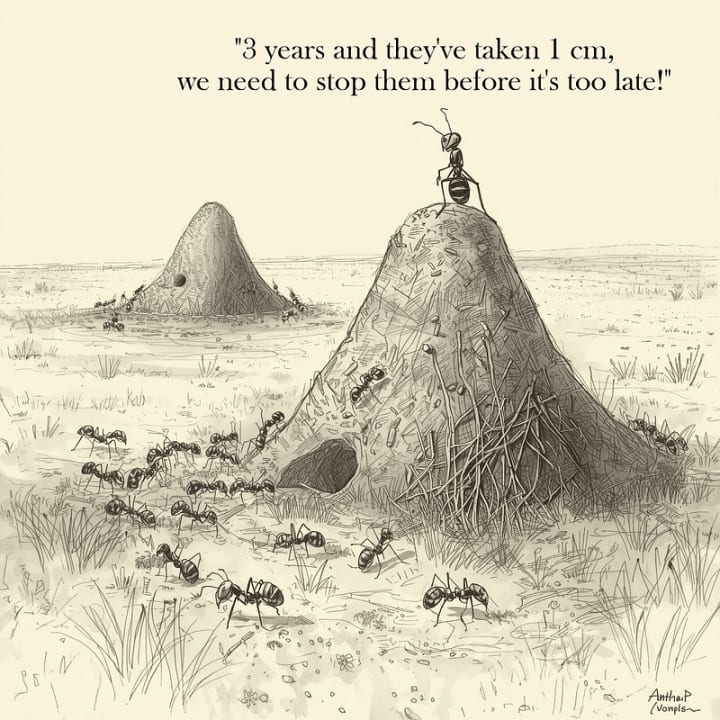
Some ants never want to let other ants have a win, no matter how small.
As animals, we have a tendency to doubt outsiders, searching for cosmetic differences in their accents, skin tones, or social systems instead of looking for similarities. This makes it hard to come to agreements that would be mutually beneficial.

Thanks for having a look! All artwork was created by me with the help of the Leonardo image generation tool.
***
The History of the Neoconservative Movement
Neoconservatism, often abbreviated as "neocon," emerged as a distinctive political ideology in the United States during the 1960s and 1970s. It originated among a group of intellectuals—many former liberals or even ex-Trotskyites—who grew disillusioned with the Democratic Party's leftward shift, the rise of the New Left, and the counterculture's rejection of traditional authority and values. These thinkers, including Irving Kristol, dubbed the "godfather of neoconservatism," Norman Podhoretz, and Daniel Bell, criticized what they saw as the excesses of 1960s radicalism, such as anti-Vietnam War pacifism and permissive social policies. Publications like Commentary magazine, edited by Podhoretz, and The Public Interest, co-founded by Kristol, became intellectual hubs, emphasizing empirical analysis of social programs and a robust anti-communist stance.
The movement's roots trace back to anti-Stalinist leftists who opposed Soviet totalitarianism while supporting civil rights and a welfare state tempered by market principles. Influenced by philosophers like Leo Strauss, who stressed moral clarity and classical political thought, neocons advocated for a strong national defense and skepticism toward utopian social engineering. By the late 1970s, many neocons, such as Jeane Kirkpatrick—famous for her 1979 essay "Dictatorships and Double Standards," which distinguished between authoritarian and totalitarian regimes—shifted to the Republican Party. They opposed Democratic nominee George McGovern's isolationism and aligned with Senator Henry "Scoop" Jackson's hawkish Democrats.
Neoconservatism ascended in the 1980s under President Ronald Reagan, who adopted their anti-Soviet rhetoric, labeling the USSR an "evil empire." Figures like Kirkpatrick (U.N. Ambassador), Richard Perle, and Elliott Abrams shaped policies that increased military spending and supported anti-communist insurgents, contributing to the Soviet Union's 1991 collapse. Domestically, neocons pushed "workfare" reforms to curb welfare dependency, influencing the 1996 welfare overhaul.
Post-Cold War, in the 1990s, neocons criticized President George H.W. Bush's restraint in not toppling Saddam Hussein after the Gulf War and advocated interventions in Bosnia and NATO expansion. Their influence peaked under George W. Bush in the 2000s, particularly after 9/11. The Bush Doctrine of preemptive war and democracy promotion, championed by Paul Wolfowitz and others, led to the 2003 Iraq invasion, aiming to reshape the Middle East. However, the war's quagmire—marked by sectarian violence and high costs—drew sharp criticism for unintended consequences and overreach. Thinkers like Francis Fukuyama distanced themselves, renouncing the label.
In the 2010s, under Barack Obama, neocons' sway diminished, though some like Victoria Nuland held roles. Donald Trump's "America First" populism fractured the movement: some, like John Bolton and Mike Pompeo, joined his administration for hawkish policies on Iran, while others, including Bill Kristol, opposed Trump and backed Democrats like Hillary Clinton in 2016 and Kamala Harris in 2024. By 2025, figures like Marco Rubio, nominated as Secretary of State under a potential second Trump term, blended neocon interventionism with MAGA priorities, such as designating Mexican cartels as terrorists.
Critics accuse neocons of ideological rigidity, excessive militarism, and ties to pro-Israel lobbies, yet the movement endures, adapting to debates over globalism and nationalism. Its legacy lies in reshaping U.S. foreign policy toward assertive idealism, though at the cost of polarizing domestic politics.
About the Creator
Scott Christenson🌴
Born and raised in Milwaukee WI, living in Hong Kong. Hoping to share some of my experiences w short story & non-fiction writing. Have a few shortlisted on Reedsy:
https://blog.reedsy.com/creative-writing-prompts/author/scott-christenson/
Keep reading
More stories from Scott Christenson🌴 and writers in The Swamp and other communities.


Comments (2)
Good evening, my name is Samuel I'm a poet and journalist I would love to read some of your work, and build community would love if you could check some of my work out as well-!
Scott, the comparison of humans to ants is an insult to ants 😜 I can watch these creatures for hours. In truth I do like that you reduced our world to the insects. Because it is truthful.