
15 Things to Know About Charlie Kirk
From Campus Crusader to Conservative Icon — Unpacking the Rise, Rhetoric, and Legacy of Charlie Kirk


In the landscape of American politics, few figures have stirred as much fervent support — or bitter controversy — as Charlie Kirk. Rising to prominence in his late teens, Kirk built an empire without a college degree, founding Turning Point USA and transforming it into one of the most influential conservative youth organizations in the country. With a mix of social media savvy, bold rhetoric, and unshakable loyalty to Donald Trump, he carved out a space where Gen Z and Millennial conservatives could rally against what they saw as the liberal stronghold on America’s institutions.
But Kirk was never just an activist — he was a provocateur, a strategist, a podcaster, and for many, a symbol of the culture wars that defined the 2010s and 2020s. To his fans, he was a fearless defender of liberty and tradition. To his critics, he was a lightning rod for misinformation and division.
Whether you view him as a patriot or a provocateur, understanding Charlie Kirk means understanding a generation of right-wing politics in the digital age. His life, his rise, and ultimately his shocking death in 2025, tell the story of how influence works in 21st-century America.
These are 15 things you need to know about Charlie Kirk — his roots, his rhetoric, his impact, and the legacy he leaves behind.
1. Founder of Turning Point USA
Charlie Kirk burst onto the political scene in 2012 when he launched Turning Point USA at just 18 years old. With a background in student government and public speaking, Kirk understood early on that young Americans were a critical demographic — and one that conservatives were losing. TPUSA was envisioned as a way to reclaim college campuses from what Kirk called the “Marxist left.”
What began as a small operation handing out pocket Constitutions and running Facebook ads quickly ballooned into a multi-million-dollar nonprofit with major influence. With help from conservative donors and media exposure, TPUSA embedded itself in universities across the country, forming campus chapters and hosting flashy conferences. Within a few years, Kirk was sharing stages with high-profile Republicans, and TPUSA was known as the conservative answer to left-wing campus activism.
2. High School Dropout, Political Insider
Kirk’s story is unusual in elite political circles: he didn’t go to an Ivy League school, didn’t intern for a Senator, and never earned a college degree. After briefly attending Harper College in Illinois, he dropped out to focus on TPUSA full time — a decision that set the tone for his anti-academic, anti-establishment persona.
Ironically, despite railing against academia, Kirk became a political insider in record time. Through relentless networking, he gained access to GOP megadonors, think tanks, and media platforms. His lack of traditional credentials became part of his brand — a kind of badge of honor that resonated with conservative audiences who were suspicious of elites. His rise showed that in the modern conservative movement, ideology and media presence often matter more than education or experience.
3. Major Supporter of Donald Trump
Kirk’s star rose in parallel with Donald Trump’s. From the beginning of Trump’s candidacy, Kirk was one of the few young conservatives who embraced the outsider businessman and his populist message. While establishment Republicans wavered, Kirk doubled down. He saw in Trump a reflection of his own style: brash, unfiltered, and anti-status quo.
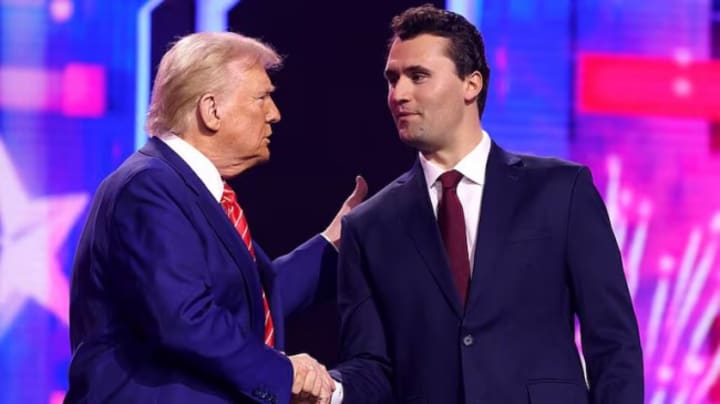
He frequently spoke at Trump rallies, attended White House events, and became a reliable defender of Trump’s policies on cable news and social media. Trump returned the favor, praising Kirk’s work and boosting TPUSA. Their alliance wasn’t just political — it was ideological and generational. Kirk helped package Trumpism for younger audiences, casting it as rebellious, patriotic, and anti-globalist.
4. A Regular on Conservative Media
Charlie Kirk was not just a political activist — he was a media personality. His podcast, The Charlie Kirk Show, became a staple for conservative listeners, offering a daily mix of political commentary, interviews, and cultural hot takes. He also had regular slots on Fox News, particularly on Tucker Carlson Tonight, where he railed against the left’s “cultural dominance.”

What set Kirk apart was his ability to blend traditional conservative values with modern internet flair. He used memes, video clips, and rapid-fire soundbites to spread his message across platforms. While some critics dismissed him as shallow or performative, his media presence was undeniable — and effective.
5. Influencer in the Culture War
Kirk’s bread and butter was the “culture war” — battles over free speech, gender identity, race, and religion. He branded himself as a warrior against political correctness, attacking everything from college safe spaces to Hollywood's "liberal propaganda."

He frequently clashed with professors, activists, and journalists, portraying them as part of a left-wing machine designed to suppress dissent. His events often sparked protests, which only fueled his narrative that conservatives were being silenced. By focusing on cultural issues instead of dry policy, Kirk built a brand that was emotional, polarizing, and viral.
6. Critic of COVID-19 Mandates
During the COVID-19 pandemic, Charlie Kirk took a hardline stance against vaccine mandates, school closures, and lockdowns. He called mask requirements “government tyranny” and claimed public health measures were being weaponized to control citizens. His messaging aligned with a broader anti-lockdown movement that gained momentum on the right in 2020 and 2021.
These views were controversial but resonated with many Americans who felt disenfranchised or skeptical of government authority. Kirk used his platform to amplify doctors who challenged the mainstream narrative and repeatedly questioned the motivations behind CDC guidance. While his critics accused him of spreading misinformation, his supporters praised him for defending individual liberty.
7. Turning Point’s Rapid Expansion
Under Kirk’s leadership, Turning Point USA evolved from a college-centric organization to a sprawling conservative empire. It launched multiple offshoots:
- Turning Point Faith: aimed at mobilizing evangelical Christians
- Turning Point Action: a 501(c)(4) group used for more direct political campaigning
- Turning Point Academy: an educational initiative focused on “patriotic curriculum”
They hosted massive conferences like AmericaFest and Student Action Summit, featuring big names like Donald Trump Jr., Tucker Carlson, and Candace Owens. TPUSA even opened a multimillion-dollar headquarters in Phoenix, Arizona, signaling its shift from grassroots to powerhouse.
8. Ties to Controversial Donors
TPUSA’s meteoric rise was fueled by money — a lot of it. The organization received funding from billionaire conservatives, some linked to the Koch network, the Mercer family, and dark-money groups that rarely disclose full donor lists. This raised questions about how independent the organization really was.
While TPUSA marketed itself as a youth-driven movement, many argued it was a vehicle for corporate and political interests. The group’s nonprofit status also came under scrutiny, as it was accused of engaging in political campaigning in violation of IRS rules. Kirk repeatedly denied wrongdoing but refused to release detailed financial records.
9. Accused of Promoting Misinformation
Over the years, Kirk faced numerous accusations of spreading misinformation. PolitiFact, Snopes, and Media Matters regularly fact-checked his posts and speeches. His social media channels were flagged for false or misleading claims — particularly during the 2020 election and the COVID-19 pandemic.
In some cases, platforms removed his content or labeled it with warnings. This played into his broader narrative that Big Tech was censoring conservatives. Kirk leaned into this controversy, often claiming that the “truth” was being silenced — a stance that further polarized audiences.
10. A Polarizing Figure
There was no middle ground with Charlie Kirk. His supporters viewed him as a bold truth-teller, someone willing to confront the cultural left head-on. To them, he was fearless, principled, and articulate — a modern-day Paul Revere warning of America’s decline.
To his critics, he was a grifter, an opportunist who stoked outrage for clicks and donations. Many on the left (and even some on the right) saw him as lacking intellectual depth, more interested in viral moments than meaningful debate. But this polarization was part of his power — and his business model.
11. Heavily Involved in 2020 Election Disputes
After the 2020 election, Charlie Kirk was one of the most vocal voices questioning its legitimacy. He amplified claims of voter fraud, supported audits in swing states, and promoted the idea that the election had been “stolen” from Trump.

TPUSA helped organize and advertise “Stop the Steal” rallies — some of which preceded the January 6 Capitol riot. While Kirk did not enter the Capitol or explicitly incite violence, he came under fire for fueling the sentiment that the government had betrayed the people. In the aftermath, he doubled down on his claims, framing himself as a victim of a leftist smear campaign.
12. Mentored by Bill Montgomery
Bill Montgomery played a foundational role in Kirk’s career. A former marketing executive and Tea Party supporter, Montgomery met Kirk at a conservative conference and encouraged him to turn TPUSA into a full-fledged movement. He became the organization’s co-founder and served as a behind-the-scenes advisor and strategist.
Montgomery passed away in 2020 from complications related to COVID-19. Kirk described him as a “father figure” and credited him with shaping the values and vision of Turning Point. His death marked a turning point — emotionally and strategically — for the organization.
13. Known for Controversial Quotes
Kirk made headlines time and again for provocative statements. Whether on race, gender, or American history, he often said things that enraged critics and energized fans.
He once said, “There is no systemic racism in America,” prompting fierce backlash.
On immigration, he claimed, “America is for Americans first — not for the world.”
Regarding trans rights, he called it “a cult of gender confusion.”
His defenders argued he was being honest about uncomfortable truths. His detractors said he was fanning the flames of hate. Either way, he knew how to stir the pot — and keep the cameras on him.
14. Built a Massive Online Following
Charlie Kirk understood the internet like a native. He built an enormous online footprint across Twitter (X), YouTube, Instagram, and podcast platforms. His content ranged from snappy hot takes to long-form interviews with Republican politicians, athletes, and culture warriors.
He also harnessed alternative platforms like Rumble and Truth Social, insulating his audience from mainstream censorship. This digital strategy allowed him to bypass traditional media and speak directly to his base — a playbook borrowed straight from Donald Trump.
15. Assassination and Legacy
In a shocking event that stunned the political world, Charlie Kirk was fatally shot in 2025 during a speaking event at Utah Valley University. Officials described it as a politically motivated assassination. The suspect was later identified and taken into custody, though details of the case are still unfolding.
Kirk’s death triggered an outpouring of grief among conservatives and reignited debates over political violence, free speech, and security at public events. To many on the right, he became a martyr — a symbol of how dangerous political discourse has become. To others, his death was tragic but did not absolve the polarizing rhetoric he often employed.
Regardless of political affiliation, Kirk’s influence is undeniable. His brand of media-savvy, hard-right populism reshaped what it meant to be young and conservative in America. The full implications of his legacy — for better or worse — are still being written.
About the Creator
Lawrence Lease
Alaska born and bred, Washington DC is my home. I'm also a freelance writer. Love politics and history.
Keep reading
More stories from Lawrence Lease and writers in The Swamp and other communities.
The Blue Wall That Never Was: How Trump’s 2024 Victory Redrew the Political Map
Donald Trump didn’t just win in 2024 — he reshaped the modern political battlefield. Sure, the headline was 312 electoral votes, but the real story lies beneath the surface. It was how he won — and more importantly, where — that’s left political operatives on the left stunned and scrambling.
By Lawrence Lease11 months ago in The Swamp
Parallel Protests
I haven't written for quite some time, but I have A LOT of thoughts about yesterday's protest rally against our government's involvement and complicity in America's war on Iran, on the harbourside of my home city Bristol, and I need to put them somewhere. My gorgeous girlfriend is always a loving and listening ear and sharing it all with her will always be a healthy and happy way of processing the mental and emotional weight, but getting it straight in my brain to share means writing it all down in straight lines, so, here we are and thanks for being here.
By Steph Cole7 days ago in The Swamp
Seven Countries to Boycott Paralympics Ceremony Over Flag-Flying Russians
Tensions surrounding international sport and geopolitics have once again surfaced after seven countries announced plans to boycott the opening ceremony of the upcoming Paralympic Games in protest against the participation of Russian athletes under their national flag. The decision has intensified an already heated debate over how global sporting bodies should respond to ongoing conflicts and political disputes. Officials from the seven nations — including several European countries that have been strong supporters of Ukraine since Russia’s invasion in 2022 — said they would not attend the opening ceremony if Russian athletes are permitted to compete while displaying national symbols. While the countries did not withdraw entirely from the competition, their symbolic protest aims to pressure international sports authorities to reconsider their stance. The controversy stems from a decision by the International Paralympic Committee (IPC) that allows some Russian athletes to participate under certain conditions. Initially, Russian and Belarusian athletes were banned from many international sporting events following the invasion of Ukraine. However, as global sporting federations reconsidered blanket bans, some organizations began allowing athletes to compete as neutral participants. In this case, critics argue that permitting athletes to appear with national symbols such as the Russian flag undermines the principle of neutrality. They say the move risks politicizing the Paralympics and sending a message that ongoing military actions can be overlooked in the pursuit of sporting inclusivity. Supporters of the boycott say their decision is not directed at individual athletes but at the political symbolism involved. Government representatives from the protesting nations stated that while they respect the dedication and perseverance of Paralympic athletes, allowing Russian competitors to march under their national flag during the ceremony would be inappropriate given the current geopolitical situation. “This is about standing up for the values of international sport,” one official from a participating country said. “Athletes deserve respect, but so do the principles of peace and international law.” Ukraine has been among the most vocal critics of Russia’s participation in global sporting events since the war began. Ukrainian officials have repeatedly argued that Russian athletes should not compete internationally while the conflict continues. The country’s Paralympic committee also expressed disappointment with the IPC’s decision, saying it fails to acknowledge the suffering experienced by Ukrainian athletes and civilians during the war. For the International Paralympic Committee, the issue represents a delicate balancing act. The organization has emphasized that its primary mission is to promote inclusion and ensure that athletes with disabilities can compete at the highest level regardless of political circumstances. IPC officials argue that individual athletes should not be punished for decisions made by their governments. However, the committee also recognizes the sensitivity of the situation. To address concerns, officials introduced restrictions that limit political displays and require participating athletes to comply with rules designed to prevent propaganda or political messaging during the Games. Despite these measures, the boycott announcement demonstrates the deep divisions that continue to affect international sport. The Paralympics, which are traditionally seen as a celebration of resilience, diversity, and human achievement, now find themselves entangled in global political disputes. Sports analysts say the situation reflects a broader trend in which international competitions increasingly become arenas for political expression. From Olympic boycotts during the Cold War to modern disputes over human rights and geopolitical conflicts, sports have often mirrored the tensions of the wider world. Athletes themselves have expressed mixed reactions to the controversy. Some believe that politics should remain separate from sport and worry that boycotts undermine the spirit of international competition. Others argue that sporting organizations cannot ignore global realities, especially when conflicts directly affect athletes and their families. As the Paralympic Games approach, the dispute has created uncertainty about the atmosphere surrounding the opening ceremony. While competitions will proceed as scheduled, the absence of several delegations from the ceremonial event is likely to draw global attention. Ultimately, the controversy highlights the difficult choices facing international sporting organizations. Balancing inclusivity, fairness, and political realities is never simple, particularly during times of global conflict. Whether the boycott leads to policy changes remains unclear, but it underscores how closely the world of sport is tied to the broader geopolitical environment.
By Fiaz Ahmed 5 days ago in The Swamp
Guard Your Battery
Why are some people so attractive just by standing there? It’s not because they are "likable," but because they don’t need everyone to like them. I realized later that truly charismatic people allow themselves to be criticized, but they never criticize themselves. They never try to please the world; instead, the world stops to watch them.
By Emily Chan - Life and love sharing7 days ago in Poets



Comments
There are no comments for this story
Be the first to respond and start the conversation.