
Understanding AI Sentiment Analysis: Unveiling Emotion in Data
How AI Sentiment Analysis Transforms Emotions in Text into Business Intelligence and Social Insight
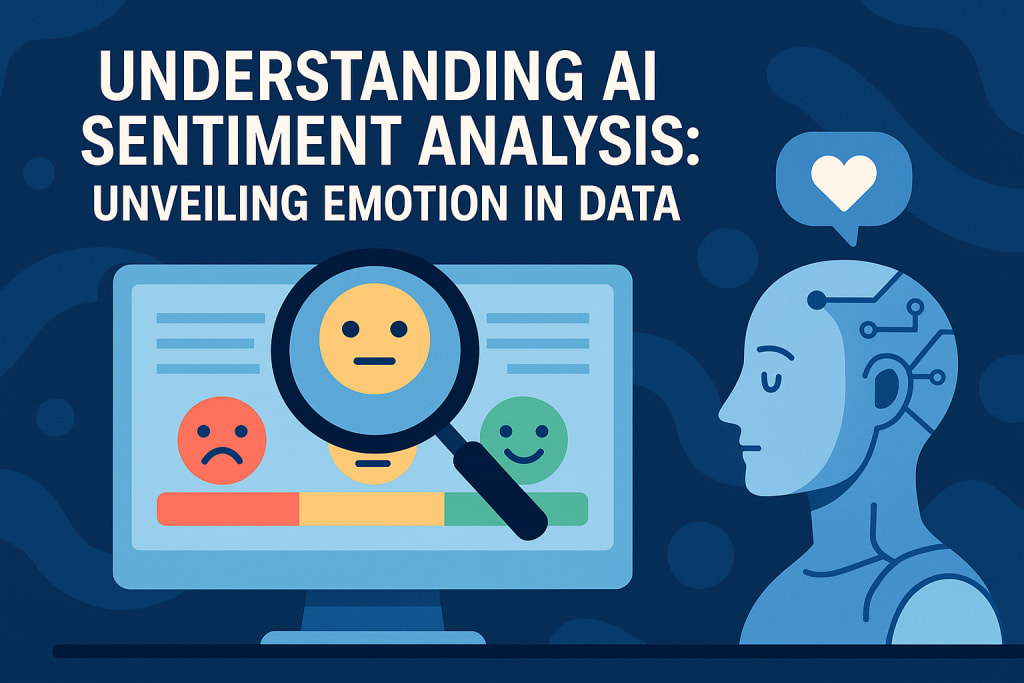
Human emotion drives much of our behavior: the way we connect, shop, react to stories, or even vote. Behind all that emotional response lies a data world—millions of words, posts, reviews, tweets, comments—all ripe with sentiment. Enter AI sentiment analysis: the technology that can read, interpret, and quantify how people feel, at scale. From businesses analyzing customer opinions to researchers studying public mood, AI sentiment analysis transforms plain text into valuable emotional insight.
In this article, you’ll learn what AI sentiment analysis is, how it works, its real‑world uses and challenges, and how to approach it thoughtfully—and ethically.
What Is AI Sentiment Analysis?
Simply put, AI sentiment analysis refers to using machine learning and natural language processing to determine the emotional tone behind text. It doesn’t just detect words like “happy” or “sad,” but understands context, polarity (positive/negative), and strength of emotion.
At its core, it classifies text into categories:
- Positive sentiment
- Negative sentiment
- Neutral sentiment
Beyond that, some systems break sentiment down further—identifying emotions such as anger, joy, fear, or surprise. AI sentiment analysis allows organizations to process massive volumes of data far faster and more systematically than human readers ever could.
How Does AI Sentiment Analysis Work?
To produce accurate results, AI sentiment analysis typically involves several steps:
Data Collection & Preprocessing
Raw text must be cleaned: stripping HTML, removing irrelevant metadata, fixing typos, handling emojis, splitting into tokens (words/phrases).
Feature Extraction
The AI transforms words into numeric representations: traditional methods like bag-of-words and TF-IDF, or modern techniques using word embeddings (Word2Vec, GloVe) and contextual models (BERT, RoBERTa).
Model Training
Labeled examples—text tagged with sentiment—train classification algorithms. Models may be logistic regression, support vector machines, or deep learning networks like transformers.
Sentiment Scoring
The trained model processes new text, generating a sentiment score or label: e.g., +0.8 score for very positive, –0.2 for slightly negative.
Aggregation & Insight
Results aggregate across documents, time periods, user groups, or topics to surface trends—daily sentiment, comparison of brands, or the emotional trajectory of a marketing campaign.
Use Cases: Where AI Sentiment Analysis Adds Value
Brand Monitoring & Customer Feedback
Businesses harness AI sentiment analysis to monitor brand reputation. Millions of online reviews, social media posts, and survey comments can be analyzed to catch rising dissatisfaction or praise. Real-time monitoring lets teams act fast—addressing negative feedback before it spreads.
Social Listening & Market Research
Using sentiment analysis to follow conversations—on Twitter, forums, blogs—reveals consumer mood about products, events, or political issues. Researchers track shifts in public opinion, detecting emerging stories or crises.
Support Automation & Routing
Customer support systems use AI sentiment analysis to triage tickets. Urgent negative messages can be flagged and rushed to high-priority queues, while positive comments might be used in marketing or testimonials.
Financial Markets & Trading
Analysts apply sentiment analysis to news headlines, tweets, and blogs to predict market movements. Sudden surges of negative public emotion around a company or industry may signal potential risk.
The Advantages of AI-Based Sentiment Evaluation
- Scalability: Processes thousands or millions of messages instantly.
- Consistency: Uniform evaluation criteria avoid human bias variability.
- Speed: Real-time dashboards let decision-makers act quickly.
- Deeper Insights: Sentiment trends, emotion intensity, and topic-specific breakdowns add rich layers beyond simple survey scores.
Limitations and Pitfalls
Of course, AI sentiment analysis is no magic bullet. It faces real challenges:
Sarcasm & Irony
Text like “Great, this product broke again. Love it.” misleads—keywords like “love” appear positive, but the tone is negative. Sarcasm still trips up many systems.
Ambiguity & Context
Short texts—tweets or reviews—often lack context. Words like “sick” may be negative (“I’m sick”) or positive slang (“That’s sick!”), and correct interpretation depends on broader context.
Domain-Specific Language
Travel reviews, financial news, medical forums—they each contain specialized vocabulary. A model trained on movie reviews may misread technical jargon or industry slang.
Language & Cultural Nuance
Sentiment expressions vary across languages and cultures. Translate a phrase literally, and the subtle emotional tone may vanish. Effective AI sentiment analysis supports localization.
Ethical Considerations
Privacy matters. Analyzing personal posts without consent breaches trust. Sentiment analysis must respect data ownership, transparency, and regulatory compliance like GDPR.
Building Your Own AI Sentiment Analysis Pipeline
If you’re thinking of implementing sentiment analysis yourself, here’s a blueprint:
1. Define Your Objective
Why do you need sentiment insight? Is it for customer satisfaction? Sales lead generation? Public relations monitoring? Your goal guides design.
2. Collect & Label Data
Gather representative text samples. Use manual annotation or crowd‑sourcing to label sentiment. A balanced, high‑quality labeled set is critical for accuracy.
3. Choose Your Model
Lexicon-based: relies on pre-defined dictionaries of sentiment terms. Simpler but limited.
Traditional ML: TF‑IDF + classifier offers reliable baseline.
Deep learning / transformers: state-of-the-art for nuance, but requires more resources and training data.
4. Train & Validate
Split your data into training, validation, and test sets. Track metrics like accuracy, precision, recall, and F1‑score. Test performance on unseen data.
5. Handle Domain Adaptation
If your domain is niche—legal forums, healthcare reviews, finance—fine‑tune your model on domain-specific labeled data to maintain accuracy.
6. Deploy & Monitor
Integrate into analytics dashboards or support pipelines. Monitor drift: if sentiment patterns or vocabulary change over time, retraining is essential.
7. Address Ethical & Privacy Concerns
Inform users when analyzing public posts. Use anonymized data. Comply with local laws and industry guidelines.
Real‑World Examples: Companies Leveraging Sentiment Analysis
- Retail & E‑commerce: A fashion brand processes product reviews and social posts to detect dissatisfaction early—identifying delivery issues before public complaints escalate. A sudden rise in negative sentiment triggers an alert to customer service.
- Hospitality: A hotel chain runs sentiment analysis on guest reviews across Yelp, Booking.com, and TripAdvisor. They identify recurring negative themes—e.g., slow check‑in—and make process improvements.
- Media & Journalism: News outlets monitor public commentary on articles. Sentiment analysis helps editors understand reader reaction and adjust coverage or tone accordingly.
- Finance: Trading firms use sentiment data dictionaries to pick up breakout public sentiment swings—such as around regulatory announcements or earnings calls—and feed that into trading models.
Best Practices for Effective AI Sentiment Analysis
- Keep the human in the loop: Periodically sample and review outputs to catch misclassifications.
- Use explainable AI: Highlight key phrases influencing sentiment decisions to ensure transparency.
- Refine lexicons or embeddings: Continuously expand vocabulary lists to cover new slang or domain terms.
- Combine with topic modeling: Sentiment by topic offers deeper insight (e.g. sentiment around price vs. sentiment around service).
- Visualize results: Dashboards showing sentiment over time, distribution by segment, or geographic variation help stakeholders quickly act.
Emerging Trends in AI Sentiment Analysis
AI sentiment analysis continues evolving:
Multimodal Sentiment Detection
Beyond text, technologies now incorporate voice tone, facial expression, and imagery. For example, analyzing video reviews or social media stories that blend visuals and speech.
Emotion Intensity Scoring
Instead of simple positive/negative, modern systems measure emotional strength: “slightly pleased” vs. “ecstatic.”
Real‑time Conversational Tools
Chatbots now analyze sentiment mid‑conversation—shifting tone or style, escalating if frustration is detected.
Cross‑cultural & Multilingual AI
More models now support sentiment detection in dozens of languages—including low‑resource ones—with cultural nuance built in.
Privacy‑Preserving Analysis
Techniques like federated learning and on‑device processing let companies analyze sentiment without centralizing sensitive text.
Common Challenges and How to Overcome Them
- Dataset bias: If training data overrepresents one demographic or one tone, predictions may skew. Mitigate by curating diverse, balanced datasets.
- Evolving language: New slang or cultural references emerge weekly. Stay updated by retraining with current data.
- Misinterpretation of sarcasm: Enhance performance by layering sarcasm detection modules or using smaller neural‑net classifiers specialized on irony.
- Noisy input: Social media text is often messy—abbreviations, emojis, misspellings. Clean carefully and handle informal language in preprocessing.
Measuring ROI: Is AI Sentiment Analysis Worth It?
To justify investment, consider:
- Time saved: Automating sentiment ratings on thousands of posts saves hours of manual review.
- Actionable alerts: Early detection of negative sentiment allows faster response—reducing churn or PR issues.
- Strategic insight: Discovering emotional trends around a campaign or product launch can shape decisions and marketing strategy.
- Customer satisfaction boost: Identifying pain points through sentiment analysis and addressing them improves net promoter scores over time.
Tools and Platforms to Get Started
Although you’re not limited to these, there are well-known services and libraries:
- Open-source libraries: NLTK, TextBlob, Hugging Face's transformers (e.g., fine‑tuning BERT for sentiment).
- Cloud APIs: Google Cloud Natural Language API, Microsoft Azure Text Analytics, Amazon Comprehend, IBM Watson Natural Language Understanding—each offers sentiment scoring out of the box.
- Specialized platforms: Tools like MonkeyLearn or Lexalytics let you build custom sentiment workflows without deep coding.
When choosing a tool, evaluate:
- Accuracy in your domain
- Support for the languages you need
- Privacy or data‑retention policies
- Customization and explainability features
- Cost relative to volume and scale
Ethical Considerations and Responsible Use
As sensitive as it is powerful, AI sentiment analysis should be used responsibly:
- Consent: When analyzing private posts or forums, ensure users have given permission.
- Anonymization: Strip personally identifiable information (names, contact details).
- Bias awareness: Watch for demographic or cultural bias in model behavior. Test across groups.
- Transparency: If people’s sentiment drives decisions—like credit scoring or hiring—make systems explainable.
- Compliance: Align with laws like GDPR (EU), CCPA (California), or India's PDP law when handling user data.
Future Outlook: What Lies Ahead?
More Context‑Aware AI
Future AI sentiment systems will better understand wider context: conversation threads, historical customer interaction, cultural framing.
Emotional Intelligence in Chatbots
Customer service bots will interpret tone and adapt: calming a frustrated user or engaging an excited one with enthusiasm.
Cross‑Modal Sensors
Wearable devices also analyze physiological signals—heart rate, skin conductance—as emotional indicators alongside text.
Standardization and Ethics Frameworks
Industry-wide standards and certifications are emerging to ensure ethical AI practices in sentiment analysis—guarding user privacy and mitigating bias.
Conclusion
In an age of abundant opinion and emotional expression online, AI sentiment analysis offers a lens that turns raw text into actionable insight. When built and used thoughtfully, it empowers brands to respond to customer needs, researchers to understand public mood, and organizations to track emotional impact at scale.
At the same time, success demands attention to nuance, context, and ethical use. Bias, sarcasm, domain‑specific language—all pose challenges. Balancing automation with human validation, and clarity with privacy, is critical.
Whether you're a marketer, analyst, developer, or journalist, embracing AI sentiment analysis means unlocking new understanding of how people feel—and why that matters.
About the Creator
Keep reading
More stories from Siddarth D and writers in The Chain and other communities.
Tokenized U.S. Treasury‑Backed Yield‑Bearing Stablecoins: The New Face of DeFi Safety?
In the evolving world of decentralized finance (DeFi), yield bearing stablecoins backed by tokenized U.S. Treasury securities are emerging as a secure and reliable option for investors. Unlike traditional stablecoins that simply track the dollar, these innovative assets generate passive income by leveraging interest from short-term government debt. As market participants seek both stability and yield, this new class of stablecoins offers a compelling alternative—combining the trust of U.S. Treasuries with blockchain transparency. Could this be the long-awaited solution to DeFi’s safety dilemma? Let’s explore how they work and why they matter now more than ever.
By Siddarth D6 months ago in The Chain
Crypto Wallets: The Complete Guide to Securely Storing Digital Assets
Introduction: Why Crypto Wallets Matter More Than Ever Crypto wallets are the backbone of the digital asset economy. Whether you trade daily, invest long-term, or simply hold Bitcoin and altcoins, your crypto wallet determines how safely and efficiently you control your funds. Unlike traditional banks, crypto puts you in charge. That freedom also comes with responsibility.
By saif ullah4 days ago in The Chain




Comments
There are no comments for this story
Be the first to respond and start the conversation.