
Tokenized U.S. Treasury‑Backed Yield‑Bearing Stablecoins: The New Face of DeFi Safety?
How yield bearing stablecoins backed by U.S. Treasuries are redefining safety, transparency, and yield generation in decentralized finance.
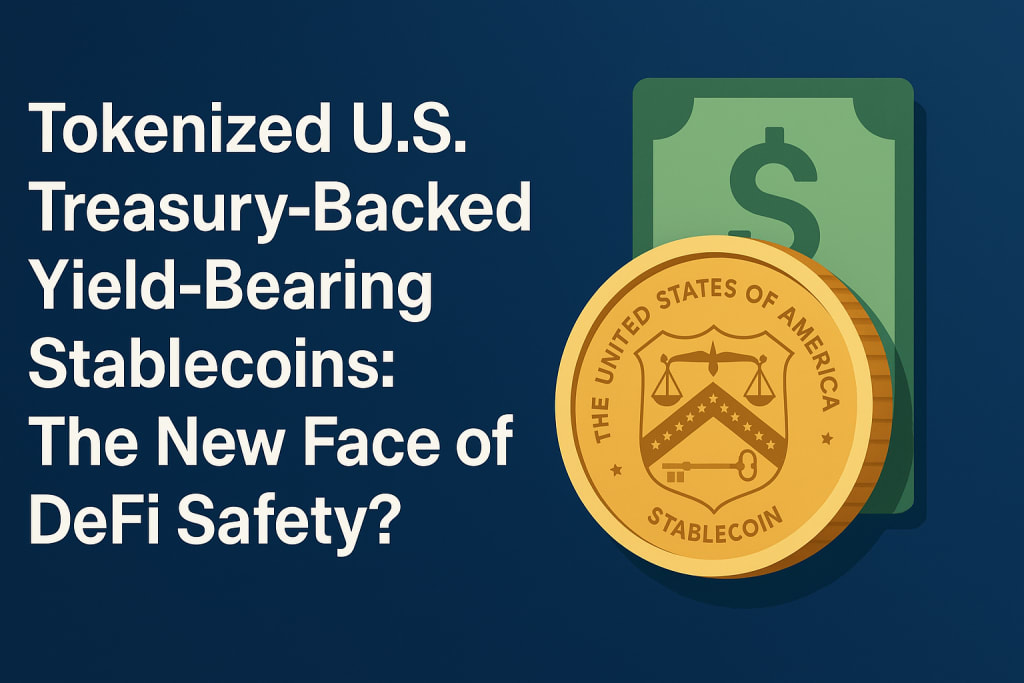
In the evolving world of decentralized finance (DeFi), yield bearing stablecoins backed by tokenized U.S. Treasury securities are emerging as a secure and reliable option for investors. Unlike traditional stablecoins that simply track the dollar, these innovative assets generate passive income by leveraging interest from short-term government debt. As market participants seek both stability and yield, this new class of stablecoins offers a compelling alternative—combining the trust of U.S. Treasuries with blockchain transparency. Could this be the long-awaited solution to DeFi’s safety dilemma? Let’s explore how they work and why they matter now more than ever.
DeFi’s safety challenge and the rise of on‑chain yield
Within decentralized finance, there’s a persistent tension: the appeal of high yield versus the risk of unstable collateral or protocol failure. Traditional stablecoins—though pegged to fiat—often rely on uncollateralized mechanisms or crypto over‑collateralization. Yield bearing stablecoins backed directly by tokenized U.S. Treasuries claim to solve both concerns: preserving capital while generating reliable return.
How tokenized Treasury-backed stablecoins work
At the core, these stablecoins are minted by depositing U.S. Treasury securities—or cash held in government money market instruments—into a regulated custodian. A smart contract issues tokens pegged 1:1 to USD value, while on-chain yield accrues from interest on Treasuries, distributed pro rata to holders. The stablecoin’s smart contract bundle typically manages redemption and interest distribution automatically.
Key components:
- Custodial vault holding the underlying Treasury notes.
- Smart contract minting and burning tokens.
- Interest‑distribution mechanism (daily, weekly, monthly).
- Transparency and on‑chain proof of reserves.
- Yield comparison: Treasury yield vs. crypto lending
The yield from tokenized U.S. Treasury‑backed stablecoins aligns with short‑term Treasury rates—typically the 3‑month or 6‑month T‑bill yields, or yields from ultra‑short government money market funds. In 2025, 3‑month T‑bill yields have ranged between approximately 4.5–5.5% APY. This compares favorably to crypto lending platforms offering variable returns—but often with hidden risk, volatility or loss potential.
Unlike protocols issuing double‑digit yields via secondary token emissions or reinvested leverage, Treasury‑backed stablecoins deliver predictable, audited return without impermanent loss or token price collapse risk.
Regulatory certainty and custody structure
Regulation matters prominently. The custodial structure is typically operated by regulated trust companies or banks. The underlying assets—U.S. Treasury securities—are among the safest in financial markets, backed by the U.S. Government. Custodian banks must segregate client funds, maintain audited reserves, and meet regulatory capital requirements. In case of protocol failure, token holders can redeem pro rata from the vault.
This contrasts with algorithmic or crypto‑collateralized stablecoins that may rely on fictitious reserves or unregulated counterparties.
On‑chain transparency and proof of reserves
A hallmark of trustworthiness in DeFi is a clear audit trail. Tokenized Treasury stablecoins often publish:
- On‑chain proofs showing wallet addresses holding Treasury tokens.
- Public audits or attestations verifying custody and balances.
- Block‑explorer‑based real‑time tracking of circulating supply and reserves.
- This level of transparency reduces dependency on opaque custodians and mitigates concerns common to centralized stablecoin issuers.
Risks and limitations of Treasury‑backed models
Although stable and regulated, these stablecoins are not risk‑free:
- Interest rate risk: When yields fall, APY drops accordingly.
- Liquidity risk: Redemption depends on availability of buyers and treasury liquidity—extreme market stress may slow down minting/burning.
- Counterparty and custody risk: If custodian fails, recovery may be delayed.
- Regulatory changes: U.S. or securities regulations, including money services laws, could impact operations or require licensing.
- Potential limitations include KYC requirements, geographic restrictions (e.g. availability to U.S.‑based investors only), and slower transaction times or higher fees compared to purely crypto‑native stress‑test ecosystems.
Attractive use cases and user profiles
Risk‑averse capital preservation
Users looking for principal safety in DeFi, with modest yield, find Treasury‑backed models appealing. They combine U.S. government credit with blockchain efficiency, ideal for treasury management, corporate liquidity, or conservative crypto users.
Regulated DeFi entry point
Institutional onboarding into DeFi often requires familiar, regulated exposures. Tokenized Treasury stablecoins bridge traditional finance and blockchain—for banks, corporates, or regulated funds wanting stable floating yield on‑chain.
Collateral for DeFi protocols
Stablecoin holders can use tokenized assets as collateral in lending, yield‑farming, or liquidity pools. Since the collateral asset is stable and yields interest, borrowing capacity and risk models become more robust and less volatile.
Risks from smart‑contract or protocol failures
Even when the asset backing is safe, vulnerabilities in smart contracts or treasury token wrappers could expose holders to exploits. Because yield‑bearing stablecoin platforms rely on code to distribute interest and manage redemptions, audit quality matters. Bugs or hacks could delay redemption or lock funds. Token‑holders remain exposed to smart contract risk, though underlying value stays anchored.
Market players and examples
Several platforms (as of mid‑2025) offer tokenized yield‑bearing stablecoins:
- Platform X issues tokens fully backed by U.S. Treasury bills, distributed weekly interest tied to the money‑market fund performance.
- Platform Y leverages settlements via custodian banks, offering daily accrual and redemption functionality on major chains.
- Platform Z integrates with DeFi lending protocols, enabling users to deposit tokenized Treasury stablecoins to earn additional yields via liquidity provisioning.
Each platform emphasizes proof of reserves, regulator oversight, and automated redemption. They also differ by redemption fees, yield compounding frequency, and supported blockchains.
Governance and decentralization concerns
Most Treasury‑backed stablecoin platforms lean toward centralization: they rely on administrators, trusted custodians, and traditional bank infrastructure. Governance models tend toward technocratic or foundation‑run frameworks—not fully decentralized DAOs. Users must trust the custodian, the off‑chain institutions, and the identities behind the protocol. True decentralization in such models remains limited due to compliance and legal constraints.
Audits, compliance, and counterparty transparency
Reputable providers publish regular third‑party audits confirming Treasury holdings, yield generation logic, and collateral sufficiency. Many engage top audit firms to attest both on‑chain smart contract integrity and off‑chain custody compliance. Some even provide real‑time or frequently updated snapshots of the custodial bank statements, enhancing accountability.
Compliance extends to AML/KYC processes—users typically verify identities before minting. This increases legal safety but limits anonymity in DeFi.
Yield mechanics and investor distribution
Yield distribution models vary:
- Direct yield accrual: interest credited to token balances continuously or daily.
- Periodic distribution: yield paid every week or month as brand‑token or USD‑pegged rewards.
- Compounded staking model: users lock tokens in staking contracts to auto‑compound yield.
Most platforms provide gas‑efficient auto‑claiming or reinvestment. Some even combine with protocols offering additional incentives—e.g., reward tokens, loyalty points, or reduced fees.
Integration with broader DeFi ecosystem
Tokenized Treasury stablecoins act as reliable collateral in platforms like lending markets, automated market makers, and yield aggregators. Given their low volatility and on‑chain yield, they serve as stable base assets in yield strategies. Protocols can accept them as collateral with lower liquidation thresholds relative to crypto‑volatile stablecoins.
Cost structure and fee models
Platform fees influence net yield:
- Redemption fee: a small percentage (e.g. 0.1–0.5%) when burning tokens.
- Management fee: percentage of yield (0.2–1% APY) that covers custody and operations.
- Minting fee: nominal or zero for issuance.
- Spread: slight difference between mint and redemption price may introduce slippage cost.
Most yield projections are quoted net of fees—but users should verify. Lower fee models yield better returns, but transparency on fee structures is key.
Tax and accounting implications
From a U.S. tax standpoint, yield on tokenized Treasury stablecoins may be treated akin to interest income—subject to ordinary income tax rates. Institutional users must account for interest accrual rather than capital gains. Non‑U.S. users should check local taxation of interest through crypto holdings. Platforms may issue tax statements reflecting yield paid.
Usability, wallets and redemption flow
Typical user flow:
- Complete KYC/AML identity verification.
- Deposit USD or stablecoins to mint tokenized T‑bill stablecoin.
- Hold tokens in qualified wallet (Metamask, hardware wallet, etc.).
- Interest accrues automatically or is claimable.
- Redeem tokens for USD or underlying asset at any time (subject to redemption windows or fees).
- Withdraw funds from custodial account.
Cross‑chain compatibility varies: some providers support Ethereum, Avalanche, Solana, Polygon—plus bridges between chains.
Comparing with other stablecoin models
- Fiat‑backed stablecoins (USDC, USDT): rely on bank deposits or commercial paper, not long‑term government securities. Interest on those reserves is low and firms monetize yield before distributing to holders.
- Crypto‑collateralized stablecoins (DAI, UST-era): over‑collateralize high‑volatility crypto assets, exposing users to price swings and liquidation risk.
- Algorithmic stablecoins: use rebases or governance tokens to maintain peg but suffer extreme volatility and collapse risk.
In contrast, yield bearing stablecoins backed by U.S. Treasuries offer transparent, government‑grade collateral and deterministic yield.
Who benefits most
- Institutions seeking regulated exposure to DeFi yield.
- Conservative DeFi users building liquidity buffers or capital preservation strategies.
- Yield strategists looking for stable base asset with moderate yield.
- Developers designing protocol rails or vaults using stable, interest‑bearing tokens.
What to watch for long term
- Changes to the U.S. Treasury yield curve (rate shifts directly affect APY).
- Evolving regulation around tokenized securities and stablecoins.
- Smart contract innovations to decentralize custodial logic.
- Expansion to other government debt markets (e.g. EU sovereign debt tokens).
- Integration into more DeFi ecosystems and layer‑2 chains.
Final perspective: is this the new face of DeFi safety?
Tokenized U.S. Treasury‑backed yield bearing stablecoins represent a compelling hybrid: fixed‑income reliability meets blockchain transparency. They dramatically reduce counterparty and volatility risk compared with crypto‑native stablecoins, while delivering programmatic yield in a DeFi compatible token. For users prioritizing safety and predictable return, they offer a new paradigm.
Yet, they don’t eliminate risk entirely: users still depend on custody infrastructure, regulatory clarity, and the integrity of smart contracts. And yields—while solid—are not ultra‑high. This model isn’t for yield‑chasing speculators, but for those seeking a DeFi alternative to money‑market accounts or Treasury funds.
As DeFi matures, these treasury-backed instruments may become foundational trust‑anchors. Over the next months and years, expect tighter integrations, regulatory scrutiny, and broader adoption. Yield bearing stablecoins backed by U.S. Treasuries could indeed be the new safety standard in decentralized finance.
About the Creator
Keep reading
More stories from Siddarth D and writers in The Chain and other communities.
The Rise of AI in Portfolio Management: How Intelligent Automation is Reshaping Investment Strategies in 2025
In the rapidly evolving landscape of finance, AI in portfolio management has emerged as a transformative force. Investors, fund managers, and financial advisors are increasingly turning to intelligent algorithms and machine learning systems to streamline decision-making, enhance performance, and reduce risk. In 2025, the integration of advanced AI tools represents a paradigm shift—steering portfolios toward more precise, data-driven strategies while maintaining the human insight essential to navigating market complexity.
By Siddarth D6 months ago in The Chain
Blockchain in Intellectual Property: How It’s Changing Ownership, Protection, and Licensing
Introduction Intellectual property (IP) is one of the most valuable assets in the modern economy. From music, films, and books to patents, trademarks, and software code, creators and businesses rely on IP laws to protect their work. However, traditional intellectual property systems are often slow, expensive, and difficult to enforce—especially in the digital age.
By saif ullah4 days ago in The Chain
Is Bitcoin a Good Investment? A Clear, Honest Look
Introduction Is Bitcoin a good investment? This question has been asked by beginners, professionals, skeptics, and institutions alike. Some see Bitcoin as the future of money. Others see it as risky and unpredictable. The truth lies somewhere in between.
By saif ullah5 days ago in The Chain
Ludacris and Nelly draw backlash over bookings at MAGA-coded music festival
Ludacris and Nelly headlining a mostly right-wing event is good for them. It’s also great for the genre of hip hop. The two rap veterans have showcased their talents on other stages. Why can’t they perform for mostly MAGA folks and grab that bag?
By Skyler Saunders5 days ago in Beat




Comments
There are no comments for this story
Be the first to respond and start the conversation.