
Stock Trading - Entry 38
How Augusta ADA King captured my investor eye


In the romper room (AKA the blockchain sphere/ecosystem/wild west), I considered other blockchains to add to my portfolio. Note that I am not dispensing financial advise here. In this article, I outline what went through my mind based on my own situation to determine whether or not to invest in Cardano (token symbol ADA).
Why Bother with Cardano?
Continuing with what seems to be my new tradition, I will frame my thoughts using the 13 questions I developed to analyze a blockchain from a micro-investor perspective (first outlined in entry 16).
1. Is "puzzle processing time" actually useless to the running of the blockchain?
Cardano comes pre-mined, so no puzzle processing time is needed.
2. Has the "puzzle processing time" been converted into something useful for...well...anything outside of the blockchain?
This is not applicable given that Cardano also uses Proof-of-Stake (specifically the Ouroboros system).
3. How does the blockchain's use case (which has real-world/analogue applications) impact the general technology requirements of a node?
Apparently, Cardano is fairly energy efficient, especially when stacked up against other blockchains. That makes sense based on my answer to Question 2 (above).
4. What is the optimal supply limit for the blockchain and what happens when that is reached?
Cardano has a capped limit of 45 billion units, but not all are accessible to the market. Many speculate over why there are so many more ADA tokens than BTC, but if it allows for lots of applications in its ecosystem, that's a good enough explanation for me.
5. What happens to tokens that are simply lost (like a penny falling into the ocean)?

Host a funeral cuz they be gone! The exception, apparently, is being able to recover tokens sent to the wrong network. Details on that can be found here.
6. How is the blockchain structured from an economics/business standpoint?
According to this article, Cardano is all about smart contracts and smart applications. In other words, it aims to facilitate decentralized finance (DeFi) as well a non-fungible tokens (NFTs).
7. Can the parameters of the blockchain be changed after-the-fact?
As it turns out, Caradano has done hard forks in the past - supposedly as part of its pre-planned evolution - although the ADA token hasn't been replaced during any fork. According to this article, it looks like token-holders will be allowed to vote. So, in short, yes.
8. What is or can be used to form/drive the value of the blockchain?
From what I gather at this point, it can be investor sentiment, companies who want to make use of the Cardano blockchain ecosystem for smart apps and smart contracts, or a mix of both. What sets Cardano apart, according to this article, is it can open up its ledger a bit for external verification (who and why). It is too difficult for me at this point to make direct links between the token's monetary value and things external to the blockchain's design.
9. Given the value drivers, how can the principal profiteers of a blockchain profit from the blockchain?
From what I gather, the principal profiteers are the remaining initial movers (Cardano Foundation, Input Output Global, and Emurgo), miners, and investors. The initial movers, should they remain whales (those who own more than 1% of a blockchain's tokens) will be well-positioned to capitalize on any value driver (in other words, any answer to Question 8 (above)). What I would like to know is why any original profiteer would ever want to give up their stake in that (pun intended, but I still wanna know).
10. Who/what is the competition, if any?
Ethereum and Solana are the closest competitors. According to this comparison against Solana, Cardano offers greater validation in exchange for speed. Both Solana and Cardano, however, are substantially cheaper to use than Ethereum. According to this comparison against Ethereum, Cardano offers no inflation.
11. Which parties benefit from creating demand for computer hardware used in nodes? What are the intents of those parties?
Not applicable given my answer to Question 2 (above).
12. Would anything to do with the blockchain be worth regulating for the benefit of any party?
Third-party regulators would literally have to dictate what happens in the Cardano smart app ecosystem, particularly with setting exchange rate limits. Also, based on my answer to Question 8 that exposed how Cardano offers users to share info, regulators could choose to recognize only certain smart apps and smart contracts. I am not sure what such a policy suite would look like since that would be cutting edge for most governments (at the date of publishing this article).
13. Imagine the blockchain was a feat of social engineering (AKA grand scale manipulation). What would that hidden objective be?
Since Cardano was apparently created by a disagreement an Ethereum co-founder had who basically ended up saying, "Screw it, I am going to start my own blockchain". Would it end simply by that same person saying, "Ha! I told you so!"? Since there is more than one person behind Cardano, I seriously doubt it, although that person might cash out at that point.
Another possibility would be to dominate the smart app space. To be evil, it would then be a hard fork closing off access to tokens except for developers who could sit back and collect user fees via a monopoly. (Hmmm...I am starting to see a trend in POS blockchains when it comes to answering this question.)
Ok, let's think really positive for minute here. Cardano is a decentralized blockchain that offers interoperability of anything on it where votes matter and it can be forked if people disagree. To maintain the value of the token, people would need to agree with each other. Oh my, ok, utopia...keep going.... People would only need to agree so much as to enable their apps to continue interacting with everybody else. It's kind of like a virtual world where everyone's...inter-exchangability, for lack of a better word, (AKA money) would follow them in whatever form the token-holder requires in that ecosystem of participation. It's difficult for me to describe, but I find it easy to envision if you take a few more steps in this direction.
Verdict for Me
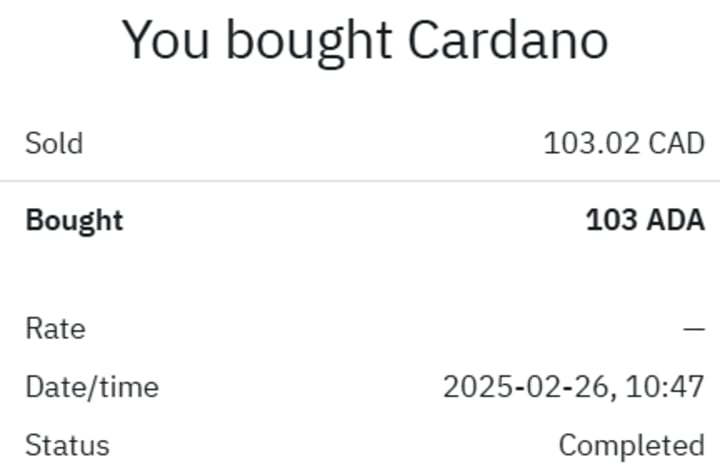
Cardano is in a competitive spot, but seems to want to create an interesting future. Plus, the fact that mining is not required makes it seem...green. In short, it strikes me as valid to get in on it to see what becomes of it, especially with the very quick unbonding period. As at the time of my initial purchase, Netcoins did not offer ADA staking, but Bitbuy did, so I got my ADA tokens there and staked them pronto.
To find out what other blockchain tokens formed part of my first blockchain portfolio, subscribe for free below to become notified right when I publish those articles. Alternatively, you can bookmark this page that contains a list of all my entries in my stock and blockchain trading journey I publish on Vocal Media.
About the Creator
Richard Soulliere
Bursting with ideas, honing them to peek your interest.
Enjoyes blending non-fiction into whatever I am writing.
Keep reading
More stories from Richard Soulliere and writers in The Chain and other communities.
Stock Trading - Entry 37
So I opened the polkadot door, but I didn't just stand at the doorway, I entered the romper room because I wanted a little of this and a little of that to hedge my bets. What follows are my thoughts and opinions as they relate to my own situation as a micro-investor; I am not dispensing financial advise. In this article, I focus on the Cosmos blockchain, whose token name is ATOM.
By Richard Soulliere11 months ago in The Chain
Real Estate Tokenization: How It Enables Property Ownership Through Tokens
The Evolution of Property Investment in the Digital Era For decades, real estate has been recognized as one of the most stable and wealth-generating asset classes. However, traditional property investment comes with notable challenges high upfront capital requirements, limited liquidity, lengthy paperwork, and complex transaction structures. Today, blockchain technology is reshaping the financial landscape, and Real Estate Tokenization Development is introducing a modern framework for property ownership. By converting physical real estate assets into digital tokens on secure blockchain networks, this approach makes property investment more accessible, efficient, and globally connected. It reflects a significant shift in how assets are owned, managed, and transferred in the digital economy.
By Michal steve4 days ago in The Chain
How Stablecoin Issuers Make Money: A Deep Dive
Stablecoins have rapidly emerged as a critical bridge between the world of cryptocurrencies and traditional finance. Unlike other digital assets, stablecoins are designed to maintain a steady value, typically pegged to fiat currencies such as the U.S. dollar. This unique positioning has fueled their adoption across global markets. But a question often arises: how stablecoin issuer make money? Behind the stability of these tokens lies a business model that generates sustainable revenue streams for issuers while keeping the ecosystem functional.
By Siddarth D8 days ago in The Chain
When the Shelter Closes
Across the street from my house, a man slept under a tree, his dog by his side. My first, naive thought: he must be traveling through. But he kept coming back, often sleeping there during the day. Then it hit me—that person might not have a home.
By Bride of Sound5 days ago in Humans


Comments
There are no comments for this story
Be the first to respond and start the conversation.