
How Commercial Real Estate Tokenization is Transforming Liquidity in 2025?
Unlocking Faster, Smarter, and More Accessible Capital in the Real Estate Market


Commercial real estate (CRE) has long been one of the most illiquid asset classes. Buying or selling a large office building, retail center, or industrial park can take months or even years, requires multiple intermediaries, and involves significant transaction costs. Owners are often locked into long holding periods, while investors find it difficult to exit before a property sale or refinancing. With interest rates rising and credit conditions tightening in 2025, these liquidity issues are under even greater scrutiny. As investors demand flexibility and faster access to capital, tokenization has emerged as a powerful tool to address these challenges and reshape the way liquidity works in CRE markets.
What Is Real Estate Tokenization (and Commercial CRE Tokenization)
Real estate tokenization is the process of representing ownership or rights to income from a real asset as digital tokens on a blockchain. Each token can represent a fraction of the asset, making large, indivisible properties more accessible. Commercial real estate tokenization specifically targets office buildings, warehouses, shopping centers, hotels, and other income-producing assets. Smart contracts encode ownership rules, income distributions, and compliance requirements. By turning a physical property into a series of programmable digital units, tokenization creates a framework for easier transfer, trading, and participation by a wider range of investors.
Key Drivers for Tokenization’s Ascendance in 2025
Several forces are converging to accelerate CRE tokenization in 2025. Regulatory clarity in major jurisdictions is improving, reducing uncertainty for issuers and investors. Institutional demand for real-world assets is growing as funds seek inflation hedges and stable yields. Technological infrastructure for token issuance, custody, and compliant trading has matured significantly, making it easier for property owners to launch tokenized offerings. At the same time, market pressures such as higher financing costs and shifting tenant demand are pushing owners to unlock value from their portfolios without selling outright. Together, these drivers create an environment where liquidity innovation is not just desirable but necessary.
How Tokenization Improves Liquidity: Mechanisms
Tokenization enhances liquidity in several ways. First, it allows fractional ownership, breaking large properties into smaller tradable units that lower investment thresholds and expand the buyer pool. Second, secondary markets for digital tokens can provide ongoing trading opportunities long after the initial offering, giving investors exit options that were previously unavailable. Third, blockchain infrastructure enables near-instant settlement and transparent record-keeping, reducing administrative delays. Fourth, smart contracts automate income distributions and compliance, lowering operating costs and risks. Combined, these mechanisms reduce time to exit, transaction costs, and barriers to participation, which are the main obstacles to liquidity in traditional CRE.
Empirical Landscape in 2025: Market Size, Adoption, and Case Studies
By 2025, tokenized commercial real estate has moved beyond pilot programs. Although still small compared to the multi-trillion-dollar CRE market, the tokenized segment has grown rapidly with billions of dollars in assets now represented digitally. Large developers, especially in North America, Europe, and the Gulf, have begun issuing tokens backed by office towers, retail portfolios, and hotels. Platforms facilitating these offerings have improved investor onboarding, compliance checks, and trading interfaces. Early case studies demonstrate that tokenization can reduce capital-raising timeframes and enable partial sales of properties, allowing owners to access liquidity without full disposition. While not every project achieves high trading volume, the trend shows clear momentum.
Barriers and Bottlenecks to Liquidity
Despite its promise, tokenization is not a magic wand for instant liquidity. Regulatory uncertainty remains in some jurisdictions, particularly around how property tokens are classified as securities. Secondary markets are still thin, with many tokenized assets trading infrequently. Valuation of real estate is inherently complex and does not update in real time, limiting price discovery. Technology and custody risks, such as smart contract bugs or inadequate security of digital wallets, can also deter investors. Additionally, traditional CRE investors may be hesitant to adopt new systems, while the lack of market makers means bid-ask spreads can remain wide. These factors can still impede liquidity even when a property is tokenized.
Regulatory and Legal Frameworks: Recent Changes Enhancing Liquidity
A key development in 2025 is the improvement of regulatory frameworks that support tokenization. More governments are introducing sandboxes, licensing regimes, and clear guidelines for digital securities backed by real assets. Standards for investor accreditation, KYC/AML procedures, and custodianship have become more robust, making it easier to design compliant offerings. This legal clarity reduces the risk that tokens will be deemed untradeable or non-compliant, which in turn gives institutional investors more confidence to participate. The evolution of these frameworks is essential to making tokenization a mainstream pathway to liquidity in commercial real estate.
Technological Enablers: Blockchain, Smart Contracts & Interoperability
Technology underpins the liquidity promise of tokenization. Modern blockchains provide secure, immutable ledgers where ownership records can be updated instantly. Smart contracts handle everything from dividend distribution to voting rights and compliance checks. Interoperability advances mean that tokens issued on one chain can be recognized or transferred across multiple platforms, reducing the problem of market fragmentation. Identity solutions, digital custodians, and secure wallets lower the barriers for investors to participate and trade safely. Faster, cheaper, and more reliable technology directly translates into more active secondary markets and higher liquidity.
Fractionalization and Democratization: How Smaller Investors Gain Access
One of the most transformative aspects of tokenization is its ability to democratize access to commercial real estate. By fractionalizing large properties into small, affordable units, tokenization allows a much broader base of investors to participate. This enlarged investor pool increases demand and potential trading activity, which naturally supports liquidity. It also enables diversification: individuals can own small stakes in multiple properties across different regions or sectors rather than tying up capital in a single asset. As investor participation widens, secondary markets become more vibrant, making it easier for any individual to buy or sell their stake.
Impact on Transaction Costs, Settlement Times, and Operational Efficiency
Traditional commercial property transactions are slow and expensive, involving brokers, lawyers, escrow agents, and banks. Tokenization automates many of these steps. Ownership records are stored on the blockchain, transfers settle almost instantly, and income distributions can be executed automatically through smart contracts. This streamlining reduces administrative overhead, cuts transaction fees, and minimizes errors. Lower friction encourages more frequent trading and lowers the cost of exiting or entering a position, which directly contributes to improved liquidity.
Risk and Liquidity: Hidden Vulnerabilities
It is important to recognize that tokenization does not eliminate market risk. In many cases, tokenized assets may still have low trading volumes because of restrictive investor eligibility, small issue sizes, or lack of awareness. Price discovery can be slow in downturns, and property tokens are still tied to the performance of the underlying asset. Custodial concentration, fragmented market infrastructure, and technological vulnerabilities may also disrupt trading. These factors mean that while tokenization can improve liquidity, it cannot guarantee it especially during market stress.
Future Trends and What to Watch for in Liquidity Transformation
Looking ahead, several trends could further boost liquidity in tokenized CRE. Specialized liquidity providers and market makers are likely to emerge, narrowing bid-ask spreads and fostering active trading. Standardization of token structures, legal documentation, and valuation methods will make tokens more comparable and easier to trade across borders. Hybrid models that combine traditional structures like REITs with tokenized offerings could help bridge the gap for institutional investors. Integration with decentralized finance, such as using CRE tokens as collateral for loans, may open additional liquidity channels. As these trends develop, tokenized commercial real estate could become a routine part of diversified portfolios.
Implications for Stakeholders: Investors, Developers, Regulators
For investors, tokenization offers the chance to enter and exit positions more flexibly, invest smaller amounts, and benefit from transparent reporting but it also requires new skills to manage digital wallets and understand smart contracts. For developers and property owners, tokenization provides a way to unlock capital without a full sale and reach a global investor base, though it entails compliance and ongoing investor relations. Regulators must balance innovation and protection, ensuring accurate disclosures and secure custody. Service providers such as custodians, exchanges, and compliance firms have a major opportunity to build infrastructure that supports liquid markets.
Limitations Today and What Still Needs to Be Solved
Even with progress in 2025, several hurdles remain. Many tokenized CRE offerings still suffer from low liquidity due to small investor bases and restrictive trading rules. Real estate valuation remains slow and subjective, hindering real-time pricing. Legal recognition of tokenized ownership in some jurisdictions is incomplete. Technology risks persist, from cybersecurity breaches to smart contract bugs. Market infrastructure such as specialized exchanges, price oracles, and insurance needs further development. Investor education and trust building will also take time. Until these gaps close, tokenization’s liquidity benefits will be uneven.
Conclusion
Commercial real estate tokenization in 2025 is no longer an experiment it is a growing segment with tangible impact on how liquidity works in a traditionally illiquid market. By enabling fractional ownership, creating secondary markets, automating compliance, and broadening investor participation, tokenization has begun to shorten exit times, reduce costs, and open new channels for capital. Yet liquidity is still evolving: it is strongest where offerings are well-structured, regulated, and supported by robust technology. As regulatory clarity spreads, infrastructure matures, and institutional adoption increases, tokenization could make commercial real estate a much more liquid and accessible asset class. For investors, developers, and policymakers, the next few years will be decisive in shaping how far and how fast this transformation goes.
About the Creator
Jack santo
I am a Blockchain, Crypto, NFT, Metaverse, etc., enthusiast.
Keep reading
More stories from Jack santo and writers in The Chain and other communities.
How to Build a DeFi Token Like Uniswap: Technical & Strategic Blueprint
Decentralized finance has rapidly emerged as one of the most transformative forces in the cryptocurrency ecosystem, with Uniswap standing out as a prime example of innovation and scalability. Uniswap’s native token, UNI, not only empowers governance decisions but also fuels the liquidity and growth of its decentralized exchange. The rise of such tokens signals a shift away from centralized control, creating trustless environments where users can trade assets directly from their wallets. For aspiring blockchain entrepreneurs and developers, building a DeFi token modeled after Uniswap offers both a technical challenge and a lucrative opportunity. This blueprint explores every stage of the process, from the conceptual groundwork to the technical execution and strategic launch.
By Jack santo4 months ago in The Chain
Bitcoin Dominance Explained: What It Is & Why It Matters for Crypto Traders
Introduction Bitcoin dominance is one of the most watched indicators in the crypto market. It shows how much of the total cryptocurrency market value belongs to Bitcoin compared to all other cryptocurrencies combined. Traders, long-term investors, and analysts track this metric because it helps explain capital rotation, market sentiment, and risk appetite across crypto cycles.
By saif ullahabout 23 hours ago in The Chain
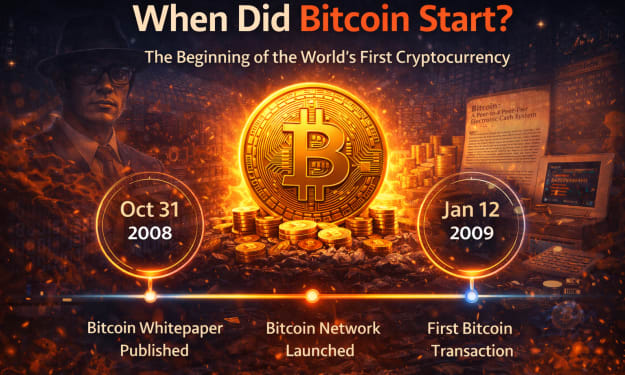
When Did Bitcoin Start? A Simple History of Bitcoin’s Beginning
Introduction Many people use Bitcoin today, but few know exactly when Bitcoin started and how quietly its journey began. Bitcoin did not launch with hype, investors, or advertisements. Instead, it emerged during a time of global financial uncertainty, offering a new idea: money without banks.
By saif ullah3 days ago in The Chain
Miss Persephone's Manual to a Seemingly Ordinary Life
Miss Persephone was found at the dining table, her blue eyes swollen, her tears arriving and retreating like the tides of the ocean. Earlier that day, her family had visited her in the retirement home where she had lived for eight years. It was her eightieth birthday.
By Imola Tóth3 days ago in Fiction


Comments
There are no comments for this story
Be the first to respond and start the conversation.