
Best Solana RPC: How to Find the Right Provider for Your Project
Choosing the best Solana RPC provider is a critical decision for anyone building on the Solana blockchain

Choosing the best Solana RPC provider is a critical decision for anyone building on the Solana blockchain. Think of a Solana RPC (Remote Procedure Call) endpoint as the API that allows your application to “talk” to the blockchain. It’s how you read data like account balances and transaction history, and how you send transactions to be included in a block. Without a reliable RPC, your app is basically disconnected from the network, which means a bad user experience.
Public vs. Private RPCs: What’s the Difference? 🤔
Before we dive into the providers, let’s clear up the difference between public and private RPC endpoints.
Public RPCs are free and anyone can use them. They’re great for learning, testing, and small projects. The Solana Foundation provides some public endpoints, but they have strict rate limits and can get congested, especially during high-traffic events like NFT mints. If your app is relying on a public endpoint and a bunch of people are trying to use it at the same time, your users will likely see slow load times and failed transactions. This is often called the “noisy neighbor” effect.
Private RPCs are dedicated endpoints you pay for from a third-party provider. They come with guaranteed performance, higher rate limits, and better security. For any serious project, whether it’s a DeFi app, a game, or a trading bot, you’ll need a private RPC to ensure your app is fast and reliable.
Key Factors to Consider When Choosing a Provider
When you’re shopping for a Solana RPC provider, you’ll want to look at a few key things beyond just the price.
- Performance and Uptime: This is non-negotiable. Look for a provider with a high uptime SLA (Service Level Agreement), ideally 99.9% or higher. Latency is also huge — the lower the better. Some providers are better at handling the “write path” (sending transactions), which is super important for things like trading or NFT mints. Others are great for the “read path” (querying data), which is what a lot of dApps need to show users up-to-date info.
- Pricing and Tiers: Providers usually offer different plans based on your usage. Most have a free or developer-friendly tier, which is awesome for getting started. When you’re ready to scale, you can move to a paid plan with a higher request per second (RPS) limit. Some providers have a credit-based system, while others have flat monthly fees. Be sure to understand what happens when you go over your plan’s limits.
- Developer Tools and Support: A great RPC provider offers more than just an endpoint. Look for extra features that make your life easier. This could include things like real-time webhooks, enhanced APIs for specific use cases (like NFTs or tokens), and access to historical data. Good documentation and responsive support are also crucial.
- Decentralization: While most top providers use a centralized infrastructure, some, like Pocket Network and Lava Network, offer a decentralized approach. This can be appealing if censorship resistance is a priority for you, as it diversifies your connection to the blockchain.
Top Solana RPC Providers You Should Check Out
There are a lot of great options out there, each with its own strengths. Here are some of the most popular and respected names in the space:
- QuickNode: A giant in the multi-chain infrastructure world. QuickNode is known for its reliability and a huge range of integrations. They have a solid reputation, a large free tier, and are a go-to for many teams.
- Helius: This is a top-tier provider for anyone building a Solana-native project. They offer a ton of enhanced APIs, including special tools for NFTs and tokens, that can save you from building your own indexers. If you’re all-in on Solana, Helius is a must-see.
- Alchemy: Similar to QuickNode, Alchemy is a powerhouse with a strong focus on developer experience and a wide range of tools. Their “Supernode” architecture is designed for data correctness and they have an excellent track record with Ethereum, which they’ve brought to Solana.
- Triton One: This provider is a favorite among those who need ultra-low latency. They are purpose-built for Solana and are a great choice for performance-critical applications like trading bots or market-making.
- Syndica: If you’re a developer who loves digging into the details, Syndica might be for you. They focus on providing deep visibility and excellent observability into your RPC usage, with tools like ChainStream for real-time data.
Final Takeaway: Start Small, Then Scale 🚀
For most people starting out, it makes sense to use a free tier from a provider like QuickNode or Alchemy. This lets you get comfortable with the ecosystem and build your app without any cost. Once your project grows and you start getting real users, you’ll know it’s time to upgrade. When you do, choose a private RPC provider that aligns with your specific needs — whether it’s super low latency, enhanced APIs, or decentralized reliability.
About the Creator
Mohammad Shahpari
Digital Marketer ✍️ Professional Crypto Content Creator | Writer, Strategist & Crypto Enthusiast
Keep reading
More stories from Mohammad Shahpari and writers in The Chain and other communities.
How I Lost Money Trading and Gained It Back by Holding
It all started with me watching a YouTube video. The guy was talking about how he made thousands of dollars in a single day by trading crypto. I was completely hooked. The idea of making quick money sounded way better than waiting years for my investments to grow. It felt like a shortcut to financial freedom, a secret that only a few people knew. So, I jumped right in, opened an account, and started trading. My brain was buzzing with the possibilities.
By Mohammad Shahpari4 months ago in The Chain
Australia Blockchain Market: Digital Trust, Decentralization & Enterprise Adoption
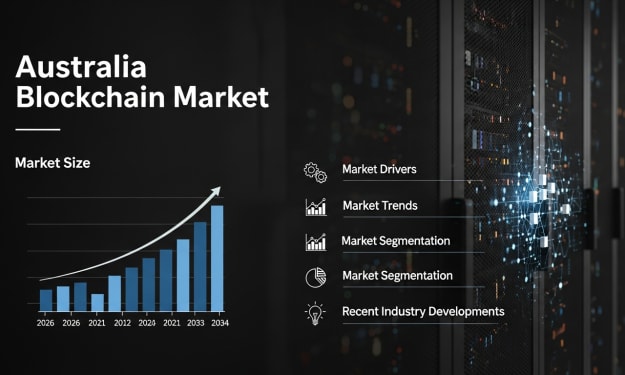
According to IMARC Group, the Australia blockchain market reached a value of USD 78.0 Million in 2024 and is projected to expand to USD 130.7 Million by 2033, growing at a compound annual growth rate (CAGR) of 5.9% during 2025–2033. This steady expansion reflects Australia’s measured but increasingly strategic adoption of blockchain technologies across financial services, government operations, supply chains and enterprise data systems. Rather than speculative use cases alone, Australia’s blockchain ecosystem is evolving around practical applications such as digital identity, payments infrastructure, smart contracts, asset tokenisation and secure data sharing. As trust, transparency and efficiency become critical in a digitised economy, blockchain is positioning itself as a foundational technology supporting long-term digital transformation.
By Shrestha Roy5 days ago in The Chain
Bruce Lee and The God of War: Kuan Ti
It starts with love.. The Power to the God Of War and Wealth Walk into a Chinese restaurant (even in Oklahoma, USA), a Chinese police station, a kung fu martial arts studio or even a Chinese temple and you often see a red faced warrior holding a heavy quan-do (spear like weapon).
By WILD WAYNE : The Dragon King5 days ago in Chapters



Comments
There are no comments for this story
Be the first to respond and start the conversation.