
Top 5 Benefits of Wearing TPU 3D Printed Sneakers
Discover How Durability, Comfort, Lightweight Design, Environmental Resistance, and Customization Are Revolutionizing Modern Footwear
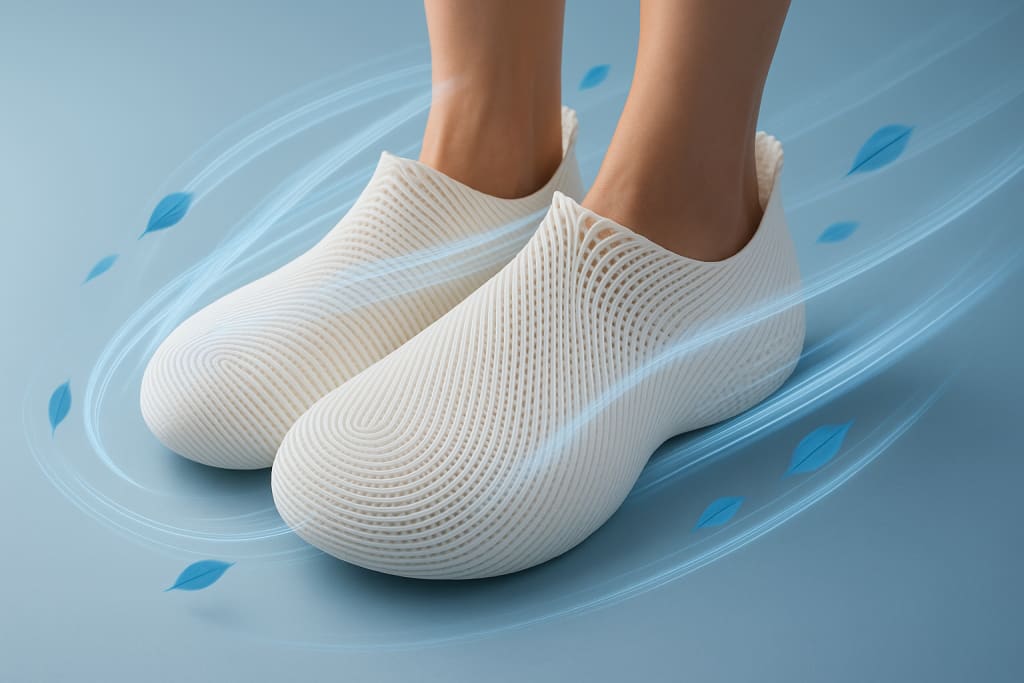
Thermoplastic polyurethane (TPU) combined with additive manufacturing unlocks a new class of footwear — sneakers that are durable, flexible, lightweight, weather-resistant and highly customizable. Below we explain the five biggest benefits, cite supporting data, and give real-world brand examples.
Why TPU + 3D Printing Matters
3D printing (additive manufacturing) allows designers to produce complex lattice and gradient structures that were previously impossible or too costly using traditional molds. TPU — a flexible thermoplastic elastomer — is widely used for printed footwear parts because it balances elasticity, abrasion resistance and resilience, making it suitable for midsoles, outsoles and whole-piece printed uppers.
Exceptional Durability & Wear Resistance
TPU exhibits strong resistance to abrasion, repeated bending and impact compared with many other 3D-printable polymers. Controlled laboratory abrasion tests on additively manufactured outsole geometries show that flexible materials in the TPR/TPU family can substantially outperform brittle resins in weight-loss and deformation metrics, indicating longer service life under walking and running loads. This makes TPU-based 3D printed sneakers more durable for everyday use than certain earlier 3D-printed attempts that used rigid materials.
Flexibility, Shock Absorption & Comfort
TPU’s intrinsic elasticity (many TPU formulations show high elongation at break and good rebound properties) enables lattice midsoles and zoned cushioning that compress under load and spring back repeatedly without permanent deformation. When designers pair TPU lattices with parametric optimization, they can create region-specific stiffness (firmer under the heel, softer at the forefoot), improving gait comfort and reducing joint stress.
Practical reporting on TPU for 3D printing highlights its tear resistance, shock-absorbing behavior and thermal stability, which translate into consistent comfort across environments and temperatures.
Lightweight Construction via Lattice Design
One of the most visible advantages of 3D printing is the ability to design open, lattice or honeycomb structures that maintain mechanical strength while using far less material. By printing lattice midsoles and porous uppers in TPU, manufacturers can reduce mass without sacrificing support — this results in less energy expenditure per step and lower perceived fatigue during long wear.
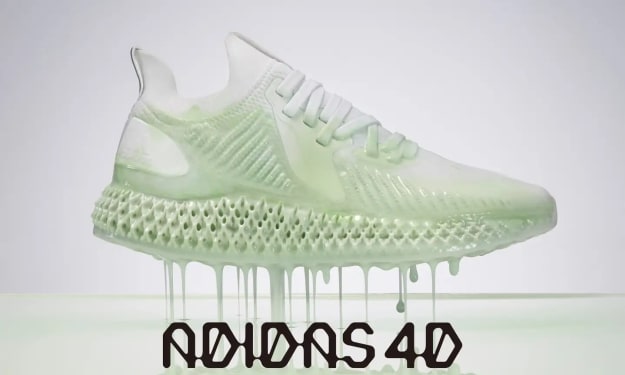
Major brands have used lattice geometry successfully at scale (e.g., Adidas’ lattice midsoles), proving that lightweight 3D architectures are not only concept pieces but commercially viable components in modern sneakers.
Resistance to Environmental & Chemical Stress
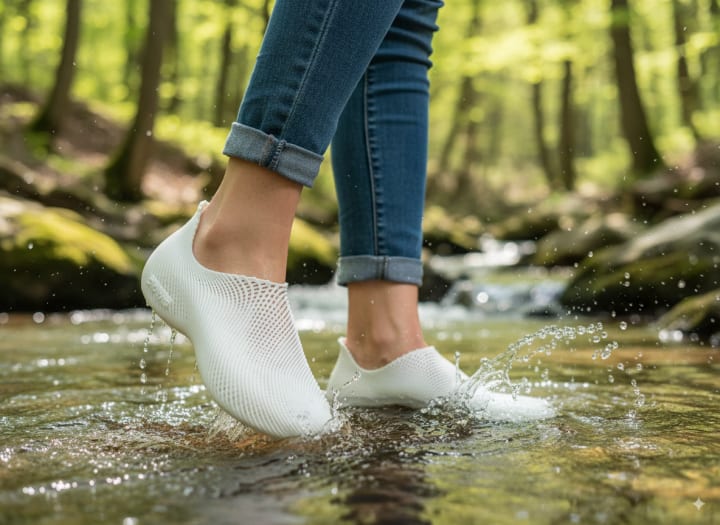
TPU offers good resistance to oils, greases, moisture and many common chemicals, and certain TPU grades display robust UV and thermal stability compared with other flexible polymers. For footwear, this means TPU sneakers are easier to clean, less prone to sudden degradation when exposed to sweat or outdoor conditions, and better suited to multi-purpose use (indoor/outdoor) than many foam-based alternatives.
Customization & Rapid Iteration
TPU is well suited for parametric and algorithmic design workflows. 3D printing enables per-user customization (foot scans → bespoke geometry), quick prototyping, and region-specific property tuning (e.g., variable lattice density). Brands that adopt on-demand printing can iterate faster, reduce inventory, and offer tailored fit and function — a major advantage for orthotics, sports footwear, and limited-edition fashion runs.
Startups and platform players have already demonstrated fully on-demand models where customers submit foot scans and receive bespoke printed footwear produced locally. This reduces overproduction and shortens supply chains.

Brands Putting TPU 3D Printing to Work
Adidas
Adidas has been among the most visible mainstream adopters of 3D-printed lattice technology, notably with its 4DFWD and Climacool projects. These efforts show how lattice midsoles and breathable printed elements can be taken from R&D into consumer products. Adidas’ Climacool rollout underlines both design maturity and commercial strategy for 3D-printed components.
Nike
Nike continues to experiment with printed uppers and performance parts (e.g., Flyprint initiatives, Air Max 1000 collaborations), aiming to merge high-performance materials with advanced manufacturing. These projects illustrate the performance-first use cases of printing beyond aesthetics.
Zellerfeld
Zellerfeld is a representative of the new wave of fully printed, on-demand footwear platforms. Their model focuses on designer collaborations, recyclable TPU usage and local production — a practical realization of the customization and sustainability thesis for printed shoes.
ARKKY
ARKKY is an emerging brand concentrating on TPU 3D-printed slippers and sneakers. The company experiments with advanced processes (including in-liquid or water-assisted printing in some prototypes), aiming for smoother surface finishes and precise lattice geometries. ARKKY positions its products as durable, breathable and suitable for everyday wear while following an on-demand, small-batch production model to reduce waste. Recent press and industry writeups highlight ARKKY as an up-and-coming name in the 3D-printed footwear space.It has received a lot of media attention and has become the most dazzling unicorn company in the 3D printing shoe industry with its AI-HALS printing platform.

Dolce Vita
Dolce Vita demonstrates how fashion brands can hybridize printed components (lattice outsoles or accents) with traditional materials like leather, offering approachable fashion items that integrate 3D printing benefits without requiring a full-scale manufacturing shift.
Market Context & Data
The global 3D-printed shoes market has been estimated to expand significantly in the coming years. One reputable market analysis projects the market to reach roughly USD 5.38 billion by 2030, growing at a double-digit CAGR as printing accuracy improves and new materials (like TPU grades optimized for footwear) gain acceptance. These forecasts underscore that TPU + 3D printing is not merely an R&D curiosity but a market with meaningful commercial potential.
Note: market estimates vary by source and methodology; consult the cited market reports for detailed assumptions and geographic breakdowns. https://www.grandviewresearch.com/industry-analysis/3d-printed-shoes-market-report
Practical Considerations & Trade-offs
- Printing complexity: TPU is more challenging to print than rigid filaments — it requires tuned extrusion, speed control and moisture management to avoid stringing or adhesion issues. (See manufacturer and community guides for best practices.) :contentReference[oaicite:12]{index=12}
- Production speed & cost: High-resolution TPU prints and post-processing (smoothing, annealing) can increase unit time and cost compared with injection molding for very large volumes.
- Material selection: Not all TPU grades are identical — shore hardness, tear resistance and UV stability vary; choose grades optimized for footwear durability.
Practical Tips for Buyers
- Look for products that specify TPU grade and testing data (abrasion, flex fatigue).
- For custom fits, prefer brands offering foot-scan or size-mapping tools.
- Check warranty and return policy — early printed footwear pioneers often provide trial periods to build consumer confidence.
Conclusion
TPU 3D-printed sneakers combine durability, comfort, lightweight performance, environmental resistance and deep customization potential. Major brands (Adidas, Nike) validate the technology at scale, while innovators (Zellerfeld, Arkky and fashion houses) explore new production and design models. As materials mature, printing becomes faster and recycling loops are established, TPU 3D-printed footwear is likely to move from early-adopter niche into a mainstream option for performance and lifestyle consumers.
About the Creator
3DPrinting
I am a technician in the 3D printing industry, and I am interested in the application of 3D printing in various fields.
Keep reading
More stories from 3DPrinting and writers in Styled and other communities.
3D Printed Shoes vs Traditional Shoes: What's the Difference?
Revolutionary Shift in Footwear Manufacturing The $365 billion footwear industry is experiencing a manufacturing revolution. 3D printing technology is fundamentally changing how shoes are designed, produced, and delivered to consumers worldwide.
By 3DPrinting5 months ago in Styled
Wild Card Weekend Recap: What Happens Now?
I think I figured out why I love Wild Card Weekend so much. It's because it's the first playoff anything of the calendar year. The NFL season starts in the fall, and once upon a time, the champion was crowned either on or slightly before New Year's. The evolution of the NFL schedule has resulted in the playoffs starting just into the New Year, and currently, the final week of the season falls on the first weekend of the New Year, with Wild Card Weekend coming a week after that. So yes, chronologically, the NFL's Wild Card Weekend serves as the first playoff anything of the calendar year.
By Clyde E. Dawkins6 days ago in Unbalanced

Comments
There are no comments for this story
Be the first to respond and start the conversation.