

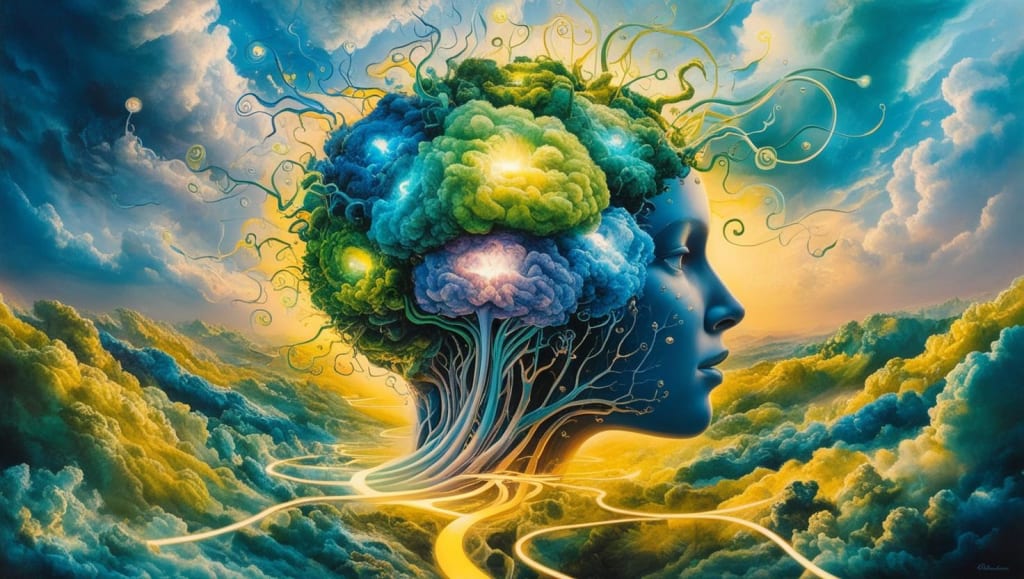
When The Mind Trembles, the Body Breaks
They say the body is a temple, but temples fall. Not because the stones grow weary, but because the foundation begins to crack — slowly, silently. And nowhere do those fractures begin more often than in the mind.
It starts as a whisper. A thought ignored. A tension beneath the ribs. Then one day you wake up, and your chest is heavy for no reason. Your stomach churns even though you haven't eaten. Your shoulders feel like they've borne a mountain.
The mind, fragile and fierce, does not fall alone. When it trembles, it sends ripples across the body — quiet, persistent, devastating.
In the afterglow of the Collapse, people started noticing it more.
Not the obvious wounds — broken bones from riots, chemical burns from the purges — but the subtle things. The ones that couldn't be seen on scans or stitched shut. A man who used to build solar rigs could no longer hold a wrench without his hands trembling. A girl who’d once danced across burning barricades now found herself paralyzed by a knock at the door. Sleep came like an enemy. Hunger disappeared. Skin grew pallid. Hearts fluttered at the slightest noise, like birds trapped in a cage.
These weren't signs of weakness.
They were signs of something deeper breaking.
In the early cities — back when they still called them "smart" — people had tried to separate mind and body. Keep them compartmentalized. Track physical health with wrist monitors, neural activity with implants, and never once consider that an unspoken grief could corrode a liver. That unexpressed rage could tighten the chest. That guilt could turn a spine into iron or jelly, depending on the hour.
It was all so clinical, so precise. Symptoms were labeled, dosed, and suppressed. But the root remained — the psychological rot, invisible and unchecked.
And then, when the system fell, that rot came to light.
Layla was a medic in the Southern Free Reaches, a former neuropsych specialist turned field healer. She’d seen more than most: chemical warfare victims, children raised in bunkers, men who'd forgotten their own names. But what disturbed her most were the ones who looked fine — until they weren't.
There was a boy, maybe seventeen, who came in with persistent migraines. No trauma, no head injury, no toxin exposure. But every day, he screamed like knives were being hammered into his temples. She ran tests. Scans. Bloodwork. All clear.
One night, during a storm, he curled into a ball and sobbed about a village. A fire. A choice.
He had been forced to pick between two homes — his mother’s and his cousin’s — and tell the strike drones which to spare.
His mind made the choice.
His body bore the cost.
The ancient healers knew this, of course. Before machines replaced medicine with management, they treated the soul as much as the flesh. They understood that a broken heart could stop another from beating. That a prolonged fear could burn out the adrenal system. That shame could poison the blood more efficiently than lead.
But such wisdom was lost in the age of cold logic and profit. Until, ironically, the ruins made room for remembering.
Now, with the cities reduced to gardens and bones, people once again began to notice the link between what they thought and how they felt. The healer's hut had returned, not sterile like the labs, but warm, alive. Painted with symbols older than memory.
And in those spaces, the truth emerged again: the battlefield of the mind was no less deadly than any other.
It’s not always dramatic. Sometimes it’s subtle. Chronic fatigue that sets in after years of keeping up appearances. A back that knots and locks from too many swallowed insults. A jaw that aches because it’s clenched through too many fake smiles. Skin that flares with eczema during times of grief. Hair falling out after betrayal. Stomach ulcers blooming in the wake of worry.
Stress, unprocessed emotion, suppressed truth — they all go somewhere.
And more often than not, they lodge themselves in the body like parasites, slowly draining it.
Juro, a former tactician turned permaculturist, once explained it like this:
"The mind is a map, the body is the terrain. If the map is torn, the traveler will be lost. If the terrain is damaged, no amount of planning will get you through. You need both to walk the world intact."
He’d lost half his unit to a decision he’d made during the third siege of Myra. The guilt didn't show up as tears. It arrived as arthritis in his fingers. As a cough that had no cause. As dreams that woke him with blood on his tongue.
He planted trees to keep the ghosts quiet.
Sometimes it worked.
The new generation is learning, slowly, painfully, how to live whole again.
They sit in circles under the open sky and speak of their fears. Not to purge them, but to name them. Naming is power. What is named can be faced. What is faced can be healed.
They dance, not for entertainment, but to shake loose the trauma that words cannot reach. They cry without shame. They scream into oceans. They write down their sins and burn the paper. They sing lullabies to their scars.
They know now: ignoring the mind means dooming the body. And vice versa.
There’s a tree in the center of what was once Capitol Sector Delta. It grew from the ruins of a tribunal hall — its roots cracking through marble, its branches high enough to reach the sky where drones once flew.
People say it hums if you press your ear to it. That it remembers.
Layla buried a satchel of medical records beneath it years ago. Not to forget, but to let the earth absorb the pain, to compost it into something new. Into healing.
She returns there sometimes. Not to diagnose or dissect, but simply to feel.
Because healing isn’t linear. And pain isn’t weakness. It’s just the body’s way of asking the mind for help.
About the Creator
Gabriela Tone
I’ve always had a strong interest in psychology. I’m fascinated by how the mind works, why we feel the way we do, and how our past shapes us. I enjoy reading about human behavior, emotional health, and personal growth.
Keep reading
More stories from Gabriela Tone and writers in Psyche and other communities.
The Rhythm of Little Stars
The Rhythm of Little Stars A Journey to Finding the Perfect Baby Schedule When Emma first brought baby Oliver home from the hospital, she thought she was ready. She had read the books, joined the forums, listened to every piece of advice from mothers, grandmothers, neighbors, and strangers in grocery store lines. "Sleep when the baby sleeps," they said. "Feed on demand." "Let them cry it out." "Never let them cry it out."
By Gabriela ToneExclusive • 11 months ago
The BAFTA Awards
By now, in a stunning departure from recent years, most of the world is aware of what happened at the BAFTA film awards. Social Media Headlines will tell you the bare bones: that John Davidson, a Tourette's Syndrome advocate, shouted a racial slur at two Actors of Colour, Michael B Jordan and Delroy Lindo.
By Natasja Rose5 days ago in Psyche
Video Call Tarot Readings: An Evidence-Based Assessment of Format Effectiveness
The proliferation of video-based tarot consultations represents a significant structural shift in how divinatory services are delivered in the digital age. Video call tarot readings combine the visual transparency of in-person sessions with the geographic flexibility of remote consultations, creating a hybrid modality that merits careful evaluation against established formats such as telephone and text-based readings.
By Enrique Martinez7 days ago in Psyche



Comments (1)
Nice