
Trapped in Silence: How Writing Freed Me—and My Late Grandmother
The dreams that haunted me, the stories that healed me, and the moment she spoke again.

She sat beside me at the Thanksgiving table. Her hands reached for the mashed potatoes. She carefully picked out only the white meat from the plate of turkey, laid it neatly on her plate, and poured my mom’s homemade gravy on top. Her white cardigan was buttoned just right. Her hair was curled in the way it had been when I was a child— back when she would get it permed, before she lost her hair to breast cancer. Her body breathed, blinked, swallowed. Everything about her looked like her.
But she never looked up.
She didn’t meet my eyes. Didn’t meet anyone’s.
We spoke to her—well, we tried. I sat down at the table next to her. “Nana,” I whispered. The sound slipped from my mouth like smoke and disappeared before it could reach her. She didn’t flinch. She didn’t hear. It was like shouting across a chasm underwater.
Everyone at the table knew. No one said it. But we all knew.
We watched her from the corners of our eyes, careful not to stare too long, like looking too directly might break something sacred. We moved around her in a strange choreography: sitting next to her at the table as we shared a meal, clearing the table once she finished eating—all in silence, all with a quiet reverence for the impossible truth sitting between us.
She was there, but she wasn’t.
Not a ghost. Not a memory. But not human either. She was something else. An echo dressed in flesh. A presence suspended in the space between here and not-here. She existed, but she didn’t live. And we could see her, but she could not see us.
I woke from that dream choking on air. Chest tight. Eyes already wet. I laid there for a long time, going back and forth from sobbing to staring at the ceiling in stunned silence. I felt that familiar weight return to my ribs: the grief that never really left, that I carried like a stone in the lining of my chest. That was the worst of them—the worst of the dreams where she appeared.
Not because she was scary, or even because she was silent. She was silent in all of the dreams where she appeared since her death. This one hurt the most because it was Thanksgiving. The first holiday we experienced without her—just two weeks after she passed.
But all of the dreams with her there hurt. A reunion I should have looked forward to, I dreaded. Because even in my sleep, I couldn’t reach her.
I had dreams like that for years.
She’d show up without warning. Sitting in a lawn chair at Aunt Tina’s annual Memorial Day picnic. Sitting on the living room couch as my cousins and I played Just Dance on New Year’s. Sitting at her kitchen table, cutting coupons out of the newspaper. Always quiet. Always distant. Everyone else in the dream always knew she was gone. But there she was anyway. A presence we all acknowledged—and just had to bear.
I never wanted to say goodbye to my Nana. But now, I never wanted to see her again. I couldn’t stand the pain.
They say time heals all wounds, but time was making mine deeper.
Then one day, I tried something new.
I wrote about her.
Vocal posted two challenges that fit perfectly with my memories of my Nana: Holidays in Verse and Through the Lens.
For the first challenge, I wrote a poem sharing the warmth of my Nana that I feel around the holidays. I touched briefly on her final moments, but the tone was positive overall. It was real, but it wasn’t the full story.
For the second challenge, I shared a photo I took of my Nana, Pappy, sister, and niece on the last day I saw my Nana before she passed. I delved into the feelings I experienced as I took the photo, and the ones that hit me afterwards.
But this time, I didn’t tiptoe around the edges—I went in.
I wrote about her final days, about preemptively grieving her. I let the words come. I let all the feelings come. Ugly, beautiful, cracked open. And in doing that, something shifted.
Because that night—or maybe the night after—she came back.
Only this time, she wasn’t quiet.
We were sitting at the kitchen table, playing rummy. She was shuffling the cards in her slow, messy way, scribbling our scores on a random page in one of her word search books. “Your go,” she said, after dealing.
And then we were in the kitchen, making purple Kool-Aid from one of those powdered mixes. I dumped in wayyy too much sugar, like always, and stirred it until the scent of fake grape filled the room. I was ten again, and I could hear her telling me to be careful when stirring so that I don’t stain my shirt.
She wasn’t just there, she was there. Lively, joyful, full of life. And her voice—God, her voice—was exactly as I remembered it. Warm. Witty. Playful. Loving.
And still, the dream continued. Pappy walked in—his usual half-grin already on his face. “You girls up for the Sports Emporium?” he asked. And just like that, the dream turned into a Saturday from a decade ago where my cousins and I were running down the hallway, ready for Nana to hand each of us a $20 bill for arcade games.
I woke up with tears running down my cheeks. But I was smiling. I felt happy.
Until later that day, when my bracelet broke.
The bracelet I wrote about in both of those previous Vocal challenges.
It was hers—a thin gold bracelet she used to wear that I had kept on my wrist since the day she died. I never took it off. Not once. It had become part of me, like a thread stitching her to my skin. I’d always been afraid of it breaking. Worried that if I lost it, I’d lose her again.
But that same afternoon, as I reached under my bed for something, I felt it snap.
Just like that.
And I felt… indifferent.
Tears didn’t come rushing to my face the way I once imagined they would if something ever happened to the bracelet. Instead, I just picked it up, looked at it inquisitively, then grabbed my pliers and managed to piece it back together. It held, barely, but minutes later, it fell apart again.
This time, the clasp was broken. Beyond fixing. And I just sat there, holding it in my hand, stunned. I still didn’t cry. I didn’t panic. I just stared at it and… understood.
It was time.
I could finally… let go.
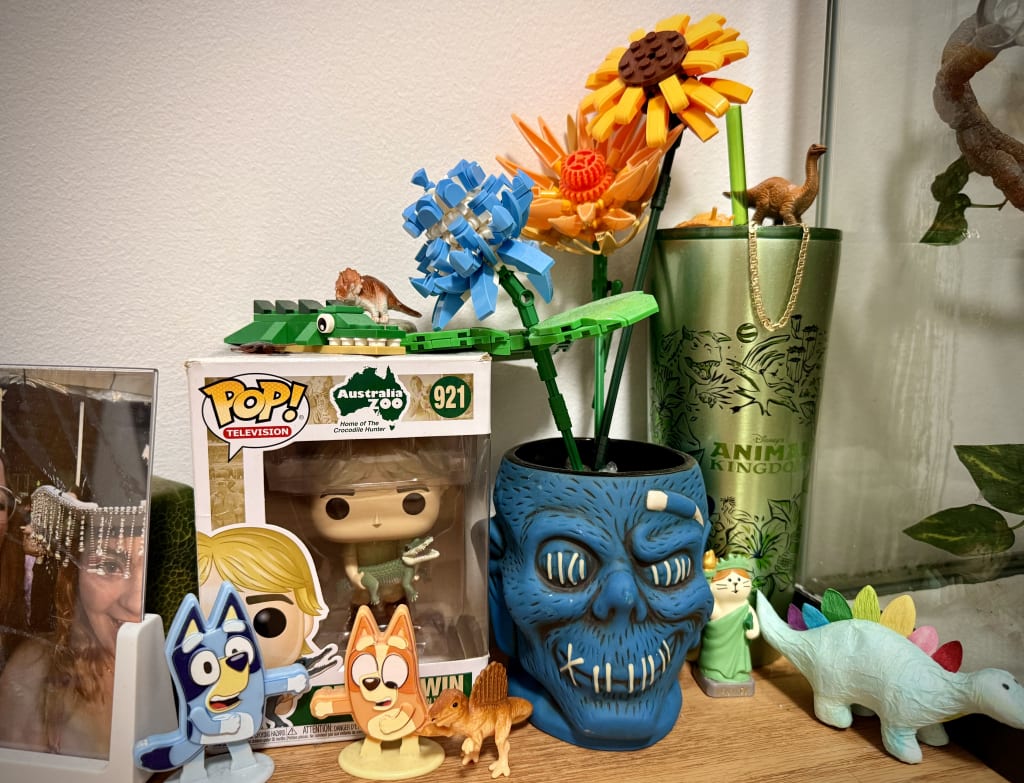
Her bracelet now rests on my desk, on top of my green tumbler, amongst all of my other little knick knacks that bring me joy. I see it every day. But I don’t need it on my wrist anymore to feel her close.
The haunted dreams have stopped. The silence is gone. She speaks in dreams now. She laughs. She shuffles cards and complains about the neighbors and their noisy goats. She hands me bills for silly arcade games and coins for cheap toy machines. She is back. My Nana, just as I remember her, is back.
Writing her story didn’t make me lose her again—it brought her back to life.
Not in the way I wanted, but in the way I needed.
No longer on my wrist, but no longer silent.
And forever in my heart.
About the Creator
Hannah Hess
A grad student trying to save the world, one species at a time.
While I study ecology, evolution, and conservation biology, I have a deep love writing about my family, pets, and life outside of academia. My stories are a bit of a mixed bag!
Keep reading
More stories from Hannah Hess and writers in Psyche and other communities.
I Didn't Write This For You To Read. Honorable Mention in The Metamorphosis of the Mind Challenge.
I don’t usually share my writing with people I know. It’s not that I’m ashamed of what I write—it’s just that the moment you let someone in, especially someone from your real life, everything feels a little more… exposed. I worry people will read into things. That they’ll recognize themselves in a sentence. And that if they do, they'll be hurt or feel uncomfortable. Or they’ll decide that something isn’t “true enough.” Or maybe they’ll just think it’s bad.
By Hannah Hess9 months ago in Psyche
Ludacris and Nelly draw backlash over bookings at MAGA-coded music festival
Ludacris and Nelly headlining a mostly right-wing event is good for them. It’s also great for the genre of hip hop. The two rap veterans have showcased their talents on other stages. Why can’t they perform for mostly MAGA folks and grab that bag?
By Skyler Saunders4 days ago in Beat




Comments
There are no comments for this story
Be the first to respond and start the conversation.