
Balancing Tradition and Individualism: Insights from Italian-Canadian Life
Part 1 of 5

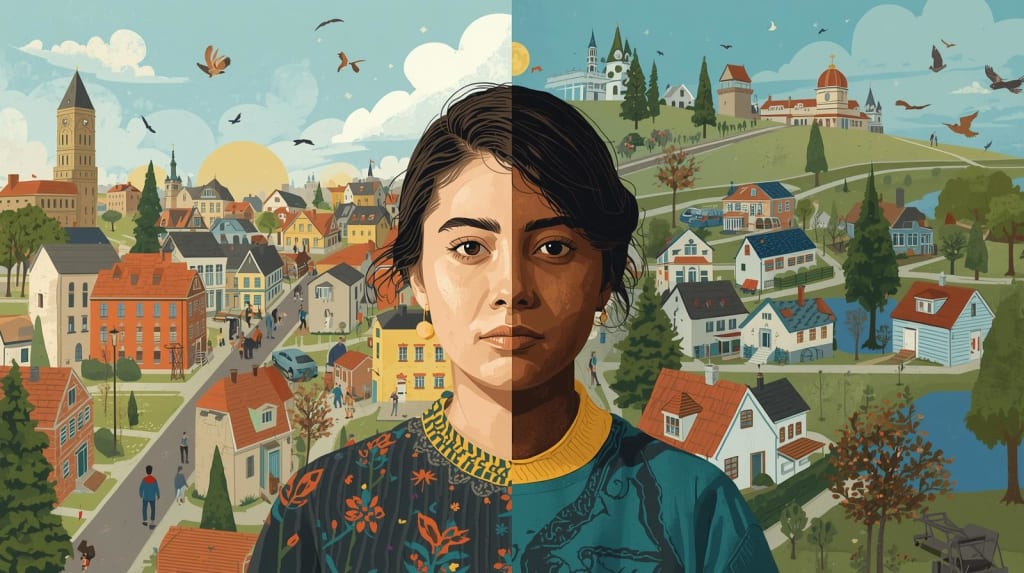
The Dual Life of a Second-Generation Italian in Canada
Being born to Italian parents in Canada often means you’re raised in a permanent state of cultural multitasking. You’re not just balancing two worlds; you’re translating them for each other. One moment you’re navigating a household where Sunday lunches last four hours and everyone talks over each other like it’s a competitive sport; the next, you’re stepping into a Canadian environment where boundaries are clearer, voices are softer, and “drop by anytime” is not an actual invitation.
On one side stands the heritage of your parents — steeped in ritual, family loyalty, and that unmistakable sense of collective pride that turns even the simplest meal into an event. It’s a culture where your last name carries history, where elders are woven into everyday life, and where you learn early that affection often sounds like worry — and that “Did you eat?” somehow counts as both a greeting and a medical assessment.
On the other side is modern Canada — a landscape built on individualism, self-expression, and the idea that you can shape your own identity without needing the approval of an entire village. It’s a place that encourages reinvention, choice, and personal boundaries your Nonna would absolutely ignore — the same boundaries she’d call “cute” right before rearranging your entire life anyway.
For many second-generation Italians, identity isn’t confusion — it’s a bilingual rhythm. It’s knowing how to switch emotional gears depending on the room you’re in. It’s understanding the value of loyalty and community while embracing the freedom to define yourself. It’s the quiet superpower of belonging to two cultures that sometimes clash, often overlap, and somehow create a third space that’s uniquely yours.
Living “in-between” isn’t a burden. It’s a vantage point. It gives you a wider lens, a sharper understanding of people, and a sense of identity built not on choosing sides — but on carrying both with intention.
The Immigrant Legacy We Inherited
The story begins long before we ever showed up, wide-eyed and bilingual. Between the 1950s and 1970s, waves of Italians boarded ships and planes with an optimism that honestly borders on heroic. They left behind post-war uncertainty, economic instability, and towns where opportunities were as rare as quiet family dinners. What they carried instead was grit, a few sacred recipes wrapped in wax paper, and an unshakable belief that hard work could restore dignity brick by brick.
Their children — the second generation — grew up in households that felt like a time capsule of Calabria, Abruzzo, Sicily, or whichever region your family swore produced the “best” everything. Inside, the air was thick with dialect, simmering tomatoes, and long-distance phone calls that sounded like they were being transmitted from the moon. Outside? Snowbanks taller than us, English or French at school, and the constant reminder that Canada moved by different rules.
For us, the immigrant dream was never some poetic idea. It lived in real, tangible sacrifices: parents taking double shifts, saving money in envelopes, building homes literally with their own hands, and treating "fare una bella figura" — making a good impression — as both a strategy and a moral obligation. In their minds, presentation wasn’t vanity; it was survival, respect, and a way to reclaim status in a country that didn’t always see them clearly.
And that legacy sticks to us — in good ways and complicated ones. We inherit the pride of belonging to a strong, resilient lineage, but we also inherit the invisible pressure to live up to it. It’s loyalty woven into identity. A quiet reminder that our successes never feel entirely our own, and our failures? Well… those feel like they’d disappoint at least four generations at once.
That’s the weight and the gift of it: knowing we stand on foundations built by people who dreamed forward, even when they had almost nothing in their pockets except hope and a packed lunch.
Between Collectivism and Individualism
Italian culture is built on togetherness — not the soft, abstract kind, but the loud, hands-on, “everyone knows your business before you do” kind. Sunday dinners are basically mandatory attendance, family debates double as sport, and phone calls from relatives operate on a frequency just slightly above concern and slightly below interrogation. Affection and accountability don’t arrive separately; they’re a bundled deal, no refunds.
Canadian society, meanwhile, tends to champion the opposite rhythm. It teaches autonomy, personal space, reinvention, and this radical notion that you can say “no” without starting a family feud. Here, success is something you define for yourself, not a group project managed by a committee of aunts.
Second-generation Italians grow up as interpreters between these two philosophies. At home, you may be the dutiful child — respectful, modest, careful not to disrupt the hierarchy. Outside those walls, you’re expected to be the assertive professional who advocates for your ideas, negotiates boundaries, and doesn’t wait for permission that will never be officially granted.
This ability to code-switch isn’t hypocrisy — it’s survival. It trains emotional intelligence in ways textbooks can’t teach. You become adept at reading rooms, adjusting tone, and knowing exactly when to speak up or pull back. It sharpens empathy, too, because you understand that people operate from different cultural logics.
But this duality also creates a quiet, stubborn tension:
How do you stay loyal to a culture that sometimes expects you to shrink in order to belong — while living in a society that encourages you to take up space?
For many of us, adulthood becomes a negotiation between the two. We learn to preserve the warmth of collectivism without losing our autonomy; to honor tradition without letting it cage us; to love our roots without letting them dictate every step forward.
It’s not confusion. It’s calibration — daily, subtle, and deeply human.
Belonging Without Borders
At some point in adulthood, most second-generation Italians hit a quiet but powerful realization: there was never a choice to make in the first place. You don’t have to decide whether you’re Italian or Canadian. You’re already both — not a 50/50 blend, but a fully integrated whole. It’s like having dual operating systems that somehow run the same machine without crashing… most days.
You can revel in the operatic chaos of family gatherings — the overlapping conversations, the unsolicited advice, the emotional volume set permanently at 11 — and still crave the Canadian luxury of solitude where nobody asks, “Why are you so quiet? Are you sad? Do you need to eat?” You can keep the rituals that matter to you while pushing back on the parts that don’t fit, whether it’s outdated gender expectations, rigid family roles, or the assumption that your life choices require a committee vote.
Belonging isn’t about squeezing yourself into a mold that never accounted for your entire reality. It’s about reshaping that mold, so it reflects who you’ve become — a person shaped by two cultures, two value systems, and two emotional languages that coexist more naturally than anyone expected.
Cultural identity isn’t a museum artifact frozen behind glass. It’s a living language, a constantly evolving dialect shaped by every generation bold enough to tweak the grammar. When we reinterpret the traditions we inherit and blend them with the values we live, we’re not betraying our roots — we’re extending them. We’re proving that identity isn’t something you guard; it’s something you grow.
In the end, belonging without borders means carrying both cultures with ease, gratitude, and just enough rebellion to make them your own.
The Gift of Hybridity
Living in the “in-between” gives you a kind of perspective many monocultural upbringings never have to develop. When you grow up switching between cultural playbooks, you start to realize that the world isn’t built on one definition of respect, success, or even love — it’s built on versions. In an Italian household, respect might mean listening to your elders and never showing up empty-handed; in Canadian settings, it might look like giving people space and not interrupting every five seconds (a skill many of us learned… eventually).
Hybridity trains you to recognize these nuances. It teaches you that family isn’t defined by unanimous agreement — if anything, disagreement is practically a love language in some Italian households. What matters is that everyone stays at the table long enough to hear each other out, even if the debate gets louder than the cutlery.
And that’s the quiet brilliance of the second-generation experience:
you turn contrast into creativity, tension into understanding, and cultural differences into emotional fluency. You become the person who can navigate complexity without panicking, who can see multiple sides of an issue, and who can translate intentions across worlds that don’t always speak the same emotional dialect.
Hybridity doesn’t dilute identity — it expands it. It gives you a wider lens, a deeper empathy, and a uniqueness that isn’t performed, but lived.
Closing Reflection
We are the bridge generation — fluent in the language of sacrifice and the dialect of possibility. We grew up understanding why our parents clung to stability like it was oxygen; while also being encouraged by Canadian culture to imagine futures they never had time to dream about. That dual fluency becomes a kind of internal compass: one needle grounded in history, the other pointed unapologetically toward what’s next.
Our parents gave us roots so we could survive — roots built on discipline, loyalty, and the stubborn belief that family is a fortress. Canada gave us wings so we could define what thriving means, teaching us that ambition isn’t arrogance, boundaries aren’t disrespect, and reinvention isn’t betrayal. Somewhere between those two forces, we learned to build lives that honor where we come from while refusing to be limited by it.
To live between two worlds isn’t to be divided — it’s to be expanded. It means carrying the resilience of one culture and the possibility of another, shaping an identity that doesn’t ask permission from either. It’s proof that identity can be both heritage and horizon, both memory and momentum. In the end, hybridity isn’t a challenge to overcome — it’s the superpower that allows us to see further, feel deeper, and move through the world with a kind of layered strength only a bridge generation could ever understand.
What about you?
If you’re a second-generation Italian — or part of any cultural in-between — I’d love to hear your story.
How did your upbringing shape your sense of identity, belonging, or possibility?
Share your reflections in the comments.
Your voice might be the bridge someone else has been searching for.
Read more at: theunicorp.net
About the Creator
Sara C
Don't you hate when you can't quite recall the word on the tip of your tongue, or when your thoughts get jumbled? Regular writing can help bridge the gap between your brain and mouth, making communication smoother and more confident.
Embracing Differences:
The Pulse of Diversity There are places in the world where diversity doesn’t just exist — it breathes. In these environments, you can sense its presence in the lively rhythm of the streets and the harmonious blend of accents that rise and fall like a living chorus. Cultures intertwine with ease, not by erasing their differences, but by learning to coexist within the same communal heartbeat. As you stroll through a single city block, the air might be filled with the spices of an Indian kitchen merging with the aroma of Italian espresso. The music of Afrobeats might spill from one café while the gentle hum of French jazz drifts from the next. This is not chaos; it is choreography — every sound, scent, and colour finding its rightful place within a vibrant mosaic.
By Sara C4 months ago in Motivation
Top tipple tricks
Been thinking a lot about drinking, lately. Not least because of a recent episode of over-indulgence and the inevitable after effects. Some readers may recall the earlier articles I wrote about beating the booze. Here I set out an experiment in techniques for cutting down on my alcohol intake. The experiment was successful, the techniques worked, and I have armed myself with an arsenal of weapons in the war against the demon drink. I have yet to fire the first round however. It's all a question of timing (perhaps procrastination).
By Raymond G. Taylor7 days ago in Psyche
How Inpatient Dual Diagnosis Treatment Can Transform Your Life
Living with both a mental health disorder and a substance use disorder can feel overwhelming and isolating. When these conditions occur together often referred to as dual diagnosis they can create complex challenges that make recovery more difficult without specialized care. Many individuals find that traditional treatment methods do not fully address both issues at the same time.
By Jordan Blake5 days ago in Psyche




Comments
There are no comments for this story
Be the first to respond and start the conversation.