
The mystery of numbers, mathematics, and the unconscious
The Abyss of the Unconscious and the Infinite

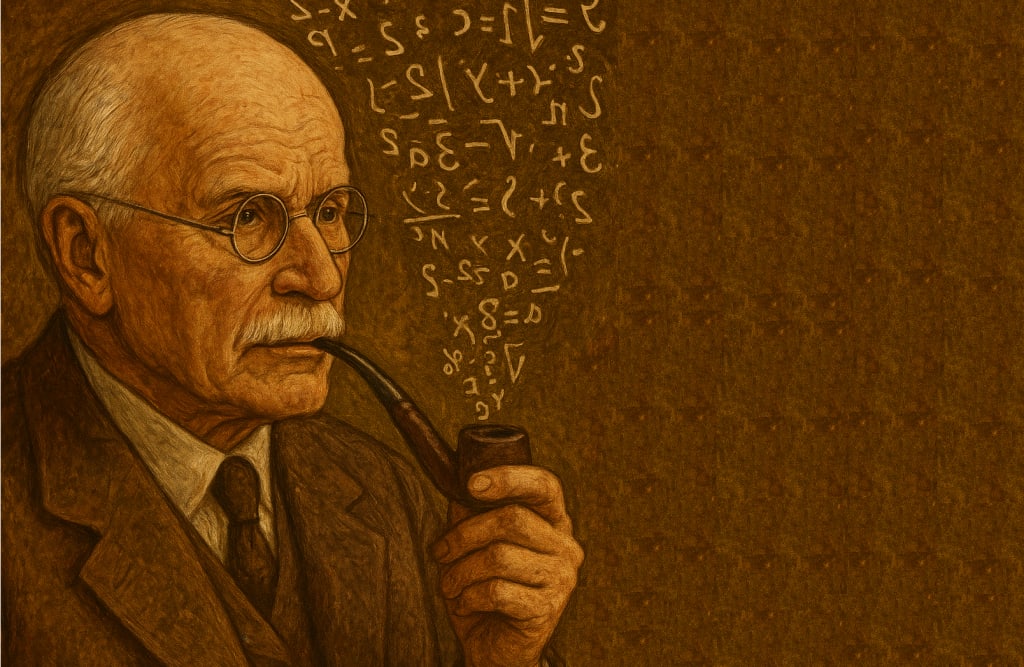
Context: In his book on Synchronicity, Carl Jung sets out to present the experiment he carried out to detect the existence of synchronistic events. But before doing so, he warns that his experiment must rely on statistics. However, for Carl Jung, mathematics and numbers are also unpredictable and reveal the unfathomable depths of our unconscious and nature.
Carl Jung says:
“The succession of natural numbers suddenly seems to be something more than a simple chain of identical units: it contains the totality of mathematics and everything that remains to be discovered in this field. Number is, therefore, in a certain sense, an entity impossible to predict (Synchronicity, Chapter One, “Exposition”).”
The great psychoanalyst Marie-Louise von Franz expressed something similar when she said:
“Nevertheless, it is very surprising that something the human mind has created—namely the series of natural integers (...), which is so simple and transparent for the constructive spirit—also contains an aspect of something abysmal that cannot be understood (Divination and Synchronicity: The Psychology of Meaningful Chance, “Conference 1”).”
For a mathematician this topic is surely easy to understand, but for those of us who are not experts in the field, we may fall into the naivety of believing that the number chain we learned as children in school (1, 2, 3, 4, 5, 6, 7, 8, 9, 0) has nothing special and simply represents quantities.
However, that sequence of numbers contains all possible mathematics, with infinite structures ranging from geometry, number theory, fractals, quantum physics, and much more.
Here begins the mystery for those of us who are not advanced in mathematics (like me), for when we see that vast world, the typical questions arise: Were mathematics invented or discovered? If they were invented, why are there discoveries? If they were discovered, who or what created them?
Both Jung and von Franz expressed that numbers were invented and at the same time discovered. However, the “abysmal” would be the unconscious: the depth that cannot be grasped rationally, the place we attempt to reach with quantum computers and far beyond—into infinity!
I understand this position very well, for I remember that when I delved a little into mathematics I had the feeling that numbers hide a depth that escapes reason. I felt as if they were emanations of a deeper order of reality, something like a kind of reality broader than human consciousness.
Later on, and in relation to the topic, Jung says:
“It is very striking that the global psychic images produced spontaneously by the unconscious—the symbols of the Self in the mandala formula—also have a mathematical structure. They are usually fours or multiples of four. These structures not only express order, but also create it. That is why they generally appear in moments of psychic disorientation to compensate for a chaotic state or as formulations of supernatural experiences.”
Here Jung is proposing a powerful thesis: The unconscious and the universe share the same structural language:
Mathematics.
It is as if the deep psyche thinks in numerical patterns instead of producing images and contents in an arbitrary way. Moreover, it is striking that it normally creates structures based on 4 and its multiples (4, 8, 16...).
The number four, in fact, is the key number in Jungian analysis, because it is the first minimal structure of totality, given that the Jungian mandala—which symbolizes totality—consists of 4 corners or their multiples.
PS: The above text is just an excerpt from a longer article you can read on my Substack. I'm studying the complete works of Jung and sharing the best of what I've learned on my Substack. If you'd like to read the full article, click the link below:
https://jungianalchemist.substack.com/p/the-mystery-of-numbers-mathematics
About the Creator
Alchemist
Scholar of Jungian analytical psychology.
Keep reading
More stories from writers in Psyche and other communities.


Comments
There are no comments for this story
Be the first to respond and start the conversation.