
The Lantern Keeper
In a seaside village shadowed by war, a quiet woman guards the light—and the hope of those waiting to return home


The sea had taken her husband, and still, Eleanor lit the lantern every night.
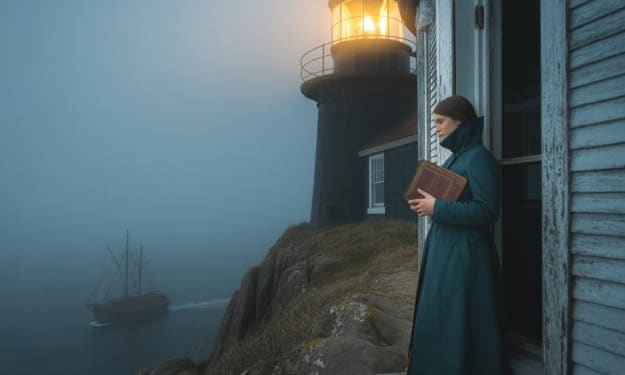
The old lighthouse on Stonewake Cliff had stood for over a hundred years, its beam sweeping the dark like a sentinel. Its gears groaned and its bricks wore salt like old wounds, but it had never gone dark. Not once. Not even now, in 1941, with war howling across Europe and the Channel full of ghosts.
Eleanor could not fight. She could not fly planes or decipher codes. But she could climb the spiral stairs, light the flame, and guide the ships home.
The villagers called her “the widow of the wind.” She rarely spoke. Grief had taken her voice years ago, when Thomas’s ship went missing during a routine patrol. No wreckage. No telegram. Just the silence of the sea.
But still, she came to the lighthouse.
Every evening, she arrived with her heavy coat, her scarf wrapped high, her hands red from the cold. She checked the oil, wound the crank, and waited for dusk. When the sun fell behind the cliffs and the tide swallowed the shore, Eleanor would climb the final stairs and light the flame.
The light turned slowly, cutting the mist.
Sometimes, in the silence, she imagined Thomas watching from somewhere far off, seeing that beam and knowing she was still there. Still waiting.
One bitter January night, a knock came at the lighthouse door.
She froze. Few came this far in the dark, especially during blackout hours. She opened the door slowly, and there he stood—not Thomas, but a boy. Barely seventeen, with a torn coat, mud on his cheeks, and panic in his eyes.
“Please,” he whispered, “I need to signal a boat. They’re waiting offshore.”
He was no villager. She could see that at once. His accent was clipped, his hair too clean. He wore no uniform, but everything about him said war.
Eleanor stepped aside.
The boy followed, breathless with relief, glancing out toward the dark horizon. He explained in bursts—part of a resistance group, trying to smuggle information across the Channel. The others were waiting in a rowboat, hidden in a sea cave beneath the cliffs.
“The storm’s coming,” he said. “They won’t risk waiting long.”
Eleanor said nothing. She climbed the stairs, turned the beacon seaward, and made the adjustments.
For two long minutes, the beam flashed a coded pattern into the night. Then nothing.
Silence.
The boy’s shoulders slumped. “Maybe they didn’t see—”
A faint light blinked on the horizon.
Once. Twice. Three times.
The boat was moving.
The boy laughed, wiped his face, and turned to her. “You saved them.”
Eleanor just nodded.
Before he left, he paused at the door. “Why did you help me?”
She looked past him, toward the sea.
She raised one hand to her chest, where Thomas’s locket hung under her scarf. Then, slowly, she pointed toward the lantern.
“I keep the light,” she whispered. Her voice cracked like dry paper. “That’s all.”
The boy left before the patrols returned, disappearing down the rocks like a shadow. She never saw him again.
But others came.
Not many. Just a whisper here, a knock there. Refugees, messengers, stranded pilots. Word traveled in quiet circles: There’s a woman on the cliffs. She keeps the light.
Eleanor never asked names. She only offered shelter, hot tea, a signal when needed.
The war raged on. Bombs fell. Lives broke. The lighthouse shook once when a raid flew too close, its windows cracked, its lantern flickered—but it never went dark.
When victory bells finally rang out in 1945, the village erupted. Flags returned. Children danced in the streets.
Eleanor stood by the lighthouse and watched the ships come home.
Some bore scars. Some bore coffins.
But some—miraculously—bore survivors.
One morning, months after the armistice, a letter arrived. No return address. Just her name, handwritten in neat lines.
“To the Lantern Keeper—
You saved more than ships. You saved lives. You gave us hope. We never forgot.”
Inside the envelope was a medal. Not military, but crafted—handmade, etched with the shape of a lighthouse and the words: In darkest hours, light endures.
Eleanor never wore it.
She placed it beside Thomas’s locket in a small wooden box, wrapped it in cloth, and set it by the lantern stairs.
And every night, until her final breath, she lit the flame.
About the Creator
Imran Khan
I am a passionate writer, meticulous editor, and creative designer. With a keen eye for detail and a love for storytelling, Me bring words and visuals together to create compelling narratives and striking designs.
Keep reading
More stories from Imran Khan and writers in Psyche and other communities.
The BAFTA Awards
By now, in a stunning departure from recent years, most of the world is aware of what happened at the BAFTA film awards. Social Media Headlines will tell you the bare bones: that John Davidson, a Tourette's Syndrome advocate, shouted a racial slur at two Actors of Colour, Michael B Jordan and Delroy Lindo.
By Natasja Rose3 days ago in Psyche
Video Call Tarot Readings: An Evidence-Based Assessment of Format Effectiveness
The proliferation of video-based tarot consultations represents a significant structural shift in how divinatory services are delivered in the digital age. Video call tarot readings combine the visual transparency of in-person sessions with the geographic flexibility of remote consultations, creating a hybrid modality that merits careful evaluation against established formats such as telephone and text-based readings.
By Enrique Martinez5 days ago in Psyche


Comments (1)
Beautiful story.