
The Illusion of Control: Why Letting Go Brings Peace
“Why Releasing Control Can Calm the Mind and Set You Free”

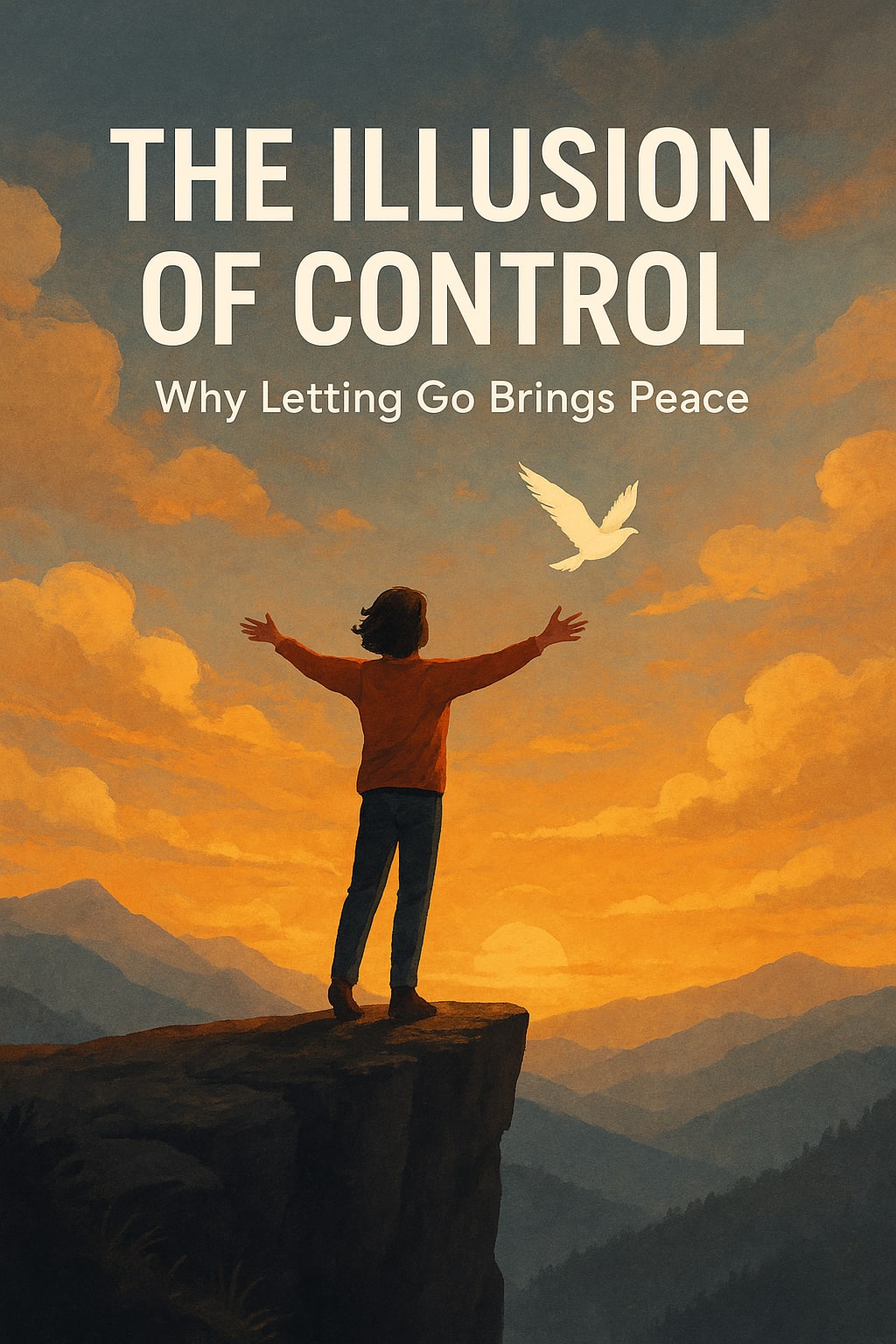
The Illusion of Control: Why Letting Go Brings Peace
Most of us like to believe we’re in control. We plan our days, set goals, check boxes, manage routines, and try to keep everything in order. We tell ourselves, “If I just try hard enough, I can make everything go my way.” It’s comforting to think that life is a puzzle we can solve with enough effort. But life has a way of showing us otherwise. A traffic jam ruins your perfectly timed schedule. A sudden illness shifts your future plans. A person you trusted lets you down. These moments feel frustrating, overwhelming, and often unfair. But they all point to one truth we often resist: we are not in control of everything — and that’s okay.
Psychologists call this need to control “the illusion of control.” It’s a powerful cognitive bias that convinces us we have more influence over outcomes than we really do. This illusion gives us a sense of safety. After all, who wouldn’t want to feel like they’re steering the ship in stormy waters? But the problem begins when we cling too tightly to control—over people, events, or even our own emotions. When life doesn’t follow our script, anxiety creeps in. We feel like we’re failing, even when we’re doing our best.
Neuroscience backs this up. Our brains are wired to seek predictability. The prefrontal cortex—our brain’s decision-making center—loves order and logic. When things go according to plan, we feel calm and capable. But when uncertainty hits, the amygdala (our emotional response system) triggers stress and fear. That’s why uncertainty feels so emotionally draining—it creates a chemical storm in the brain.
But here’s the twist: trying to control everything actually creates more anxiety, not less. Why? Because life isn’t a machine—it’s a dance. It moves with rhythm, but not always in straight lines. Trying to force outcomes that are beyond your control leads to constant tension. You might find yourself overthinking every detail, replaying conversations, obsessing over what “should” happen. Instead of living, you’re constantly managing, fixing, micromanaging. And that’s exhausting.
What if the solution isn’t to grip tighter—but to let go?
Letting go doesn’t mean giving up. It means surrendering the need to control things that are fundamentally uncontrollable—like other people’s opinions, the future, or unexpected outcomes. It’s the radical acceptance that life is uncertain, and peace comes not from mastering the chaos but from trusting yourself to navigate it. It’s choosing to respond instead of react.
Take relationships, for example. You can’t control how someone feels about you. You can’t control whether they stay or leave, whether they forgive or hold a grudge. But you can control how you show up—with honesty, love, and boundaries. When you let go of trying to control their actions, you reclaim your energy. You stop trying to manage their emotions and start tending to your own.
The same is true for goals. You can’t control whether a project goes viral, whether a job interview lands, or whether your dream pans out exactly as imagined. But you can control your effort, your consistency, and your mindset. Ironically, letting go of the outcome often improves your results. Why? Because when you stop fearing failure, you act more freely and authentically. You give your best without the heavy weight of perfection.
One of the most powerful practices in learning to let go is mindfulness. It trains your brain to stay in the present moment instead of spiraling into what-ifs. You learn to observe your thoughts without judgment, to breathe through uncertainty, to trust that even if you don’t have all the answers, you have the strength to face whatever comes. Mindfulness isn’t passive—it’s the bold act of being fully alive in the now.
Another tool is journaling. Writing down your thoughts helps you identify what you’re trying to control. Ask yourself: “What am I afraid of losing?” “What outcome am I trying to force?” “What can I let go of today?” The more you name your fears, the less power they hold over you. Slowly, you begin to shift from control to clarity, from pressure to presence.
Letting go is not a one-time event. It’s a daily decision. It means waking up each day and choosing peace over perfection, flow over force, trust over tension. It’s not always easy. In fact, it can feel terrifying at first. But over time, it brings a deeper kind of confidence—the kind that doesn’t depend on everything going right, but on your ability to stay grounded when things go wrong.
In a world that glorifies hustle, control, and certainty, surrender feels like weakness. But in truth, it’s a kind of strength the world desperately needs. Because the most peaceful people are not those who have life perfectly planned—but those who have learned to dance with its uncertainty.
About the Creator
Muhammad Hussain
I have been through very tough time, life is not safe for everyone, some people may have gifted the things they want, and some struggling to get things, don't lose hope no matter how upset you are, be a role model for someone
Keep reading
More stories from Muhammad Hussain and writers in Psyche and other communities.
Social Media and Anxiety: The Neuroscience Behind Constant Comparison
Social Media and Anxiety: The Neuroscience Behind Constant Comparison We open our phones with a swipe and step into a world where everyone seems to be living their best lives. Smiling faces, perfect bodies, exotic vacations, career milestones—all served up in a never-ending scroll. At first glance, it feels harmless, maybe even motivating. But underneath that glittering surface, a silent war brews in the mind. As likes pour in for others and silence greets our own posts, a subtle unease sets in. That unease, over time, often turns into something deeper: anxiety. And the science shows—it’s not all in your head.
By Muhammad Hussain8 months ago in Psyche
Top tipple tricks
Been thinking a lot about drinking, lately. Not least because of a recent episode of over-indulgence and the inevitable after effects. Some readers may recall the earlier articles I wrote about beating the booze. Here I set out an experiment in techniques for cutting down on my alcohol intake. The experiment was successful, the techniques worked, and I have armed myself with an arsenal of weapons in the war against the demon drink. I have yet to fire the first round however. It's all a question of timing (perhaps procrastination).
By Raymond G. Taylor3 days ago in Psyche




Comments
There are no comments for this story
Be the first to respond and start the conversation.