
Social Media and Anxiety: The Neuroscience Behind Constant Comparison
Unmasking the Hidden Mental Toll of Likes, Filters, and Constant Comparison

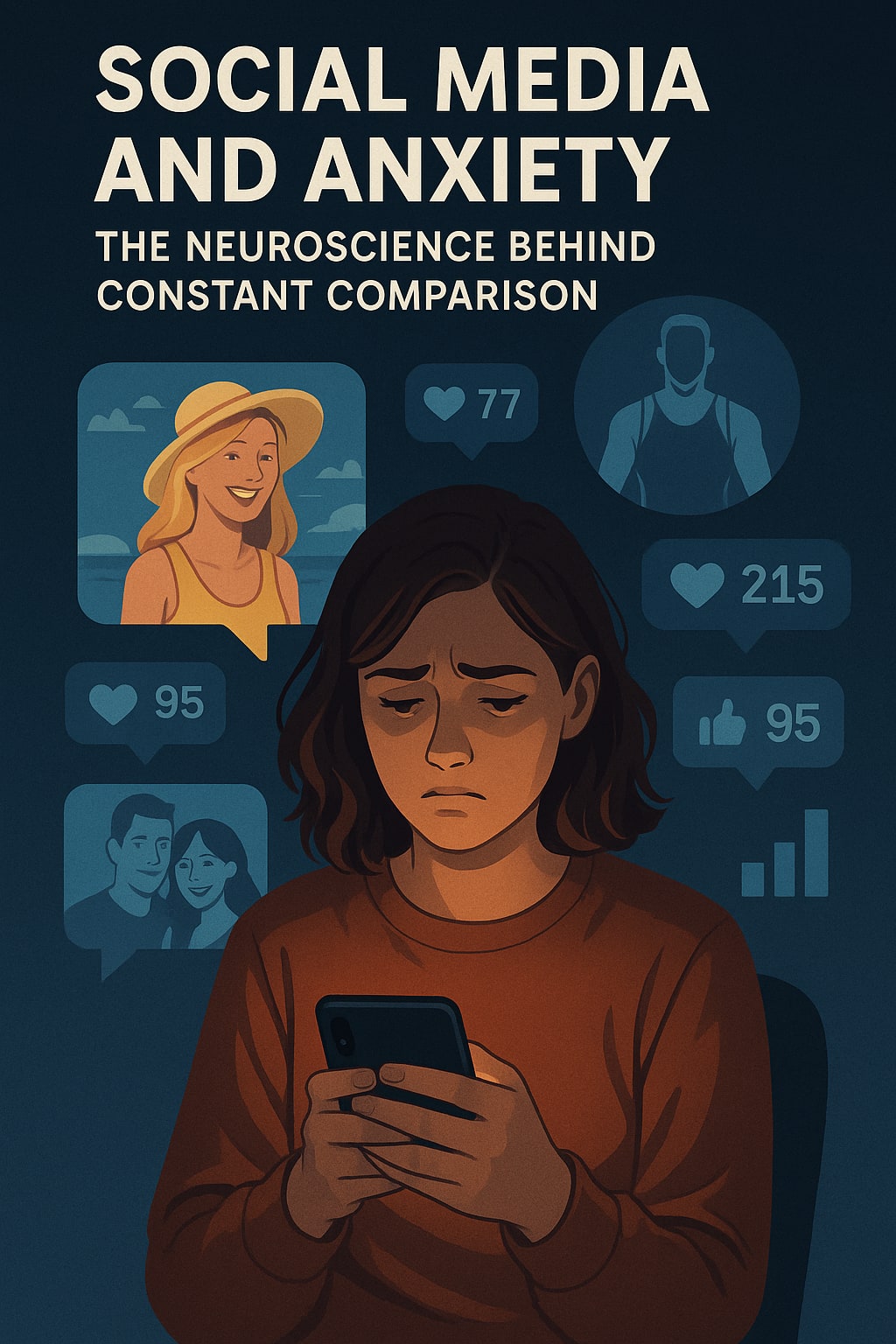
Social Media and Anxiety: The Neuroscience Behind Constant Comparison
We open our phones with a swipe and step into a world where everyone seems to be living their best lives. Smiling faces, perfect bodies, exotic vacations, career milestones—all served up in a never-ending scroll. At first glance, it feels harmless, maybe even motivating. But underneath that glittering surface, a silent war brews in the mind. As likes pour in for others and silence greets our own posts, a subtle unease sets in. That unease, over time, often turns into something deeper: anxiety. And the science shows—it’s not all in your head.
Social media platforms are designed to keep us engaged, and they do that by constantly feeding us content tailored to our interests and social circles. But the human brain didn’t evolve to process highlight reels from hundreds of people every single day. In fact, comparing ourselves to others is a very old psychological instinct. Thousands of years ago, it helped us understand where we stood in a tribe or community. But now, thanks to social media, we are comparing ourselves not to ten people—but to thousands. And worse, we’re comparing ourselves to carefully edited, filtered, and curated versions of them.
At the core of this phenomenon lies a part of the brain called the amygdala—the region responsible for processing emotions like fear, stress, and threat. When you see someone who appears to be more successful, attractive, or happier than you, your brain interprets it as a kind of social threat. This triggers a stress response, releasing cortisol—the body’s primary stress hormone. Over time, repeated exposure to this cycle can lead to chronic stress, feelings of inferiority, and a persistent sense of anxiety.
But it’s not just the amygdala doing the heavy lifting. The dopamine system, which governs the brain’s reward circuit, plays a massive role in social media addiction. Every like, comment, or follower triggers a small release of dopamine—the same chemical involved in addiction to gambling or drugs. So, we begin to crave validation. We post for approval. And when we don’t get it? The dopamine crashes, and the anxiety rushes in.
The most dangerous part is how subtle it all is. You might not even realize you're comparing yourself until it’s already affecting your mood. You open Instagram “just to relax,” but 15 minutes later, you're feeling worse about your body, your job, your life. You see a friend announce a promotion, and suddenly your own progress feels meaningless. You watch a couple post vacation selfies, and your own relationship begins to feel dull in comparison. It’s a slow erosion of self-worth, pixel by pixel.
What makes it more complicated is the illusion of connection. Social media promises closeness, but often delivers isolation. You may be surrounded by content, but not real conversation. You know what someone ate for breakfast but haven’t heard their voice in months. This fake sense of closeness can deepen the loneliness, especially when your feed is filled with people you don’t even speak to anymore. And as loneliness rises, so does anxiety.
However, this doesn’t mean social media is evil. Like any tool, its impact depends on how we use it. The first step toward reclaiming your mental peace is becoming aware of when and how social media is triggering anxiety. Do you feel worse after scrolling? Are you checking it first thing in the morning and last thing before bed? Are you measuring your worth in likes and followers? Awareness is everything.
Once you’ve identified the patterns, you can begin to shift your habits. Curate your feed with intention. Follow people who inspire you—not those who make you feel inferior. Take breaks, even if it’s just for a few hours a day. Use features like “mute” or “limit screen time.” And most importantly, remind yourself that what you’re seeing isn’t real life—it’s someone’s edited version of it.
Another powerful practice is to replace screen time with grounding activities: journaling, walking in nature, talking to someone in real life, or reading. These actions reconnect you with your true self, outside the noise of the algorithm. They also give your brain the break it needs from the comparison loop and reintroduce real dopamine sources—like achievement, connection, and creativity.
If you're a content creator or someone who has to be online a lot, create with a mindset of authenticity rather than validation. Post because you have something valuable to say, not because you’re hoping for external approval. The more genuine your interaction with social media, the less anxious it will make you.
In the end, social media isn't the villain—comparison is. But now we know the science behind it. We understand how our brains respond. And with that knowledge comes power: the power to pause, reflect, and protect our mental peace. Because you are more than what fits inside a square box. Your life is worth more than a caption. And no amount of scrolling will ever replace the value of real self-worth.
About the Creator
Muhammad Hussain
I have been through very tough time, life is not safe for everyone, some people may have gifted the things they want, and some struggling to get things, don't lose hope no matter how upset you are, be a role model for someone
Keep reading
More stories from Muhammad Hussain and writers in Psyche and other communities.
The Silent Power of Self-Talk: How Your Inner Voice Shapes Reality
The Silent Power of Self-Talk: How Your Inner Voice Shapes Reality We all have a voice inside our head. It’s the one that whispers doubts before a big presentation, cheers us on in tough moments, or criticizes us when we fail. This inner voice is called self-talk, and though it’s silent to the world, its effects on our mind and life are profound. What most people don’t realize is that the way we speak to ourselves shapes not only our emotions and confidence but even how we perceive reality. In other words, your internal dialogue is one of the most powerful psychological tools you carry — and it can either become your biggest motivator or your worst enemy.
By Muhammad Hussain8 months ago in Psyche
Top tipple tricks
Been thinking a lot about drinking, lately. Not least because of a recent episode of over-indulgence and the inevitable after effects. Some readers may recall the earlier articles I wrote about beating the booze. Here I set out an experiment in techniques for cutting down on my alcohol intake. The experiment was successful, the techniques worked, and I have armed myself with an arsenal of weapons in the war against the demon drink. I have yet to fire the first round however. It's all a question of timing (perhaps procrastination).
By Raymond G. Taylor4 days ago in Psyche
The Mind Behind Your Money: Why Wealth Starts in Your Head
"You can earn more, save more, and invest wisely—but if your mind doesn’t understand money, it will always slip through your fingers. The real wealth isn’t in your bank account—it’s in the way you think about money."
By Zakir Ullah7 days ago in Psyche


Comments
There are no comments for this story
Be the first to respond and start the conversation.