
The Hidden Psychology of Why We Procrastinate (and How to Stop)
Why We Delay Even When We Know Better

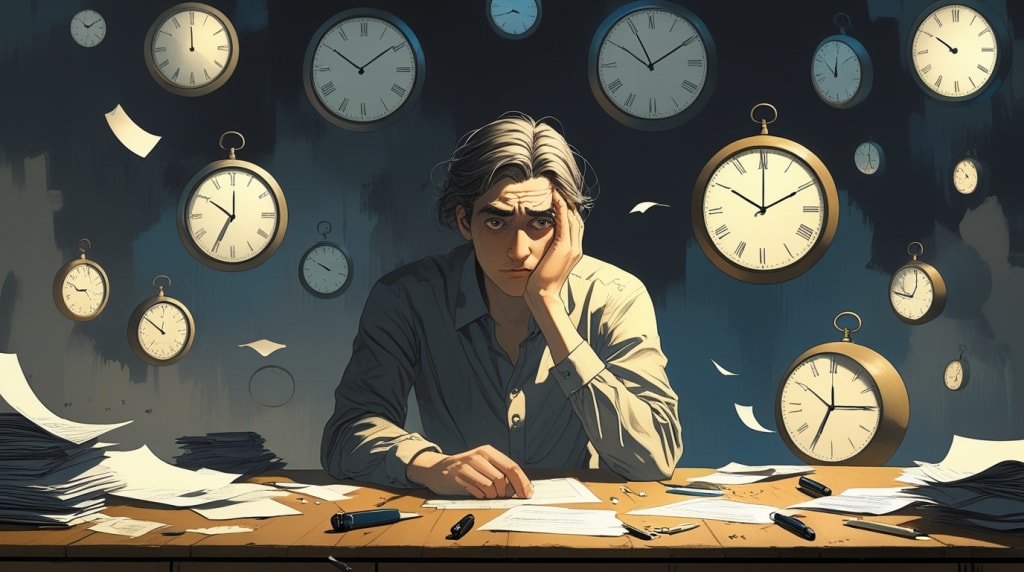
The Night Before Everything Falls Apart
It was 11:47 p.m., and Daniel was finally opening the document.
The proposal was due at 9 a.m. A proposal he'd had six weeks to write. Six weeks that had somehow evaporated into this single desperate night, his laptop screen glowing in the darkness like an accusation.
His coffee had gone cold three hours ago. His phone buzzed with a text from his girlfriend: "You're doing it again, aren't you?"
He didn't reply. What would he say? Yes, I'm doing it again. Yes, I hate myself for it. Yes, I know this is insane. No, I don't know why I can't stop.
Daniel had been procrastinating his entire adult life. Missed deadlines. Last-minute scrambles. That sick feeling in his stomach that started weeks before something was due and grew heavier with each passing day until it became a physical weight he carried everywhere.
People called him lazy. Irresponsible. Lacking discipline.
But here's what they didn't see: Daniel wasn't relaxing during those six weeks. He was suffering. Every day he didn't work on the proposal, he thought about the proposal. It haunted his meals, poisoned his sleep, turned every moment of would-be leisure into guilt-soaked avoidance.
He wasn't choosing pleasure over productivity. He was choosing a familiar agony over an unknown terror.
And tonight, at 11:47 p.m., with exhaustion pulling at his eyes and panic flooding his chest, Daniel finally understood something: procrastination had never been about time management.
It had always been about fear.
The Lie We Tell Ourselves About Procrastination
Most people think procrastination is a character flaw—a moral failing that separates the disciplined from the undisciplined, the successful from the stuck.
But research in psychology and neuroscience reveals something radically different: procrastination isn't about laziness. It's about emotion regulation.
Dr. Timothy Pychyl, a psychologist who has spent decades studying procrastination, puts it bluntly: "Procrastination is an emotion regulation problem, not a time management problem."
When Daniel stared at that blank document for six weeks, his brain wasn't being lazy. It was protecting him from something it perceived as dangerous.
Every time he thought about starting the proposal, his amygdala—the brain's threat detection system—fired up. His body released cortisol. His heart rate increased slightly. Anxiety flooded his nervous system.
The task itself wasn't dangerous, of course. But to Daniel's brain, the possibility of failure, judgment, or inadequacy triggered the same threat response as a physical danger.
And humans have a deeply ingrained response to threats: avoid them.
Neuroscientist Dr. Judson Brewer's research using fMRI scans revealed that when people procrastinate, they're actually seeking relief from negative emotions. The moment they choose to do something else—check social media, clean the kitchen, reorganize their desk—their brain's reward centers light up with a hit of temporary relief.
Procrastination feels like a solution because, in the moment, it is a solution. It's just solving the wrong problem.
Daniel wasn't avoiding work. He was avoiding the feeling that came with work—the vulnerability of trying and possibly failing, the exposure of being judged, the discomfort of not knowing if he was good enough.
And every time he chose temporary relief over long-term progress, his brain learned: This is how we handle scary feelings. We run.

The Perfectionist Who Can't Begin
Daniel's coworker, Priya, had the opposite reputation. Everyone thought she was a model of productivity—always early with submissions, always polished, always seemingly in control.
What they didn't see was Priya at home, rewriting the same paragraph seventeen times. Deleting entire sections because they weren't "quite right." Starting projects enthusiastically and then abandoning them the moment they stopped being easy.
Priya's procrastination looked different from Daniel's, but the psychology was identical.
She was a perfectionist procrastinator—someone who delays starting because the gap between her vision and her current ability feels unbearable.
Research by psychologists Gordon Flett and Paul Hewitt found that perfectionism and procrastination are intimately connected. Perfectionists don't avoid tasks because they're lazy—they avoid tasks because their standards are so impossibly high that failure feels inevitable.
For Priya, starting meant confronting the possibility that her work might be mediocre. That she might be mediocre. And that thought was so psychologically threatening that her brain preferred the limbo of not-yet-started over the pain of not-good-enough.
She told herself she was "waiting for inspiration" or "doing more research." But what she was really waiting for was a guarantee that didn't exist—a promise that if she started, she would be brilliant.
Dr. Brené Brown's research on shame and vulnerability reveals why perfectionism is such a powerful procrastination trigger: "perfectionism is not about achievement and growth. It's a shield we carry to protect ourselves from the pain of blame, judgment, and shame."
Priya's procrastination wasn't protecting her from the task. It was protecting her identity. As long as she hadn't started, she could still believe she was capable of perfection. The moment she started, reality would intrude.
And reality, with its imperfections and rough drafts and learning curves, felt like a threat to who she needed to believe she was.
The Hidden Comfort of the Crisis
At 1:23 a.m., Daniel was finally making progress. Words were appearing on the screen. Not good words—desperate, caffeine-fueled, barely coherent words—but words nonetheless.
And somewhere beneath the panic, he felt something familiar: a strange, terrible comfort.
This was the only way Daniel knew how to work. In crisis. At the edge. With no time for doubt or revision or the paralysis of perfectionism.
Psychologist Dr. Joseph Ferrari identified different types of procrastinators, and Daniel fit perfectly into one category: the thrill-seeker. People who, consciously or not, create artificial deadlines and last-minute pressure because it gives them an adrenaline rush that makes work feel possible.
For thrill-seekers, the panic isn't a bug—it's a feature. The emergency overrides all the emotional barriers that normally prevent them from starting. Fear of failure gets drowned out by fear of immediate consequences.
But here's the devastating part: this pattern creates a neurological loop.
Every time Daniel pulled off a last-minute miracle, his brain received a massive dopamine reward. He'd survived! He'd escaped disaster! The relief was so intense it actually felt good—almost euphoric compared to the weeks of dread that preceded it.
And that reward reinforced the behavior. His brain learned: This is how we work. This is what productivity feels like.
The cost was enormous. His health deteriorated. His relationships suffered. His work quality was never what it could have been. But the pattern felt impossible to break because it was the only pattern his brain knew.
Dr. Piers Steel, author of The Procrastination Equation, explains that this is how procrastination becomes chronic: "Our brains prioritize immediate rewards over future consequences. And the immediate reward of anxiety relief is so powerful that it overrides the long-term cost of procrastination."
Daniel wasn't choosing to procrastinate. He was trapped in a neurological pattern that had been reinforced hundreds of times—a pattern that felt more like who he was than a behavior he could change.
The Rebellion Hidden in Delay
Three floors down from Daniel's apartment, his neighbor Marcus sat on his couch, scrolling through his phone. His law school application essays had been due two days ago. He'd requested an extension. The third extension he'd requested this semester.
Marcus told everyone he was "just bad with deadlines." But alone, in the dark, he knew something else was true: part of him didn't want to finish the applications at all.
His parents wanted him to be a lawyer. His girlfriend thought it was a practical choice. Everyone in his life had opinions about what Marcus should do.
No one had asked what Marcus wanted.
And so Marcus's procrastination wasn't avoidance—it was a silent rebellion. A way of saying "no" without having to actually say no. A way of maintaining some illusion of control in a life where every major decision felt like it had already been made for him.
Psychologists call this "passive-aggressive resistance." Dr. Linda Sapadin identifies it as one of the key reasons people procrastinate: the task represents something they resent, so delaying becomes an unconscious act of defiance.
When your procrastination is really rebellion, no amount of time management or productivity hacks will help. Because you're not failing to do the task—you're succeeding at avoiding something you never wanted to do in the first place.
Marcus's procrastination was a message from his authentic self, trying desperately to be heard: This isn't your dream. Stop pretending it is.
But acknowledging that would mean disappointing people. Changing course. Admitting uncertainty. Having difficult conversations.
So instead, Marcus scrolled through his phone at 2 a.m., caught between the life he was supposed to want and the life he couldn't yet imagine wanting instead.
His procrastination wasn't protecting him from the work. It was protecting him from a choice he wasn't ready to make.
The Breaking Point That Became a Beginning
Daniel submitted his proposal at 8:47 a.m. Thirteen minutes before the deadline. It wasn't his best work—how could it be?—but it was done.
He collapsed into bed, feeling the familiar mixture of relief and self-loathing. Never again, he thought, the same lie he told himself every time. Next time will be different.
But then something unexpected happened.
He didn't get the contract. The proposal was rejected. And instead of the devastation he expected, Daniel felt something strange: curiosity.
Why had he done this to himself? Why did he keep choosing suffering over simple, early starts? What was he really afraid of?
For the first time, he stopped treating his procrastination as a character flaw and started treating it as information.
He made an appointment with a therapist who specialized in anxiety and perfectionism. And in their first session, she asked him a question that changed everything:

"What does procrastination protect you from feeling?"
Daniel sat with that question for a long time. And then, quietly: "From finding out I'm not as good as I need to be. From discovering that trying my best isn't good enough. From... being average."
The therapist nodded. "And what would happen if you were average?"
"Then I'd just be... nothing. Forgettable. Ordinary."
"And ordinary people," she said gently, "don't deserve love? Success? Happiness?"
Daniel's eyes filled with tears. Because there it was—the belief underneath all the procrastination, all the last-minute panic, all the years of suffering: I have to be extraordinary to deserve to exist.
The procrastination had been trying to save him from this unbearable truth. But in protecting him from the pain of being ordinary, it had prevented him from ever discovering if he could be extraordinary at all.
The Neuroscience of Change
Understanding why we procrastinate doesn't magically make us stop. Daniel's brain had decades of neural pathways connecting "important task" with "threat" and "avoidance" with "relief."
But neuroscience offers hope: brains are plastic. Patterns can be rewired.
Dr. Kelly McGonigal's research on willpower reveals that procrastination recovery isn't about becoming more disciplined—it's about becoming more compassionate with yourself.
When Daniel started approaching his work differently, he didn't start by trying to work harder. He started by working smaller.
He practiced something called "the five-minute start." Instead of committing to finishing—or even making significant progress—he committed only to starting for five minutes. No pressure to continue. No judgment about quality.
The psychology behind this is brilliant: procrastination is sustained by anxiety about the whole overwhelming task. By shrinking the commitment to something laughably small, you remove the threat that triggers avoidance.
Daniel discovered that starting was the hard part. Once he was in the work for five minutes, continuing felt easier. His brain switched from threat mode to task mode. The anxiety dissolved not through avoidance but through action.
He also learned to separate his identity from his output. With his therapist's help, he practiced believing: I am not my work. A bad proposal doesn't make me a bad person. Mediocre effort doesn't make me mediocre.
These weren't just affirmations—they were neurological repatterns. Every time he practiced self-compassion instead of self-criticism, he weakened the shame-avoidance loop that had sustained his procrastination.
Research by Dr. Kristin Neff confirms this: self-compassion is one of the most powerful predictors of overcoming procrastination. People who treat themselves with kindness when they fail are more likely to try again quickly. People who shame themselves create more anxiety, which creates more avoidance.
The cruel irony: being harsh with yourself about procrastination makes you procrastinate more.
The Different Faces of the Same Fear
Priya learned her perfectionism was fear wearing a crown. Marcus learned his rebellion was grief disguised as resistance. Daniel learned his crisis-seeking was a way to bypass the terror of not being enough.
But beneath all these different faces of procrastination was the same underlying truth: they were all trying to protect themselves from vulnerability.
From the exposure of trying and possibly failing. From the discomfort of being seen as they really were—uncertain, imperfect, still learning, still growing, still beautifully and terribly human.
Dr. Tim Urban, in his viral TED talk on procrastination, describes the "Instant Gratification Monkey" that lives in the procrastinator's brain. But what he captures so perfectly is that the monkey isn't evil—it's scared.
It's trying to protect you from something that feels dangerous. It just doesn't understand that avoiding the discomfort now creates more suffering later.
Overcoming procrastination isn't about defeating the monkey. It's about understanding what it's afraid of and teaching it, slowly and gently, that you can survive the discomfort of beginning.
The Morning Daniel Started Early
Six months after his rejected proposal, Daniel sat down at his laptop at 9 a.m. on a Tuesday. He had four weeks until his next deadline.
And he started.
Not because he felt inspired. Not because the anxiety had disappeared. Not because he'd magically become a different person.
But because he'd learned to tolerate the discomfort of imperfection. To sit with the vulnerability of not knowing if what he was writing was any good. To trust that starting badly was infinitely better than not starting at all.
His hands shook slightly as he typed the first sentence. His brain offered its familiar protests: This isn't good enough. You're not ready. You should do more research first.
But Daniel had learned to recognize these thoughts as fear, not truth. He kept typing.
Five minutes became ten. Ten became thirty. Before he knew it, he'd written three pages. Messy pages. Imperfect pages. Pages that would need revision.
But pages that existed.
He saved the document and stood up, feeling something he hadn't felt in years when working on a project: pride. Not in the quality of what he'd written—it was rough and he knew it—but in the fact that he'd started early. That he'd chosen long-term peace over short-term avoidance.
That he'd been brave enough to be mediocre on the way to becoming better.
Priya started keeping a "messy drafts" folder—a place where imperfection was the whole point. Marcus finally had the conversation with his parents about law school. It didn't go well, but it went honestly.
None of them stopped procrastinating entirely. The neural pathways were too deep, the patterns too familiar. But they stopped treating procrastination as a moral failing and started treating it as a signal—information about what they were really afraid of.
And slowly, with compassion and practice and a willingness to be uncomfortable, they learned to start before they were ready.
To work before they felt like it.
To be imperfect in public and survive it.
Because that's the secret that procrastinators spend their whole lives avoiding: you don't overcome fear by avoiding the thing that scares you.
You overcome it by doing the thing scared.
By starting when it's hard. By continuing when it's boring. By finishing when it's messy and imperfect and not at all what you imagined.
By learning, gradually and painfully and beautifully, that you are not your output.
That your worth doesn't depend on being extraordinary.
That ordinary, imperfect effort is not just enough—it's the only way anything extraordinary ever gets made.
Daniel looks at his laptop now without dread. The document is still there, growing slowly, day by day.
It won't be perfect. It might not even be particularly good.
But it will be done. On time. Without crisis.
And for Daniel, that's not just productivity.
It's freedom.
About the Creator
Keep reading
More stories from Ameer Moavia and writers in Psyche and other communities.
Why Smiling Can Feel Like the Hardest Thing
The Unbearable Weight of a Smile: When Your Face Refuses to Lie Anymore "Just smile," they said, as if my face were a light switch I could simply flip. As if the muscles required to curve my lips upward hadn't become so heavy that lifting them felt like deadlifting my own despair. As if smiling—the simplest, most automatic human expression—hadn't become the most exhausting performance of my entire day. I'm standing in line at the coffee shop, and the barista is making small talk. "How's your day going?" she asks, cheerful, genuine, expecting the standard response. My jaw tenses. My face feels like stone. I know what I'm supposed to do—smile, say "great, how about you?", participate in this basic social ritual that I've performed thousands of times without thinking. But I can't. My face won't cooperate. The muscles required to form a smile feel paralyzed, or more accurately, weighted down by something too heavy to lift. I force it anyway. The corners of my mouth move upward mechanically, but it doesn't reach my eyes. It doesn't feel genuine. It feels like I'm wearing a mask that doesn't quite fit. "Fine, thanks," I manage, and the barista's smile falters slightly. She can tell. Something's off. My smile is wrong somehow—too tight, too forced, too obviously fake. I take my coffee and leave quickly, exhausted by the thirty-second interaction. My face hurts from the effort of that brief, failed smile. And I still have an entire day of this ahead of me. When Your Face Becomes a Traitor I used to smile easily, automatically. It was a reflex, an unconscious response to humor, kindness, joy, social situations. I never thought about it, never had to try. Now every smile is manual labor. Every upward curve of my lips requires conscious effort, deliberate muscle activation, sustained energy I don't have. My face has become resistant, like it knows I'm lying and refuses to participate in the deception. In meetings at work, I'd notice other people smiling, laughing, their faces animated and expressive. And I'd try to match them, to mirror their expressions, to look like I was engaged and present. But my face wouldn't cooperate. It would freeze in this neutral, flat expression that read as either bored or angry, even though I wasn't trying to look either way. I just... couldn't make my face do what faces are supposed to do. "You look upset," my boss said after one meeting. "Is everything okay?" "I'm fine," I said, and tried to smile to prove it. But even I could feel how wrong it looked—this grimace that pretended to be a smile, this contortion that fooled no one. "If something's bothering you, you can talk to me," he pressed. Nothing was bothering me. At least, nothing specific. I wasn't angry or upset about work. I was just... unable to smile. Unable to make my face perform the basic signals that tell others I'm okay, I'm engaged, I'm a functioning human being having a normal interaction. The Exhaustion of Performance Every day became a marathon of forced facial expressions. Wake up. Try to smile at my partner over breakfast. Fail. See his concern. Force a smile to reassure him. Feel my face muscles strain with the effort. Get to work. Try to look pleasant and approachable. Feel my face settle into that blank, heavy expression despite my best efforts. Force periodic smiles during conversations. Feel exhausted by 10 AM from the sheer effort of manipulating my own face. Lunch with colleagues. They're laughing about something. I hear the joke, understand it's funny, know I should be laughing too. Try to make my face do the laughing expression. Produce something that's almost a smile but not quite right. See them notice. Feel them pull back slightly, unsure how to read me. By the end of each day, my face would actually ache. Not from overuse, but from the constant tension of trying to force expressions that wouldn't come naturally, of fighting against muscles that wanted to remain flat and unresponsive. I started avoiding situations that required me to smile. Stopped going to social gatherings where I'd have to perform happiness I didn't feel. Turned down invitations to celebrations, parties, events where smiling would be expected and my inability to do so would be conspicuous. My world shrank to environments where I didn't have to pretend—mostly my apartment, alone, where my face could rest in its natural state of heavy neutrality without judgment or concern. Understanding the Impossibility "Why can't I smile?" I asked my therapist, genuinely baffled by this loss of what seemed like the most basic human function. "I'm not trying to look miserable. I just... can't make my face do it anymore." She explained it in a way that finally made sense. "Depression doesn't just affect your mood—it affects your motor functions, including the facial muscles. The neurotransmitters that allow for spontaneous emotional expression are depleted. Your face isn't refusing to smile. Your brain isn't sending the signals that create smiling." She showed me research about something called "facial feedback"—the way our facial expressions both reflect and influence our emotional state. When you smile, your brain registers that feedback and generates corresponding positive emotions. It's a two-way street. But in depression, that street is blocked. Your brain can't generate the positive emotions that produce genuine smiles, and forcing smiles doesn't trick your brain into feeling better—it just exhausts you with the effort of manually operating machinery that's supposed to be automatic. "It's not laziness," she emphasized. "It's not attitude. It's a literal neurological impairment. Your brain has lost the ability to generate spontaneous positive facial expressions." Knowing this didn't make it easier, but it helped me understand why something so simple had become so impossibly hard. The Social Cost The inability to smile carries a staggering social cost that people who've never experienced it can't understand. Humans are wired to read faces. We make split-second judgments about people based on their expressions. A lack of smiling reads as unfriendly, unapproachable, angry, or unstable—even when that's not what you're feeling at all. My relationships deteriorated. Friends stopped reaching out because interactions with me felt flat, heavy, unrewarding. I wasn't fun to be around anymore. Not because I was actively negative, but because I couldn't reflect back the warmth and positive energy that social bonds require. My partner grew increasingly frustrated. "You never seem happy to see me," he said one night. "I come home and you just... look at me. No smile, no warmth, nothing." "I am happy to see you," I insisted. "I just can't make my face show it." "That doesn't make sense," he said, hurt and confused. "If you're happy, why can't you smile?" How could I explain that happiness and smiling had become disconnected? That I could feel some small sense of gladness that he was home, but that feeling couldn't translate into facial expression? That the pathway between emotion and face had been severed? I couldn't explain it in a way that made sense to him. And eventually, he stopped believing I was happy to see him at all. The Judgment and Misunderstanding The worst part was the constant judgment from people who didn't understand. "You should smile more!" Random strangers, usually men, felt entitled to offer this advice, as if my face existed for their viewing pleasure. "Cheer up, it might never happen!" People would joke, assuming my expression meant something bad had occurred, when really it just meant my face was resting in its default depressed state. "Why are you so angry?" I wasn't angry. I was just unable to smile. "You need to work on your attitude." My attitude was fine. My face just couldn't show it. People assumed my lack of smiling meant I was rude, unfriendly, hostile, or miserable. They couldn't see that I was simply exhausted from trying to operate machinery that had stopped working. Even well-meaning people hurt me with their attempts to help. "Just fake it till you make it!" they'd say. "Force yourself to smile and you'll feel better!" But forcing smiles didn't make me feel better. It made me feel like a fraud. It highlighted the gap between what my face was doing and what I was actually feeling. It made the depression more obvious, not less, because the smile never reached my eyes, never looked genuine, never fooled anyone including me. The Breaking Point The crisis came during my niece's birthday party. She was turning five, excited, adorable, having the time of her life. She ran up to me with a drawing she'd made, her face lit up with pure childhood joy. "Look what I made for you, Auntie!" I looked at the drawing—a colorful, enthusiastic rendering of the two of us holding hands. She'd drawn me with a big smile. And I couldn't smile back at her. I tried. God, I tried. This innocent child showing me something she'd made with love, and I couldn't produce even a small smile of acknowledgment. My face remained flat. Heavy. Unresponsive. Her face fell. "Don't you like it?" "I love it, sweetheart," I said, my voice breaking slightly. "It's beautiful." But she'd already seen my expression—or lack of it. She walked away, confused and a little hurt, and I stood there holding her drawing, hating myself for not being able to give this child the one simple thing she wanted: a smile. That night, I called my psychiatrist. "Something's really wrong," I said. "I can't even smile at a five-year-old. What's happening to me?" The Medical Reality My psychiatrist adjusted my medication and explained what was happening. "What you're experiencing is called 'psychomotor retardation'—a slowing down of physical and emotional responses. It's a core symptom of major depression. Your facial muscles aren't responding normally because the neural pathways that control spontaneous expression aren't functioning properly." She also mentioned something called "anhedonia"—the inability to feel pleasure—which often comes with an inability to express pleasure, even when you're trying. "The medication we're adjusting should help," she said. "But it takes time. Six to eight weeks, possibly longer, before you notice a difference." She also recommended something unexpected: facial exercises. "Research shows that deliberately practicing facial movements—even without the corresponding emotion—can help retrain the neural pathways. It won't cure the depression, but it might make the physical expressions easier." So I started doing these bizarre exercises. Standing in front of the mirror, manually moving my face through expressions. Lifting the corners of my mouth with my fingers to simulate a smile. Holding it. Releasing. Repeating. It felt ridiculous. I felt ridiculous. But I was desperate enough to try anything. The Slow Return The medication took seven weeks to start working. Seven weeks of forced smiles, exhausted facial muscles, and social situations I couldn't navigate properly. Then one morning, my partner said something funny at breakfast and I felt it—a real smile, spontaneous and genuine, breaking across my face without effort. It lasted maybe three seconds before fading. But it was real. It was mine. It happened without me having to manually operate my face. I started crying, which alarmed my partner until I explained: "I just smiled. A real smile. I didn't have to force it." He looked at me with such relief and sadness. "I didn't realize how hard it's been for you," he said quietly. After that, smiles came more frequently. Not all the time—I still had days where my face felt weighted and unresponsive. But the genuine smiles started outnumbering the forced ones. The effort required diminished. My face started cooperating again. Living With the Memory A year later, I can smile relatively easily again. Not effortlessly like I used to, and not constantly. But the heavy impossibility has lifted. My face has mostly remembered how to express what I'm feeling without requiring manual operation. But I haven't forgotten what it was like. That period when smiling felt harder than anything else, when my face betrayed me every day, when the simplest human expression became impossible. I'm gentler with people now. When I see someone with a flat expression, with a face that doesn't smile easily, I don't assume they're unfriendly or angry or rude. I wonder if maybe they're fighting this same battle. If maybe their face is as heavy as mine once was. I also don't take smiling for granted anymore. Every genuine smile feels like a gift, like evidence that my brain is working properly again, that the neural pathways are transmitting signals the way they should. The Truth That Needs Telling If you can't smile right now—if your face feels like dead weight, if forcing expressions exhausts you, if people keep telling you to cheer up and you want to scream that you're trying but your face won't cooperate—please know this: You're not broken. Your face isn't defective. This is a symptom of depression as real and valid as any other symptom. Your brain's ability to generate spontaneous positive expressions has been impaired by depleted neurotransmitters and disrupted neural pathways. This isn't attitude. This isn't choice. This is neurology. And it's treatable. With the right medication, therapy, and time, your face can remember how to smile again. The heaviness can lift. The effort can diminish. The genuine smiles can return. Don't let people shame you for something you literally cannot control. Don't let them tell you to "just smile" as if you haven't been trying. Don't let them mistake your depression for rudeness or hostility. Your face will cooperate again. The pathways will reconnect. The expressions will come naturally once more. Until then, be patient with yourself. You're not failing at something easy. You're managing something impossibly hard. And you're doing better than you think. When smiling becomes the hardest thing, it's not because you're ungrateful or negative or refusing to see the bright side—it's because depression has literally disconnected the neural pathways between emotion and facial expression. Your face isn't betraying you out of spite. It's malfunctioning because your brain chemistry is disrupted. The effort it takes you to produce a smile is the same effort it would take someone else to deadlift a car. You're not being difficult. You're being incredibly strong, showing up to social situations and manually operating facial machinery that's supposed to be automatic. The heaviness will lift. Your face will remember. Until then, please stop judging yourself for not being able to do something your broken neurology has made nearly impossible. --------------------------------------------- Thanks for Reading!
By Ameer Moavia2 months ago in Psyche
The BAFTA Awards
By now, in a stunning departure from recent years, most of the world is aware of what happened at the BAFTA film awards. Social Media Headlines will tell you the bare bones: that John Davidson, a Tourette's Syndrome advocate, shouted a racial slur at two Actors of Colour, Michael B Jordan and Delroy Lindo.
By Natasja Rose2 days ago in Psyche



Comments
There are no comments for this story
Be the first to respond and start the conversation.