
The Dimming Mind: How Convenience Culture Is Making Us Forget How to Think
In a world where AI writes, GPS navigates, and apps decide what we eat, are we outsourcing not just tasks—but our very ability to reason?

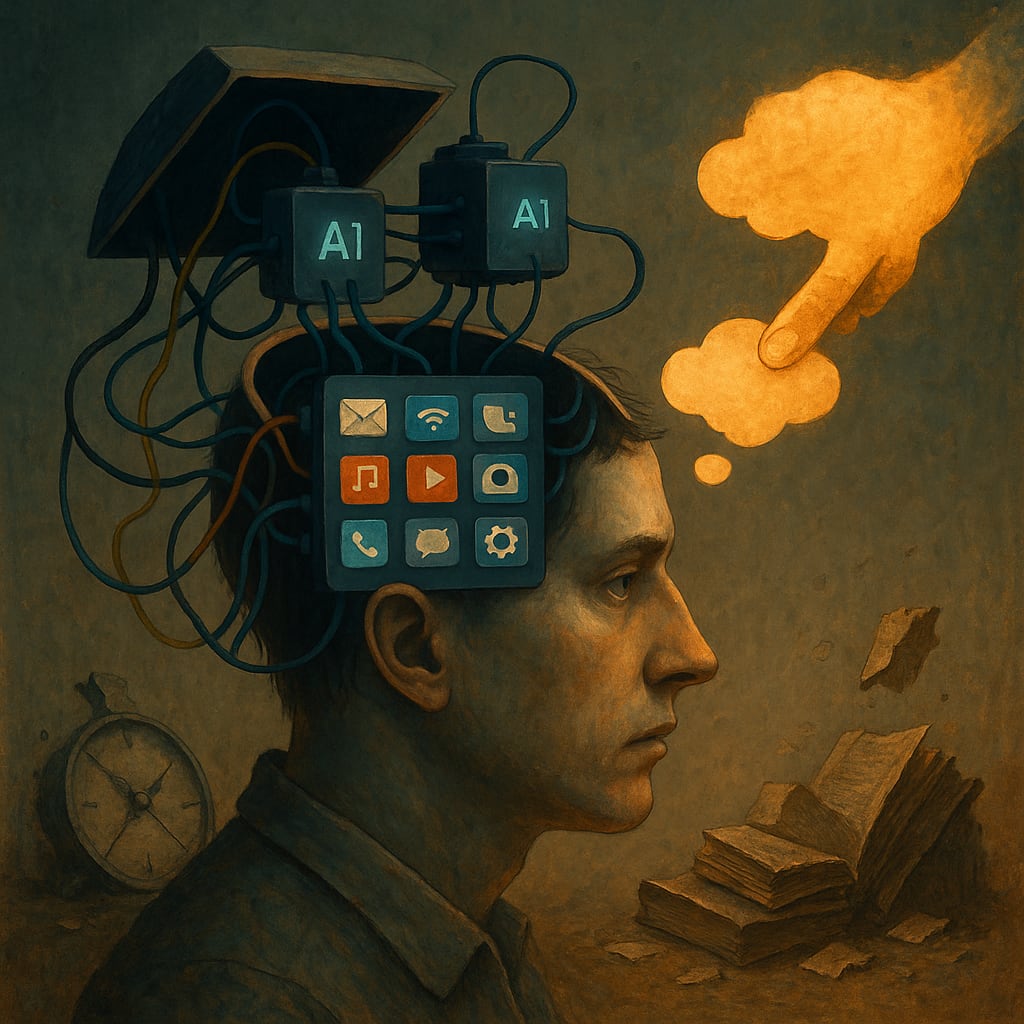
We live in an age of astonishing ease. With a few taps, we summon dinner, diagnose a rash, translate a foreign text, or generate an entire business plan. Algorithms anticipate our desires before we consciously register them. The idea that technology should do the thinking for us has become not only accepted—but celebrated.
But here's the quiet cost no one’s billing us for: our cognitive muscles are atrophying. Our tolerance for ambiguity is vanishing. Our ability to hold multiple, even contradictory ideas in our minds, is fading. Welcome to the era of cognitive outsourcing, where convenience doesn’t just serve us—it replaces us.
Chapter 1: The Algorithm Ate My Curiosity
Once, curiosity was a survival skill. We read to discover. We asked questions to uncover the unknown. Now, we scroll to be fed answers in bite-sized, auto-completed forms. TikTok teaches us history in 15-second bursts. YouTube serves us "the next video" before we even decide what we're in the mood for.
When everything is one swipe away, there's no room for confusion, for wonder, for the messy, uncertain paths that real thinking often takes. Curiosity thrives in gaps, not in endless feeds.
Convenience kills the question.
And when the question dies, so does the thinker.
Chapter 2: Navigation Without Orientation
There was a time when getting lost was part of traveling—and of growing. We memorized routes, followed maps, read signs, asked strangers. Today, we plug in an address and follow robotic instructions. "Turn left in 300 meters." We arrive—but at what cost?
A study from the University of London found that habitual GPS users showed decreased activity in the hippocampus—the brain region responsible for spatial navigation and memory. When we stop mapping our world, our brains stop mapping it too.
We get to places faster but lose our sense of place.
What’s the point of knowing where you are if you no longer know how you got there?
Chapter 3: Thinking in Templates
AI writes poems now. It drafts essays, resumes, emails—even this article, perhaps. But as templates proliferate, they begin to shape not only how we write, but how we think. Creativity becomes auto-formatted. Opinions become echoes.
The paradox of AI-assisted thinking is this: it gives us infinite output, but often in finite forms. It predicts what we probably want to say. It doesn’t ask what we should be thinking.
A prompt that starts with "Write me a story about..." becomes a funnel—not a seed.
And slowly, we trade imagination for optimization.
Chapter 4: Emotions on Autopilot
The convenience revolution doesn’t just rewrite our intellect—it rearranges our emotional lives.
We ghost people because confronting feelings is hard. We “like” instead of expressing real appreciation. We rely on apps to tell us when to hydrate, meditate, even when to breathe.
Therapy apps promise emotional healing on demand. Mindfulness is sold as a productivity hack. But what happens when inner reflection becomes a scheduled push notification?
We begin to outsource emotional labor, not just mental tasks. We want relief, not understanding. We seek quick fixes for complex pain.
Chapter 5: The Illusion of Empowerment
All this technological power can feel like autonomy—but often, it’s the opposite. Every decision delegated is one less muscle moved. Every automated process is one less moment of friction that teaches us patience, analysis, or empathy.
Ironically, our abundance of choices has created a kind of learned helplessness. We consult reviews before tasting. We wait for ratings before trusting. We follow trends before forming preferences.
When machines do the work, we feel powerful.
But when machines do the thinking, we become passive.
Chapter 6: Resisting the Mental Drift
So how do we reclaim our ability to think?
We don’t need to reject technology—but we do need to reinstate the value of struggle, reflection, and manual mental labor.
Read things you disagree with.
Navigate without GPS once in a while.
Try to recall something before Googling it.
Write long-form thoughts without AI assistance.
Sit with confusion. Let it simmer.
Make decisions without a review score.
The point is not nostalgia. It’s agency.
The mind, like the body, needs resistance to grow.
Conclusion: Are We Becoming Too Convenient to Think?
There’s a fine line between “smart tools” and “thinking substitutes.” When we forget that line, we risk becoming spectators in our own minds—scrollers instead of seekers, responders instead of reasoners.
The danger is not that AI or algorithms will take over the world.
It’s that they will slowly take over the one thing that made us human to begin with: our capacity for conscious thought.
And we won’t even notice—because it will be so convenient.
About the Creator
Ahmet Kıvanç Demirkıran
As a technology and innovation enthusiast, I aim to bring fresh perspectives to my readers, drawing from my experience.
Keep reading
More stories from Ahmet Kıvanç Demirkıran and writers in Psyche and other communities.
The Echo Chamber of the Self: How Personal Algorithms Are Rewriting Our Reality
In the early days of the internet, we marveled at its ability to open up the world. With a single search, we could find voices from distant lands, cultures we’d never known, and ideas that challenged our own. It was chaotic, but liberating. And then, bit by bit, the web stopped feeling so wide.
By Ahmet Kıvanç Demirkıran9 months ago in Psyche
The Seed Of Certainty
The Seed of Certainty You realize, at some point, that there is a deep part of you that has been practicing—quietly and persistently—being correct all the time. This aspect has never announced itself. It has never demanded authority or recognition. It does not argue, perform, or posture. It simply observes. It listens. It tests. It refines. While other parts of the mind rush to conclusions, cling to opinions, or defend identities, this part waits. It has always waited. And it has always known when something was true and when it was not.
By Chase McQuade5 days ago in Psyche


Comments (1)
Marvellous story telling 🌼💙🌼