
The Day I Unfollowed My Anxiety
My anxiety had 10,000 followers in my head, but I hit ‘unfollow’—and learned to mute the noise.

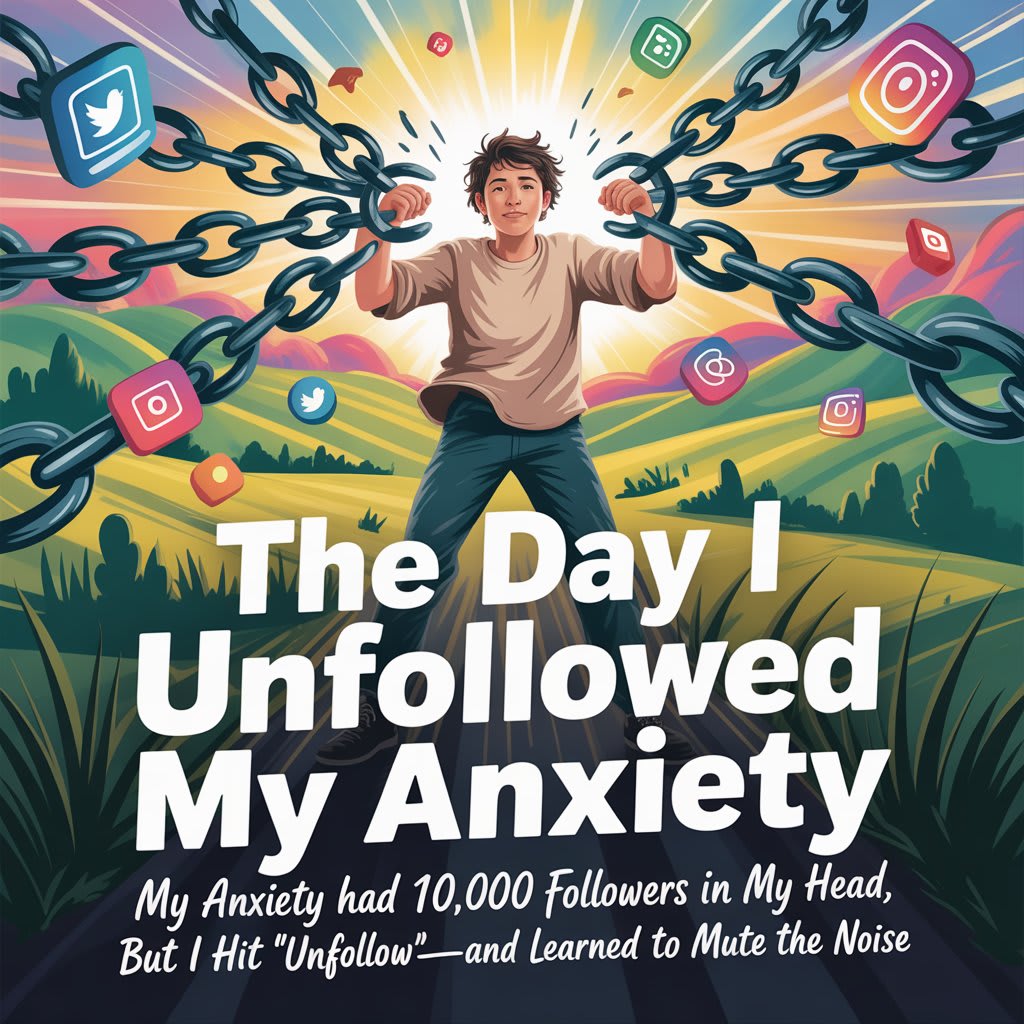
The Day I Unfollowed My Anxiety
“My anxiety had 10,000 followers in my head, but I hit ‘unfollow’—and learned to mute the noise.”
By Muhammad Haroon
The notification buzzed in my brain at 3:17 AM, sharp and uninvited, like a DM from a stranger who knows too much about you. You’re going to mess this up. You always do. My anxiety was at it again, scrolling through my insecurities like a curated feed of doom. It had 10,000 followers in my head, each one amplifying its voice until it drowned out reason. That night, tangled in sweaty sheets, I decided I was done. I was going to unfollow my anxiety.
It started small, as most revolutions do. I was 29, working a desk job that felt like a treadmill to nowhere, living in a one-bedroom apartment where the walls seemed to whisper my failures. My anxiety wasn’t just a feeling—it was a presence, a roommate who never paid rent but always had opinions. It told me I’d bomb my presentation at work, that my friends were tired of me, that the barista’s curt “next!” was a personal slight. It posted endless stories in my mind: Here’s you tripping over your words. Here’s everyone laughing. Here’s you alone. I’d refresh, and the algorithm would serve up worse.
That morning, bleary-eyed and clutching my coffee like a lifeline, I stumbled across a quote on my phone: “You can’t control the world, but you can control your attention.” It felt like a glitch in my mental feed—a moment of clarity in the noise. I thought about social media, how I’d culled accounts that made me feel small or envious. Why couldn’t I do that with my thoughts? Anxiety wasn’t a fact; it was a filter. And I could change the settings.
Step one was naming it. I called my anxiety “Karen,” because it was always demanding to speak to the manager of my peace. Karen loved catastrophic what-ifs: What if you get fired? What if you’re unlovable? I started talking back, not in my head but out loud, in my empty kitchen. “Karen, you’re being extra today. Sit down.” It felt ridiculous, but it worked. Naming her made her less omnipotent, more like a cranky commenter I could mute.
Next, I set boundaries. Karen thrived on my late-night scrolls through work emails or my obsessive replays of awkward conversations. So I made rules: no emails after 8 PM, no ruminating past 10. When Karen tried to hijack my thoughts, I’d redirect. I’d focus on the texture of my sweater, the hum of the fridge, anything to anchor me in the now. It was like switching apps when an ad pops up—clumsy at first, but I got faster.
The real test came at work. I had a pitch meeting for a project I’d poured weeks into. Karen was in full influencer mode, flooding my head with predictions of failure: They’ll hate it. You’ll freeze. You’re a fraud. My heart raced, my palms sweated, but I remembered my plan. I’d written a note on my phone: “Karen’s loud, but she’s not the boss.” Before the meeting, I stepped into the bathroom, splashed cold water on my face, and whispered, “You’ve got this. Karen’s just background noise.” I walked into that room, and for the first time in years, I spoke without second-guessing every syllable. The pitch wasn’t perfect, but it landed. My boss nodded; my colleagues smiled. Karen sulked in the corner, unfollowed.
It wasn’t a one-day fix. Unfollowing anxiety was a daily choice, like flossing or drinking water. Some days, Karen snuck back into my feed, louder than ever. Like when I got a text from an old friend canceling plans, and Karen whispered, They’re done with you. I’d spiral, then catch myself. “Karen, you’re projecting. People get busy.” I’d text back, keep it light, and move on. Other days, I’d win bigger—like when I joined a yoga class, something I’d avoided for years because Karen said I’d look foolish. I wobbled through downward dog, laughed at my own clumsiness, and felt free.
I started curating a new mental feed. I read books on mindfulness, not because I wanted to be a guru, but because they gave me tools. I practiced box breathing—four seconds in, hold, four seconds out—when Karen got loud. I journaled, spilling my fears onto paper where they looked smaller, less like headlines and more like drafts I could edit. I even tried gratitude, which sounded cheesy but worked. Each night, I’d list three things that went well: a good sandwich, a kind email, a sunset. Slowly, my brain’s algorithm shifted, serving up less doom and more hope.
The biggest shift came when I realized Karen wasn’t my enemy. She was a part of me, wired to protect me by spotting threats. She just had terrible aim, turning every uncertainty into a lion. So I thanked her, weirdly enough. “Thanks, Karen, for keeping me alert, but I’ve got this.” It was like tipping a bad waiter—you acknowledge the effort, then move on. This softened her grip, made her less desperate for my attention.
A year later, I’m not anxiety-free. Karen still has a few followers, popping up during big changes—like when I applied for a promotion or went on a first date. But she’s no longer trending in my head. I’ve learned to mute her noise, to choose what gets my focus. That 3:17 AM wake-up call? It happens less now, and when it does, I don’t scroll her feed. I breathe, I ground, I rest.
Unfollowing my anxiety didn’t delete it, but it gave me back my voice. I’m the one posting now, curating a life that’s messy, real, and mine. And when Karen tries to comment, I just smile, hit “block,” and keep going.
About the Creator
Keep reading
More stories from Muhammad Haroon and writers in Psyche and other communities.
How We Read Ourselves
📖 How We Read Ourselves By Haroon In the quiet corner of the café, Marla sat hunched over her notebook, sipping lukewarm espresso and tracing her pen along the creases of the page. The words were hers—at least she believed they were. Her handwriting, curled and deliberate, danced across the paper in a way that felt too poetic to belong to her in real life.
By Muhammad Haroon5 months ago in Art
Society Often Teaches Us to Suppress Our Sad Feelings, Branding Them as Negative.
Allow yourself the time to feel, process, and let go. What a journey we’ve traveled together. You can relate to that pain that appears out of nowhere and wants to linger in our minds. Once fear moves in, it takes root—spreading doubt, loneliness, and confusion It’s that kind of pain that overtakes your mental health, gradually making a home within you. Your thoughts can create a space filled with fear, a feeling that we often cling to because it’s the one our minds use against us—leading to a fierce battle between your thoughts and your feelings. It’s a struggle no one wants to lose, yet losing yourself feels like an ever-present threat. Isn’t that a trick life plays on us?
By Johana Torres13 days ago in Psyche
Watch Out Wednesdays - 1/14/26 (Opinion)
We are now in the second week of 2026. Even though we are only in the first fourteen days of this year, so much has happened in America and throughout the world that would normally take up about 6 months of news. Events are accelerating to an all-time high.
By Adrian Holmanabout 18 hours ago in Psyche


Comments
There are no comments for this story
Be the first to respond and start the conversation.