
The Architecture of Starting: Why We Struggle, and How We Can Redesign Action
Insights from Cognitive Drive Architecture on the dynamics of readiness, Drive, and initiation.


Last year, I couldn't start anything on time.
Not because I was lazy.
But because I never defined where the start actually was or how to make starting possible.
If you've struggled with procrastination, inertia, or task avoidance, despite caring about the outcome, you know the pattern. You intend to do the work. You know what needs to happen. You even want it done.
But nothing begins.
What's happening beneath the surface?
Modern psychology offers many partial explanations:
- Motivation theories explain why tasks matter.
- Executive function models describe how we regulate attention and behavior once we've started.
- Behavioral economics maps our irrational delays and trade-offs.
But across all these models, one blind spot remains consistent:
What determines the exact moment when action begins or fails to?
In other words, where is the ignition switch?
This is the question at the heart of a new field called Cognitive Drive Architecture (CDA), a structural science of how effort begins, sustains, and collapses across time.
And in that science, we find a powerful new explanation for why even capable, motivated people so often fail to start.
Effort Is a Configuration, Not a Feeling
Here's a key insight:
Effort isn't something you summon by force of will.
It isn't the sum of your motivation or a reflection of discipline.
It is a system configuration.
In CDA, action readiness, what we typically call "Drive," emerges when a specific set of internal variables align into an ignition-ready state.
If they don't align, effort cannot start, no matter how much you care.
This is why last year, even when I was desperate to meet deadlines, I couldn't begin. The system wasn't misaligned emotionally; it was misaligned architecturally.
And crucially, that ignition threshold isn't metaphorical. It is a dynamic, computable gate inside the architecture of cognition.
The Equation of Drive
At its core, Cognitive Drive Architecture models Drive using a structural equation.
The original version of this equation, proposed in the foundational theory of CDA, is shown here:
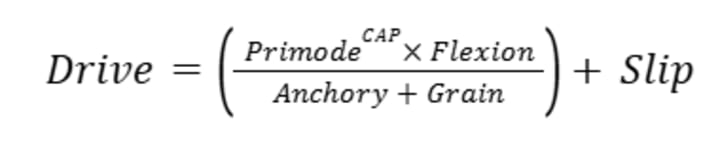
The essence of this law remains intact: Drive emerges from the interaction of ignition readiness (Primode), emotional-volitional amplification (CAP), cognitive alignment (Flexion), attentional stabilization (Anchory), internal friction (Grain), and systemic noise (Slip).
However, as CDA evolved through subsequent research, the model was refined into a stable and updated version, which is now used in new theories and applied contexts:

This updated form introduces important enhancements:
- The Primode term is modeled with a dynamic comparator loop (binary ON/OFF but driven by continuous readiness signals).
- Small constants ε and δ were added to prevent computational artifacts when the Primode or Grain approach boundary values.
- The time dependence of all variables is now explicit (Drive(t), CAP(t), etc.), reflecting their dynamic behavior in real-world cognition.
- The architecture now explicitly supports hysteresis, bistability, and entropy-driven volatility, critical features of human effort patterns.
In short, the updated equation preserves the core insight of Lagun's Law while making it more robust and biologically plausible for current and future applications of CDA.
Is Readiness a Switch or a Scale?
A key point: readiness is not a fixed binary state; it is a continuous comparator loop.
Internally, your system continuously evaluates:
Is my current internal readiness signal greater than my dynamic ignition threshold?
When the signal exceeds the threshold, Primode flips ON (1), and ignition occurs.
When it does not, Primode remains OFF (0), and no action starts.
The ignition threshold itself is highly dynamic, influenced by:
- Urgency and time pressure
- Emotional state
- Identity alignment with the task
- History of failure (hysteresis, past failure raises future threshold)
- Recovery and fatigue
This explains why you can feel fully motivated but still frozen: your readiness signal may be high, but the threshold is temporarily higher still.
Why "Start" Is a Moving Target
Because the ignition threshold fluctuates dynamically, the experience of starting is inherently unstable.
Some days:
- Your readiness signal naturally exceeds the threshold; action feels effortless.
Other days:
- Prior failures, fatigue, or misaligned self-concept raise the threshold beyond your current readiness signal. Even small tasks feel impossible.
This is not a personality flaw. It is a structural state of the system.
One particularly powerful, and often misunderstood, feature of this architecture is hysteresis:
Repeated failure raises the ignition threshold, creating self-reinforcing inertia.
Conversely, successful starts lower the threshold, building momentum.
This is why early wins matter; they structurally reshape the readiness landscape.
Precision Entry: Why One Action Can Shift the System
Given this architecture, vague goals are counterproductive.
They overload the comparator loop, increasing Grain and destabilizing Anchory:
"Write the report."
"Finish the project."
"Clean the house."
These are not actionable entry points. They demand complex state alignment.
CDA predicts, and this is one of its strongest novel claims, that precise, minimal entry cues can transiently lower the ignition threshold, making Primode more likely to flip ON:
- Write one sentence.
- Open the file and type today's date.
- Put one dish in the sink.
But here's the critical nuance: this strategy is conditionally effective.
- If Grain is extremely high (emotional overload), even precise entry may fail.
- If Anchory is low (high distractibility), entry may trigger dropout.
- If Flexion is poor (the task feels alien), even small starts may trigger aversion.
Precision of entry is necessary but not sufficient.
Its efficacy depends on the global system state.
That's why starting small works sometimes, and sometimes doesn't. CDA provides a structural account of these failures.
Predicting Outcomes: What CDA Adds
A theory is only as useful as the novel predictions it makes.
Here are just a few outcomes that CDA predicts, outcomes poorly explained by traditional motivation or executive function models:
- Identity alignment modulates ignition threshold independently of emotional state; tasks congruent with your self-concept lower the threshold dramatically.
- Repeated failure raises the ignition threshold (hysteresis), explaining chronic procrastination cycles.
- Performance volatility (Slip) causes even high-readiness individuals to experience spontaneous Drive collapse, which is why good days suddenly turn bad.
- Hyper-precise entry cues lower the threshold only when Anchory > Grain; otherwise, they fail, explaining the inconsistent success of "start small" advice.
These are not intuitive truths. They are architectural predictions, and they have been supported in initial behavioral and modeling studies.
Redesigning Action: A Structural Prescription
So what can you do?
First, abandon the myth that readiness is a feeling. It is a system state.
Second, work with the architecture:
- Define your entry point with surgical precision.
- Stabilize Anchory; focus on environments that matter.
- Lower Grain through rest, reframing, and recovery.
- Respect the non-linear dynamics of Drive, expect hysteresis, and plan accordingly.
Today, I write one sentence.
That's the first step, not because it magically ensures success, but because it structurally lowers the ignition threshold just enough to enable Drive, if other conditions permit.
Conclusion
For decades, we've told people to "just try harder."
Cognitive Drive Architecture shows why that's insufficient.
Effort is not something you try to have. It is something your system must be configured to produce.
And that configuration can be consciously influenced, but only if you understand the architecture beneath the surface.
So next time you're stuck, don't try to force yourself to do the whole thing.
Design the first moment your system can actually enter.
One sentence. One action. One structural shift.
The rest will follow when your architecture is ready.
About the Creator
Keep reading
More stories from Nikesh Lagun and writers in Psyche and other communities.
Focus Isn't About Trying Harder: It's About Friction
In the age of constant notifications, open tabs, background noise, and infinite scrolling, we've come to believe that focus is a matter of willpower. If we just tried a little harder, eliminated laziness, and summoned more discipline, we could finally sit down and get things done. But what if this assumption is wrong?
By Nikesh Lagun8 months ago in Psyche
This Show Makes You Suspicious on Purpose
At first, it feels harmless. You sit down to watch His & Hers the way you sit down to watch any thriller. Lights dimmed. Phone face-down. A body on screen. A mystery to solve. Two people telling the same story in different voices. You tell yourself this is entertainment. Suspense. Craft.
By Aarsh Malik3 days ago in Psyche



Comments
There are no comments for this story
Be the first to respond and start the conversation.