trauma
At its core, trauma can be thought of as the psychological wounds that persist, even when the physical ones are long gone.
Tragedy in Rhode Island: When Violence Shattered an Ordinary Day
The gunshots in Rhode Island did not begin when the weapon fired. They began much earlier, in a mind that slowly shifted from frustration to fixation, from anger to action. By the time the trigger was pulled, something inside the shooter had already hardened.
By Aarsh Malik8 days ago in Psyche
How I Saved My Sleeping Family from Suffocating to Death
It was late September, and I had moved up to senior school. I was only just eleven and wouldn’t be twelve until the far end of June. I had spent the summer holidays carefree, happy, and getting prepared for my new ‘big’ school, and my twin and I were both ecstatic to leave junior school far behind us.
By Chantal Christie Weiss11 days ago in Psyche
Inner Child Healing: Release Childhood Trauma and Find Peace. AI-Generated.
Many of us carry echoes from the past that shape our present experiences, often in ways we barely notice. Learning inner child healing allows us to acknowledge these hidden parts of ourselves, release unresolved wounds, and cultivate self-healing practices that foster emotional resilience. Whether trauma shows up as anxiety, difficulty in relationships, or self-doubt, attending to the inner child creates a pathway toward lasting transformation.
By Jose Morris14 days ago in Psyche
Drugged, Assaulted, and Filmed by My Predator “Friends”. Content Warning.
“You’re not a victim for sharing your story. You are a survivor setting the world on fire with your truth. And you never know who needs your light, your warmth, and raging courage.” — Alex Elle
By Chantal Christie Weiss15 days ago in Psyche
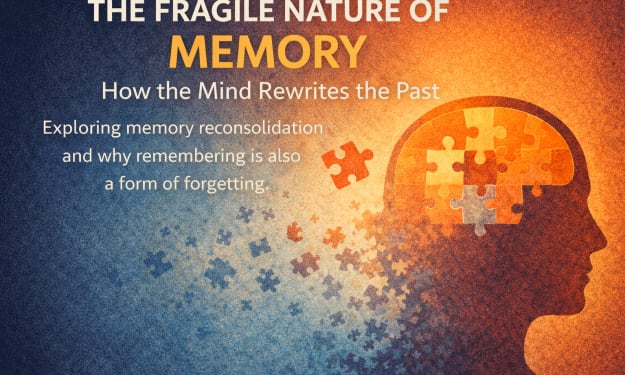
The Fragile Nature of Memory: How the Mind Rewrites the Past
We often view memory as a recording device. Something happens, and the brain stores it. Later, we recall it unchanged, like opening a file. Psychology presents a different picture. Memory is not fixed; it is fluid, reconstructive, and surprisingly fragile. One interesting aspect of cognitive psychology is memory reconsolidation, which is the process that alters our memories every time we recall them. This instability is not a flaw; it shows how our minds adapt, protect themselves, and reshape our identity over time.
By Kyle Butler17 days ago in Psyche
When Thinking Feels Like Action
There is a particular satisfaction that comes from understanding something clearly after wrestling with it for a long time. The mind settles. Tension releases. Pieces line up. In that moment, it can feel as though real movement has occurred, as though something meaningful has been accomplished. That feeling is not imagined. Cognitive resolution is a real event. The danger appears when that internal resolution is quietly mistaken for external change, and thinking begins to substitute for action rather than prepare the way for it.
By Peter Thwing - Host of the FST Podcast17 days ago in Psyche
The Terrifying Psychology That Can Turn Anyone Into a Monster (Including You)
What do you think is your quiet thought when you hear something really awful, a story of cruelty, or a dreadful injustice? It is most likely to be something such as, "I would never do that." We reassure ourselves that monsters are of another breed. They are the bad men, the men with a crooked soul, the men with something wrong in their hearts.
By Tarek Rakhiess18 days ago in Psyche