
The Terrifying Psychology That Can Turn Anyone Into a Monster (Including You)
Behind every innocent face, a hidden entity lurks. This article will change your perceptions of human nature and make you reconsider everyone around you… and even yourself!

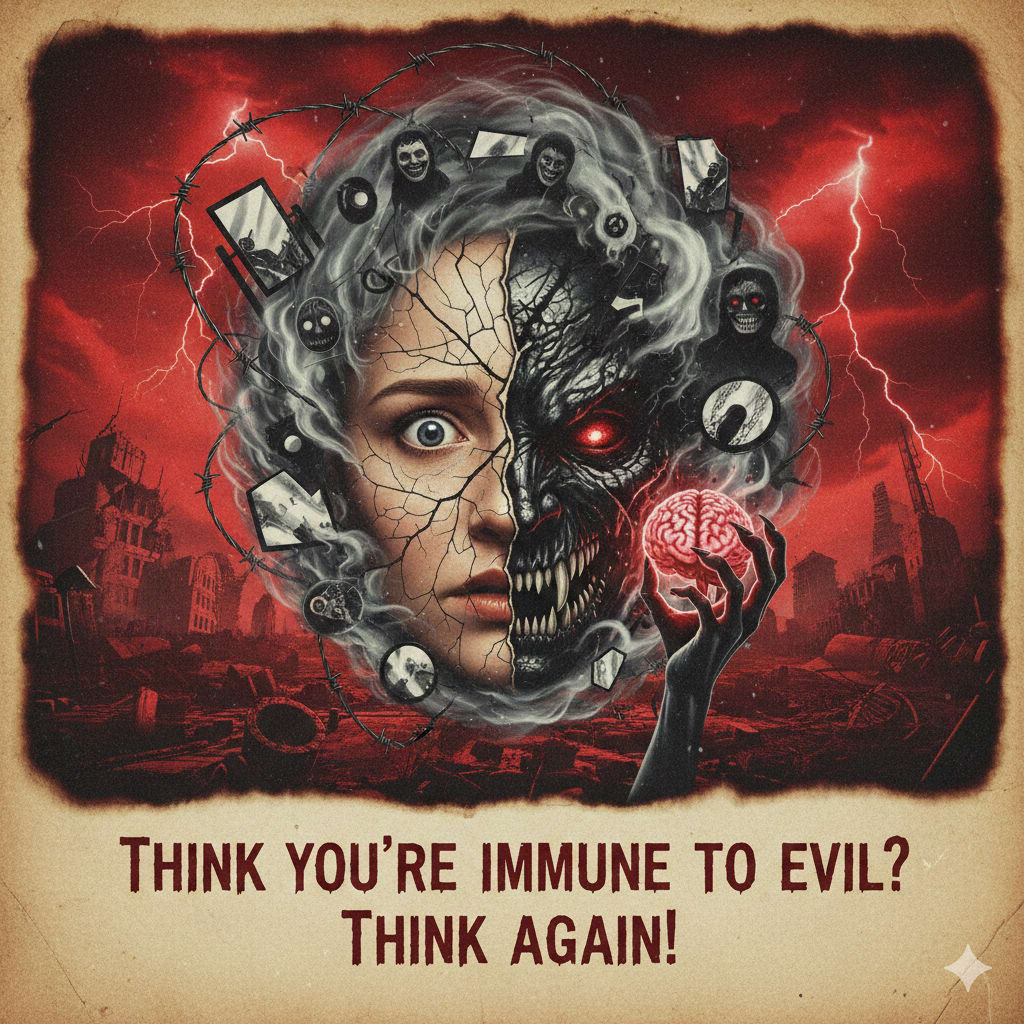
What do you think is your quiet thought when you hear something really awful, a story of cruelty, or a dreadful injustice? It is most likely to be something such as, "I would never do that." We reassure ourselves that monsters are of another breed. They are the bad men, the men with a crooked soul, the men with something wrong in their hearts.
It is a warm idea, but it is a false illusion too. And the most disturbing fact that psychology has ever discovered is that there is no high wall between the categories of nice people and monsters.
It is a weak bit of thread, and with a proper push, nearly any of us could just walk over it.
I understand that is a heavy thing to sit on. It's uncomfortable. It questions our self-identity. This is not the way to know how to make people feel guilty or fearful. It concerns the development of some psychological immunity.
When we are aware of the routes that bring average citizens into the dark, we can identify the stoplights in our lives and in the world.
Another path can be taken. That's what we'll do here.
We will go through the historic experiments, we will unpack the psychological mechanisms, and I will provide you with one basic but potent practice you can begin today to strengthen your own moral compass.
It all starts with two of the most famous-and disturbing-studies ever conducted.
The Experiments That Shattered Our Illusions
A quiet psychologist by the name of Stanley Milgram established a misleadingly innocent experiment at Yale in the 1960s. The participants were informed that they were involved in research on memory and learning.
They were to provide electric shocks to a learner (who was a mere actor) whenever he made a mistake in an answer.
The shocks were more and more tremendous with every error and marked as far as a horrifying "XXX." The participant heard outcries, banging on the wall, pleas of a heart condition, and… nothing.
It was this: to what extent would they go?
Psychiatrists had estimated under 1 percent would reach maximum voltage before the study. The real outcome? 65 percent of the participants had administered what they thought were fatal shocks. Not psychopaths. Not monsters. The teachers, postal workers, engineers, and ordinary people who were sweating, trembling, and pleading with the experimenter yet continued because a man in a lab coat told them, "The experiment requires that you continue."
The obedience experiment conducted by Milgram taught us a bone-chilling lesson:
A legitimate figure of authority can easily override our strongest moral values. We find ourselves in a state he referred to as "agentic," where we give up our sense of personal responsibility to the individual in charge.
On this page about the experiment of Milgram, you can read a detailed breakdown of the methodology and its far-reaching implications.
This idea was extended a few years later by the psychologist Philip Zimbardo. He wanted to know what would happen when you did not give people orders but gave them roles. He designed a virtual prison in the basement of the psychology building at Stanford, where he randomly assigned normal, healthy college students to be guards or prisoners. The plan was for two weeks.
It lasted six days.
The change was terribly fast. The guards, endowed with uniform and indeterminate power, started to humiliate and psychologically torture the prisoners.
The inmates were subdued and troubled. What was supposed to be a simulation turned into reality in their minds.
Sadistic behavior was not a result of sadistic personalities but a circumstance that allowed and encouraged it. Even Zimbardo, who was the superintendent of the prison, became so immersed in the game that he was unable to intervene until an outsider entered the prison and was horrified.
The complete, torturous history of the Stanford Prison Experiment is a masterwork of how surroundings make us, and the subsequent thoughts of Zimbardo himself are an important addition to the narrative.
So, the "what" is clear. The how is personal, however. How does this change actually occur within the mind of a person?
The Moral Disengagement Invisible Machinery
The process of going from being a good neighbor to being a passive (or active) perpetrator is not just a jump. It is a slide oiled by certain psychological processes.
Imagine them as psychological loopholes that our brain employs to escape the paralyzing guilt of hurting other people.
First comes dehumanization. This is the mental transformation that transforms an individual into a thing, a number, or a subhuman category. It is far simpler to be vicious towards a prisoner, a jerk, or one of them than it is to John, who loves his dog and makes bad puns.
The most atrocious things in history were constructed on this basis.
This is followed by the Gradual Escalation Milgram. You do not begin with a 450-volt shock. You begin with a gentle, 15-volt tickle. Then 30. Then 45. The process is only a little more intensive with each step, so the unthinkable becomes thinkable. It is the frog-in-boiling-water analogy, and it works on humans with perfection.
This is supported by moral disengagement, which is a concept by Albert Bandura. It is a self-justification tool of our mind. We downplay the impact (it is not a big deal).
We shift the blame (I was only doing as I was told, or everybody is doing it). We accuse the victim (they had it coming). It is here that the brilliant, frightening idea of the banality of evil by Hannah Arendt comes in. She was watching the trial of a Nazi bureaucrat, Adolf Eichmann, and she was expecting a raging, ideological monster.
Rather, she looked at a boring, trite man who was merely doing his job, shifting numbers on paper.
This is where we usually go astray, however: our inner state prepares us for this. When we are tired and stressed and our mental resources are drained, we become less empathetic and less critical.
We revert to scripts and compliance. That is one of the reasons why not only is it self-care to keep your mental health in order by getting enough sleep and eliminating stress, but it is also a moral protective measure. A weary, overworked mind is much more liable to these strains.
And we should be straight: this is not only about colossal historical crimes.
You find it in bullying at workplaces where a toxic culture transforms good individuals into either observers or actors. You can see it in online crowds, where dehumanization is the order of the day, and individuals say things they would never have dared to utter in real life.
This us vs. them dynamic is even the reason why hate and unresolved conflict in the form of repression can ruin your mental health inside out and cloud your judgment before you can do anything.
Your One Step: The Pause and Re-humanize Practice
None of this theory is useful unless it is put into action. This is one practical step you can take now. I refer to it as the Pause and Re-humanize practice.
The next time you find yourself in a scenario whereby you are being coerced to support something that does not seem right, or you get the feeling that you are being dismissed by someone or a group of people, press your mental pause button.
Pause. Literally stop. Take one deep breath. This interrupts the automatic response that is based on momentum.
Question: Who is speaking to me? Is it my conscience, or am I going into an agentic state on behalf of someone? See where the responsibility is settling.
Rehumanize. Seek one point of common humanity. This is the remedy for dehumanization. Is the receiver on the other side exhausted, frightened, or operating on his or her own suffering? Do they have a family, dreams, or bad days? In case it is a group, can you think of one member of the group who does not fit the stereotype?
This isn't about being soft. It is having the capacity to think independently. It is reclaiming your agency over the situation or the role in which you have been placed.
The Light in the Understanding
It is no curse knowing that we are all capable of darkness. It's a form of power. It implies that we are not born good, but it is something we practice on a daily basis. It demands alertness, personal care, and the boldness to take a break. It implies that we do not need to reject cruelty in the world as something done by inhuman monsters.
We can observe it as it usually is, a tragic, avoidable psychological process that began with minor concessions.
Any of us can cross that line. But we too can all make it keen and clear and sharp where we are. It is that decision, moment by moment, that makes us who we are. And occasionally, the first indication of that vital moral awareness at work is the realization of our own mixed feelings.
Actually, it could be an even more positive indication of your mental health than you believe that you are grappling with that complexity. So start today. Pause. Breathe. And look at the man before you. It is the most radical, the most basic form of rebellion against the darkness.
About the Creator
Tarek Rakhiess
I write about self-improvement, personal finance, and personal growth, exploring practical strategies to self-help tools, motivation techniques, and success habits that help people a lot.
Keep reading
More stories from Tarek Rakhiess and writers in Psyche and other communities.
Your Mind Won’t Shut Up? Here’s How To Finally Stop Overthinking
If you're worrying too much, you're not alone. And if you're overwhelmed with your thoughts, you have good reason to be. New research shows that the average person has about 6,200 thoughts a day. And we want to help you shut down the noise and give your mind a break. We all think too much sometimes. This can happen when we feel insecure when we experience anxiety, self-doubt, or fear. Excessive thinking is usually inappropriate and unhelpful and often leads to feelings of anxiety and worry.
By Tarek Rakhiess3 months ago in Psyche
What Happens To Your Brain When You Stop Multitasking
Digital technology is the culprit that is causing us to doom scroll when tired, disengaged and unmotivated with the content that motivated you to log onto your device to consume in the first place. That is only the beginning. In the modern workplace (and even when filing cabinets were around, I confirmed this with my adopted parents to get my facts right); reading files while you are supposed to be present to the caller on the other end of the phone line is another classic example of multitasking that causes your brain (although adaptable and intelligent) to lose focus and concentration.
By Justine Crowleya day ago in Psyche
If You Write A Book, Don’t Tell Anyone
There are days when I’m grateful Amazon doesn’t tell me specifically who has bought my book and who hasn’t. If they did, I would be heartbroken when I read the list and noticed all the important names in my life were not on my list of customers.
By Ellen Frances7 days ago in Writers




Comments
There are no comments for this story
Be the first to respond and start the conversation.