support
A solid support system is invaluable for one's recovery from psychiatric illness and mental health issues.
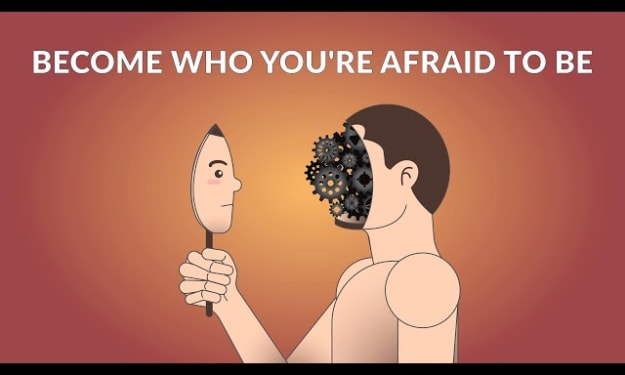
Become who you are Afraid to be.
Most people are afraid to fully be themselves. They’re afraid to embrace the parts of themselves that might be regarded as unacceptable, because embracing these unacceptable parts makes them feel uncomfortable. So to escape this uncomfortableness, they divide themselves into two halves: conscious and unconscious. In the conscious-half, they construct an ideal image of themselves: an image formed out of the bits and pieces of their past that they deem as good and acceptable. And as a result, in the unconscious-half, they repress the parts of themselves that they view as bad and unacceptable. In Jungian psychology, this repressed part of the personality is called /The Shadow/. And unless The Shadow is integrated into the personality, a person can never reach their fullest potential. Instead, one will always remain incomplete, fractured, and partial—living a life of regret rather than the full life that could have been. Imagine, for example, that I’ve solved a few equations and convinced myself that I’m a great mathematician. I might meet a few friends, and they tell me that they have a maths club. They gather every weekend and try to have a crack at maths most difficult problems. This scares me, because if I join, I’ll no longer get to be the ‘great mathematician’ that I’ve convinced myself I am. Instead, I’ll be a concrete person with actual strengths and weaknesses. And in this scenario, there are two possible actions I can take. The first action is to run from my shadow and let it grow. I refuse to join the maths club and realize my own weaknesses as a mathematician. I get to cling to the ideal image of myself as a great mathematician, but as a result, I lose the opportunity to actually become one. The second action is to come into contact with my shadow and integrate it. I join the maths club and realize that I’m not the great mathematician that I thought I was. In the short term, this hurts. I discover that I’m not very good at geometry, but also that I excel in differential equations. I become measured with my colleagues. I have an actual place and rank among other mathematicians. In reality, I realize I’m not the great mathematician I thought I was, but now I open up the possibility of actually becoming one. I can actually improve my skills and rank. In the long run, this ends up being the best decision I’ve ever made. See, in a way, we often prefer to be pure potential. We convince ourselves we /could be/ whatever we want to be, but don’t actively work to /actually/ be something. We just comfort ourselves with the idea that we could be something if we wanted to. This is because when we work towards something, we start feeling our weight in the world. We’re measured and ranked. We’re quantified and actual. And this actual reality is often less pleasurable to live in than our ideal fantasy. But it’s real, not a fantasy. And reality can be improved, but a life of imagination always ends in tragedy. The path to self-improvement starts with self-acceptance. Only by embracing and integrating our shadow, by accepting the ugly parts of ourselves, by becoming who we’re afraid to be, can we reach our fullest potential. But if we reject our shadow, if we pick and choose the parts of our past, personality, and behaviour that we like and repress the parts of ourselves we fear, we become incomplete and partial. And instead of living a full, whole life, we live one full of regrets. But it’s up to you to decide: in Jungian terms, will you embrace your shadow or reject it? Would you rather fail in actuality or succeed in mere hypotheticals?
By Ash Martin2 years ago in Psyche
Unraveling Alzheimer's. Content Warning.
Alzheimer's disease is a progressive neurodegenerative disorder that primarily affects memory, cognitive function, and behavior. It is the most common cause of dementia, a term used to describe a group of symptoms affecting memory, thinking, and social abilities severely enough to interfere with daily functioning. In this comprehensive article, we will explore the symptoms, psychological and biological causes, consequences, medical treatments, psychological interventions, and precautions associated with Alzheimer's disease
By Shams Ul Qammar2 years ago in Psyche
Conquering Anxiety: 5 Detailed Tips to Regain Control of Your Life
Introduction Anxiety is a common experience for many people, and it can have a significant impact on our daily lives. However, there are ways to manage and overcome anxiety. In this blog post, we will explore five detailed tips to help you battle anxiety and regain control of your life.
By Harini V C2 years ago in Psyche
Retrogrades - What are they and why do they make me feel weird?
You’ve probably heard the term “it’s because Mercury’s in retrograde” before – poor Mercury, always getting blamed for everyone’s shitty decisions – and even though you may be familiar with the term, you may not actually know wtf it means.
By Jessica Rasile2 years ago in Psyche
7 Key Reasons Why Some People Procrastinate
Trying to motivate someone who is reluctant to act is not such an easy task for anyone, as the procrastinator will usually find a handy excuse for their delays. However, one would need to start with the reasons behind the need to procrastinate. Remedying a particular situation is not possible until we understand why we do certain things, and how we can alter our mindset and perspective to change those habits.
By Elaine Sihera2 years ago in Psyche
Ikigai
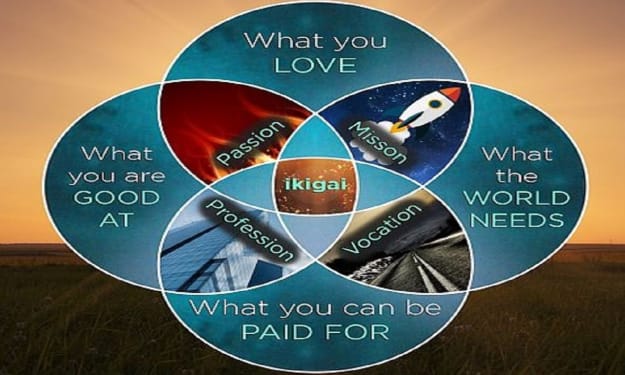
Ikigai, a concept deeply rooted in Japanese culture, is a profound philosophy that holds the key to finding purpose, joy, and fulfillment in life. Derived from the words "iki" (meaning life) and "gai" (meaning value or worth), Ikigai represents the intersection of passion, mission, vocation, and profession. It is the sweet spot where our passions align with what we are good at, what the world needs, and what we can be paid for. In this blog, we will explore the essence of Ikigai, its components, the benefits of living a life guided by it, and practical steps to discover and cultivate our own Ikigai.
By Dr Naveed Ahmed 2 years ago in Psyche
The Psychological Effects of Social Media.
Social media has become an integral part of modern life, connecting people across the globe and providing a platform for communication, sharing, and networking. While social media offers numerous benefits, such as fostering social connections and disseminating information, it also comes with psychological implications. In this article, we will explore the psychological effects of social media usage and examine its impact on mental well being.
By Naeem Shahzad2 years ago in Psyche