
Scientists Discover a New Particle That Could Rewrite the Laws of Physics:
Scientists may have discovered a new particle that challenges the Standard Model of physics. This breakthrough could explain dark matter, hidden forces, and reshape our understanding of the universe.

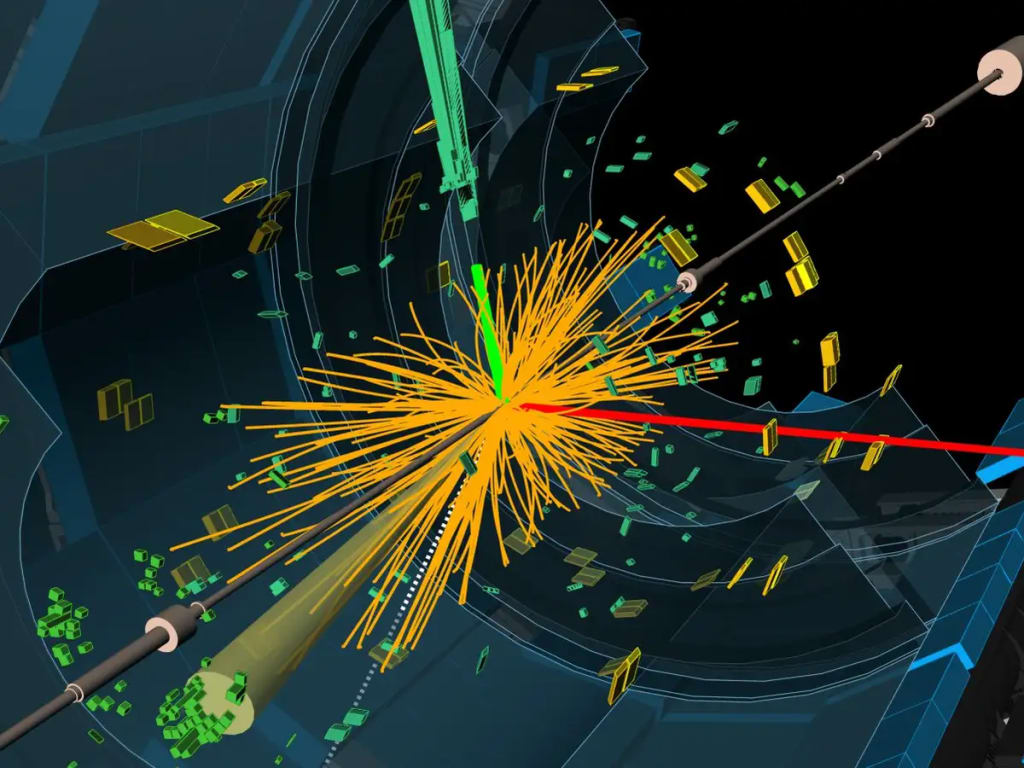
For more than a century, physics has been guided by a framework known as the Standard Model.
It explains how the universe works at its smallest level.
It predicts how particles behave.
It tells us why matter exists at all.
And for decades, it has been mostly right.
But now, scientists may have found something that doesn’t fit.
Something strange.
Something unexpected.
Something that could change everything we thought we knew about reality.
A Discovery That Shook the Scientific World:
The discovery didn’t come from a dramatic explosion or a cosmic event visible to the naked eye.
It came quietly.
Deep underground.
Inside massive particle detectors.
From data that looked… wrong.
Physicists analyzing experimental results noticed anomalies tiny inconsistencies that refused to disappear.
At first, they assumed error.
Then coincidence.
Then statistical noise.
But the data kept repeating itself.
And slowly, a terrifying and thrilling idea began to form:
What if we are seeing evidence of a brand-new particle?
Why Particles Matter More Than You Think?
Particles aren’t just abstract ideas from textbooks.
They are everything.
You are made of particles.
Your phone is made of particles.
Stars, planets, galaxies all particles.
Every force in the universe works through particles:
• gravity
• electromagnetism
• the strong nuclear force
• the weak nuclear force
Understanding particles means understanding reality itself.
So when scientists suggest there might be a particle outside the Standard Model, it’s not a small claim.
It’s revolutionary.
The Standard Model: Physics’ Greatest Success
To understand why this discovery matters, we need to understand what the Standard Model is.
Think of it as the periodic table of reality.
It describes:
• quarks (which make up protons and neutrons)
• leptons (like electrons and neutrinos)
• force-carrying particles (photons, gluons, W and Z bosons)
For decades, it predicted particles before they were discovered.
The Higgs boson was the last missing piece confirmed in 2012.
Physicists celebrated.
The model was complete.
Or so they thought.
The Cracks in the Model:
Despite its success, the Standard Model has always had problems.
Big ones.
It cannot explain:
• dark matter
• dark energy
• gravity at the quantum level
• why matter exists more than antimatter
• why particles have the masses they do
Physicists have long suspected something more exists beyond the model.
But finding evidence?
That’s incredibly difficult.
Until now.
Where the New Particle Was Found:
The possible new particle emerged from experiments conducted at high-energy particle accelerators, where atoms are smashed together at near light speed.
These experiments recreate conditions similar to those just after the Big Bang.
When particles collide, they decay into other particles.
Physicists track those decay patterns carefully.
And that’s where the anomaly appeared.
Certain particles were behaving differently than predicted.
Not randomly.
Not once.
But consistently.
The Particle That Shouldn’t Exist:
The data suggested the presence of an unknown particle influencing these decays.
It wasn’t directly observed.
Instead, scientists saw its effects.
This is common in particle physics.
You don’t always see the particle you see what it does.
And what this one was doing didn’t match any known particle.
That’s when the excitement exploded.
What Makes This Particle So Special?
This isn’t just “another particle.”
Physicists believe it may be connected to new forces of nature.
Or hidden dimensions.
Or unknown symmetries.
Or dark matter itself.
Some theories suggest it could be:
• a new boson
• a leptoquark
• a carrier of an unknown force
• a bridge between visible matter and dark matter
Each possibility is world-shattering.
The Statistical Threshold: Why Scientists Are Careful
Science doesn’t jump to conclusions.
In particle physics, a discovery requires five sigma a statistical confidence level meaning there’s only a 1 in 3.5 million chance the result is a fluke.
Right now, the data sits just below that threshold.
Close enough to be exciting.
Not close enough to declare victory.
That’s why scientists are cautious with their words.
They say “evidence.”
They say “hint.”
They say “anomaly.”
But behind closed doors?
They’re thrilled.
Why This Could Rewrite Physics?
If confirmed, this particle would mean the Standard Model is incomplete.
And that’s not failure.
That’s progress.
Every major scientific leap came from breaking an old model:
• Newtonian physics broke when relativity emerged
• Classical physics broke when quantum mechanics appeared
• Determinism broke when uncertainty entered the picture
This could be the next leap.
The Link to Dark Matter:
One of the most exciting possibilities is that this particle interacts with dark matter.
Dark matter makes up about 27% of the universe.
Yet we’ve never directly detected it.
We only know it exists because of its gravitational effects.
If this new particle connects ordinary matter to dark matter, it would solve one of the biggest mysteries in science.
It would change cosmology forever.
Why This Discovery Took So Long?
You might wonder:
If this particle exists, why didn’t we find it earlier?
The answer is simple:
The universe hides its secrets well.
These particles:
• exist for fractions of a second
• appear only at extreme energies
• leave subtle traces
• mimic known processes
Detecting them requires:
• massive machines
• years of data
• advanced AI analysis
• international collaboration
This discovery took decades of work.
The Human Side of the Discovery:
Behind every data point is a human being.
Physicists working 12-hour days.
Graduate students analyzing endless spreadsheets.
Researchers questioning their own sanity.
Many scientists involved have spent their entire careers chasing evidence like this.
Some are near retirement.
For them, this isn’t just data.
It’s a lifetime achievement.
Skepticism and Debate:
Not everyone is convinced.
And that’s healthy.
Some physicists argue:
• the anomaly could disappear with more data
• systematic errors might exist
• unknown background effects could explain it
This debate is intense.
But it’s also beautiful.
Science advances through disagreement.
What Happens Next?
The next few years are critical.
Scientists will:
• collect more collision data
• refine measurements
• cross-check results with other experiments
• attempt direct detection
Other laboratories around the world will try to replicate the findings.
If they succeed?
Physics textbooks will be rewritten.
Could This Lead to New Technology?
History suggests yes.
Quantum mechanics led to:
• computers
• smartphones
• lasers
• GPS
Particle physics gave us:
• medical imaging
• cancer treatments
• the World Wide Web
New physics often leads to new technology sometimes decades later.
We don’t know how yet.
But the potential is enormous.
The Emotional Impact on Scientists:
Many researchers describe a strange mix of emotions:
• excitement
• fear
• disbelief
• joy
One physicist said it felt like “standing at the edge of a cliff and realizing the world is bigger than you imagined.”
That feeling is rare.
And priceless.
Why This Matters to Everyone?
You don’t need to understand equations to care about this discovery.
This is about human curiosity.
It’s about asking:
• What is reality made of?
• Why does the universe exist?
• Are we missing something fundamental?
These questions belong to everyone.
The Bigger Picture:
The universe is not finished surprising us.
Every time we think we understand it, it whispers:
Look again.
This possible new particle reminds us that knowledge is never complete.
And that humility is essential in science.
A Turning Point in Physics?
It’s too early to say.
But moments like this are rare.
They don’t come every year.
Or every decade.
Sometimes, they come once in a lifetime.
If confirmed, this discovery will mark the beginning of a new chapter in physics.
One filled with questions, possibilities, and wonder.
Final Thoughts:
Science isn’t just about answers.
It’s about courage.
The courage to admit we don’t know everything.
The courage to challenge our best theories.
The courage to explore the unknown.
This new particle if it exists is more than a discovery.
It’s an invitation.
To rethink reality.
To expand our understanding.
To rewrite the story of the universe.
And that’s what makes it truly extraordinary.
About the Creator
Zeenat Chauhan
I’m Zeenat Chauhan, a passionate writer who believes in the power of words to inform, inspire, and connect. I love sharing daily informational stories that open doors to new ideas, perspectives, and knowledge.
Keep reading
More stories from Zeenat Chauhan and writers in Psyche and other communities.
Do You have a Support Network?
Life is harder when you’re on your own. Human beings are social creatures, and we usually feel better when we have support from a strong social network around us. For most people, it’s our families that hold us together like glue.
By Elizabeth Woodsabout 23 hours ago in Psyche
This Show Makes You Suspicious on Purpose
At first, it feels harmless. You sit down to watch His & Hers the way you sit down to watch any thriller. Lights dimmed. Phone face-down. A body on screen. A mystery to solve. Two people telling the same story in different voices. You tell yourself this is entertainment. Suspense. Craft.
By Aarsh Malik2 days ago in Psyche



Comments
There are no comments for this story
Be the first to respond and start the conversation.