
Liquidating our Children
A Better World Begins With Putting Our Children’s Pain Before Everything Else — Everything.

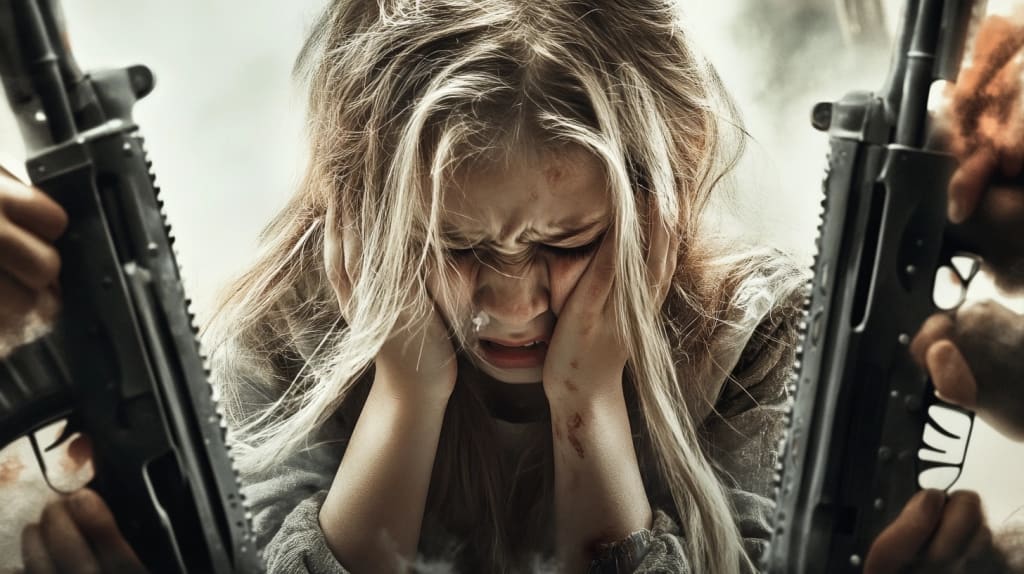
Society tends to focus on the here and now—on policies, laws, and adult behaviors—while often overlooking the foundational experiences that shape those very adults. We debate how to fix crime, how to curb corruption, how to foster a better, more harmonious world, but rarely do we stop to ask: Where does it all start? The answer is deceptively simple yet often ignored: It begins in childhood.
At birth, we enter the world as something unformed, malleable—a center point in an infinite trajectory of possibility. If life were a circle, childhood would be the dot at its very center, with adulthood and eventual death at the edges. Where we end up on that circle is not entirely random; much of it is influenced by the forces exerted upon us early in life. The closer an event is to the center, the greater its effect on the final trajectory. A small shift in direction at the start of the journey can lead to dramatically different destinations by the time we reach the outer edge.
Small moments matter. The quiet cruelties of childhood—bullying, exclusion, neglect—create ripples that extend far beyond what is immediately visible. The psychological imprints left at a young age do not simply fade with time; they shape how individuals perceive themselves and the world. A child who is bullied may grow into an adult who second-guesses their every decision, who holds themselves back, who struggles to reach their full potential. Conversely, a child who internalizes aggression may develop into someone who perpetuates cycles of dominance, control, or even violence. The bullied and the bully can often be two sides of the same coin—both shaped by forces beyond their full understanding.
Yet, society often minimizes bullying as a “normal” part of childhood, something that “toughens” kids up. But if we step back, this logic begins to unravel. We do not starve children to prepare them for hunger. We do not expose them to toxins so they can “get used to it.” We recognize that certain adversities cause more harm than good, and we take measures to protect the vulnerable. If that’s the case, why do we allow psychological wounds to develop under the assumption that they build resilience?
The effects of bullying extend far beyond the immediate pain of the moment. It’s not just about the child who cries in a bathroom stall, the one who sits alone at lunch, or the one who dreads school every morning. It’s about what these experiences create—fractured adults who struggle with self-worth, who never quite feel safe in their own skin. Some become withdrawn, hesitant to take up space. Others, in an attempt to reclaim power, develop into the very figures they once feared—tyrants in workplaces, in relationships, in leadership roles. In the most extreme cases, a bullied child becomes so consumed by alienation and unresolved pain that they lash out in ways that shake entire communities. School shootings, public acts of violence—these are often the desperate actions of individuals who felt unheard, unseen, and powerless for too long.
If we look at this more broadly, bullying is not just an issue of childhood; it plays a significant role in shaping the future. It fuels cycles of aggression and power imbalance that surface in politics, corporations, and even within families. When early intervention is lacking, people carry these wounds into adulthood, sometimes passing them down to the next generation. A bully is often acting out of their own pain, desperately seeking validation or control in a world where they feel neither. They need to feel heard just as much as their victims do—but if we allow them to harm others without intervention, we perpetuate a cycle in which neither side ever truly heals.
Some may argue that people can change, that adulthood is a time of self-reinvention. And to some extent, that’s true—people can shift their trajectory at any point in life. But the farther one travels from the center, the harder that change becomes. If you’ve ever moved to a new city, started fresh where no one knows your past, you may have felt a fleeting sense of freedom—the ability to redefine yourself unburdened by the weight of history. But patterns return. Ingrained self-perceptions are difficult to shake. The longer we live with them, the more deeply they become a part of us.
So, what if we could change the source? What if we could intervene before the scars set in? What if someone had stepped in to tell the bullied child, “This does not define you”—or had reached the bully themselves and asked, “What pain are you carrying that makes you do this?” How many lives could be redirected before they veered too far off course?
This is why bullying is not just an issue of childhood; it is an issue that extends into the future. If we act now, we aren’t just protecting today’s children—we are influencing the world they will one day shape. Addressing this problem isn’t simply an act of compassion; it may be one of the most impactful ways to alter the trajectory of our collective future.
Because by the time we reach the edge of the circle… for many, change is possible, but it’s much harder. And for some, it’s too late.
About the Creator
Daniel Pierce
Filmmaker, voice actor, producer. It all start with writing. All writing starts with listening. I’m always listening.
Keep reading
More stories from Daniel Pierce and writers in Psyche and other communities.
A Faded State
Regarding the Trump presidency, a theory of its trajectory, and the potential outcomes within a four-year timeline— It’s safe to glean from the last 40 years that Trump is a person appears more concerned with himself and how the populous receives him than anything else. More than money, he craves attention. Right now, there are multiple forces at play, nearly equal in influence.
By Daniel Pierceabout a year ago in The Swamp



Comments
There are no comments for this story
Be the first to respond and start the conversation.