Latest Stories
Most recently published stories in Psyche.
Holistic Health
Holistic Health is an approach to life. Rather than focusing on illness or specific parts of the body, this approach to health considers the whole person and their interactions within their environment. It accentuates the mind, body, and spirit connection, with the goal being to achieve optimum well-being. Holistic health patients accept responsibility for their own level of well-being, and their everyday choices, to take responsibility of their own health. The four strategies to consider when promoting positive mental health are; encourage typical life experiences, increase coping skills, increase social support, and empower families (Huff, McClanahan & Omar, 2010). Holistic medicine focuses on treating the entire person and not just the disorder or affliction. In the assessment and management of chronical illness and specific disorders the holistic health care provider considers biopsychosocial factors of biological, psychological, and social concerns. These biopsychosocial aspects influence one another and are integral to healthy emotional functioning (Huff, McClanahan & Omar, 2010). In considering wellness, fostering positive mental health, the medical management goal is to minimize the impact of the disease on the physical, emotional development and functioning of the patient. Holistic health promotes a mental health goal of achieving balance between disease management and positive mental health. The Holistic health care provider embraces quality of life, believing all parts of physical, emotional, environmental, and spiritual aspects help patient life balance to address any issues, sickness, or disorder, to make a person whole (Walter, 1999).
By Shanie Walker5 years ago in Psyche
Green with Envy
I’m a jealous person. It’s not pretty. And it is why social media is a tricky place for me. And by tricky, I mean like toxic fiery tar pits. I don’t have the constitution for it. I say that a lot, “I don’t have the constitution for it.” It’s a heady way of being self-deprecating without overtly putting myself down. I’m good like that.
By Mandy Osterhaus Ream5 years ago in Psyche
Freedom, Two Ways
It was happening again. Alicia flinched and ducked her head under the covers. When Dad came home drunk, there was nothing to do but hope you could avoid the line of fire. Luckily, it was late, so he wouldn't expect to find the kids awake. It was better that way.
By Jennifer Eager5 years ago in Psyche
The Real “Invisible” Man
Elizabeth Moss stars in a new version of the Invisible Man where she plays a woman caught, but somewhat escaping, the clutches of an abusive and controlling man. As for how good the movie is, it was a “Meh, I’m not mad at it” on a scale of “made me angry it was so bad” to “Whoa, I need to tell all my social media peeps to watch this movie!!!” . In spite of it being a bit on the lukewarm side of “ok”, it did inspire me to delve into some mind soup on the topic of life after domestic violence.
By Nadine Buxton-Whatoname5 years ago in Psyche
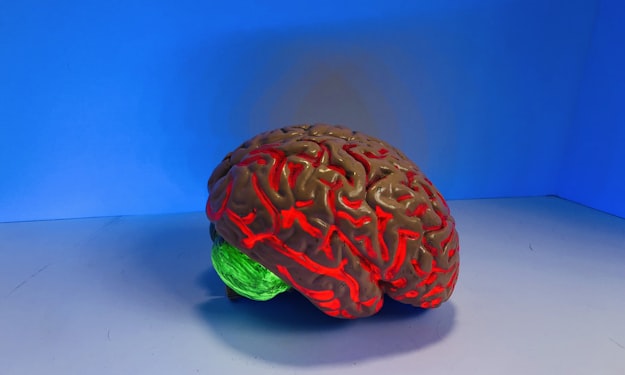
The Hidden Superpower of Our Human Brain
Imagine the following scenario: You are in the situation where you are writing something, and you’ve been struggling for hours trying to find the right words. It’s super painful and frustrating, and no good ideas are coming to your head. But all of a sudden, something hits you. The right words magically seem to just come to you.
By Ghani Mengal5 years ago in Psyche
The Final Binge
The sun beat down as Lucas opened his eyes to the world, weathered green paint filled his view as he rolled over onto his back. He lay in daze, doing his best to fight waking up fully. A seagull in the distance and the sound of waves shocked his mind back to reality however, quickly sitting up to examine his surroundings, he became aware that he was on the back deck of some cheap beachside motel. He should be panicking considering he lives nearly three hundred miles from the nearest beach, but he was accustomed to waking up in strange places. The last thing he remembered he had gone to the pub for a few drinks after he had been let go from his job for being late or drunk for too many shifts, and he hadn’t driven since his license had been revoked two years prior, so he knew he hadn’t gotten here on his own. He searched around him for his phone so he could try to piece things together knocking over an empty bourbon bottle in the process. He became nervous when he didn’t see it, crawling around on all fours back and forth from one end of the deck to the other picking through the rubbish he had spread then passed out in the night before. He was on the verge of giving up when the glare of the sun bounced off something in the sand nearby, his phone sat half submerged about a foot away on the other side of the deck.
By Jarred S Baker5 years ago in Psyche
Five Things I Can See
Five things I can see. The breeze left its brushstrokes along the gently billowing sails of the charter. It painted their divots with shadows of dark blues from the sea and highlighted their convexities with bright whites from the midday sun. The boat sailed along with ease and with no great haste, making its way to the end of the world, where the sky meets the ocean. Several dolphins in a pod danced off to the left of the journeying sailboat. The brightness of the day was cause for squinting, even more so as it reflected off the white sand. Trees on shore swayed casually side to side, dancing to the lullaby of the wind and waves.
By Skylar Callahan5 years ago in Psyche
When You Say You ‘Feel Fat,’ You're Reinforcing Harmful Stigmas
“Ugh, I feel SO fat today.” On a regular basis, words like this are spoken in my vicinity. Every time, it reinforces the idea that in our culture, existing as I do is bad. The thing is, fat is not a feeling. A feeling is an emotional state or reaction. You can’t feel fat, or like a fatty, or like a total fatass.
By Rachael Hope5 years ago in Psyche
The Brain Never Gets Tired
The feeling of fatigue after a cognitively exhaustive day is quite ubiquitous in people. It is a radical change in the kind of "tiredness" experienced by the people in the past centuries. Surprisingly, your brain never gets tired. From where does the feeling of 'burnout' arrives after a workday? Is it the effect of physical fatigue that ensconces inside neurons? To add some weight to our following assertions, I would like to present a snippet from the book Deep Work by Cal Newport -
By Saral Verma5 years ago in Psyche