
Inside the Mind of a Modern Human: Overthinking, Overworking, Overwhelmed
Why our minds feel louder than ever—and how to quiet the chaos within.
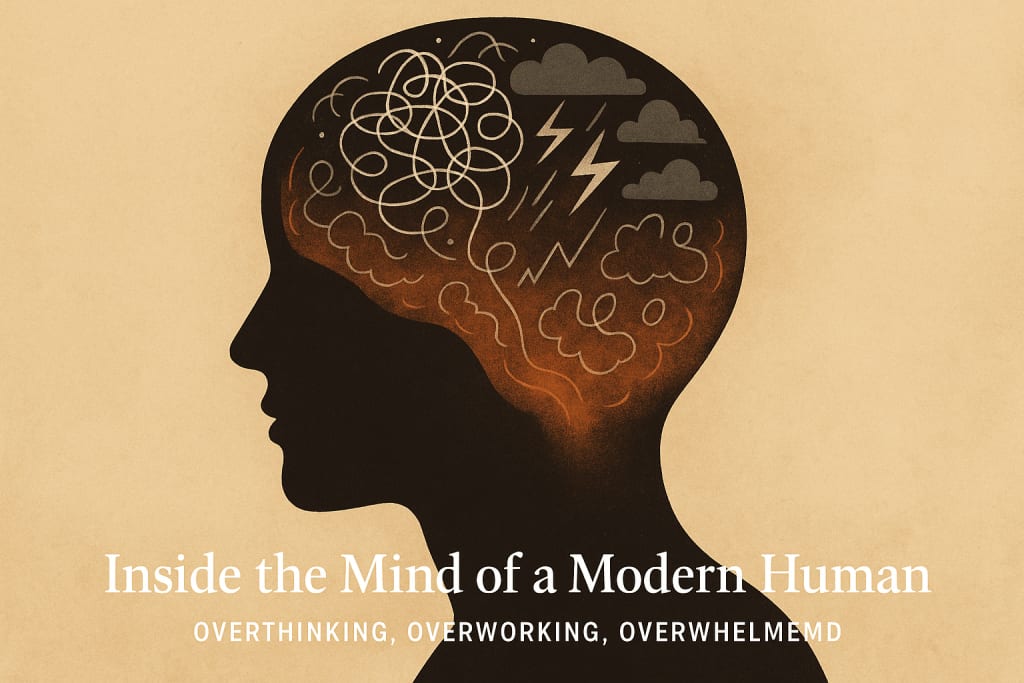
Introduction: The Inner Storm
We live in an age of endless options, infinite information, and invisible expectations. But beneath the surface of glowing screens and busy schedules, the modern mind is restless—constantly overthinking, endlessly overworking, and slowly becoming overwhelmed.
This is not just burnout. It’s a deeper, more intimate unraveling of focus, peace, and self-worth. We aren’t just tired—we're mentally overloaded.
So what’s really going on inside the mind of today’s human? Why are so many of us feeling like we’re drowning while appearing fine on the outside? And more importantly, how do we stop the spiral?
1. The Overthinking Era: When Thoughts Don’t Stop
Overthinking is often mistaken for being careful or reflective. But in reality, it’s mental paralysis—revisiting conversations, predicting outcomes, regretting choices, imagining disasters.
In a digital world where we're bombarded with opinions, options, and what-ifs, our brains are forced to work overtime. Social media shows us how others live, think, and succeed, causing comparison loops that generate self-doubt and anxiety.
Why we overthink:
Too much information. We scroll through more content in a day than our ancestors did in a lifetime.
Fear of missing out (FOMO). We’re scared to make the wrong choice, so we think endlessly and decide nothing.
Perfectionism. We believe mistakes are not acceptable, so we mentally rehearse every possible outcome.
The cost? Peace. Sleep. Confidence. Relationships. Energy. Overthinking is a thief dressed as logic.
2. The Cult of Overworking: Always On, Always Behind
Working hard used to be admirable. Now it’s a baseline expectation. The modern worker is expected to be available 24/7, constantly improving, climbing, producing. Remote work blurred the lines between home and hustle, and the pressure to monetize hobbies, side-hustle everything, and prove productivity never ends.
Why we overwork:
Identity is tied to output. If you aren’t doing, you feel like you’re failing.
Workplaces reward burnout. People who sacrifice well-being are often praised as dedicated.
Fear of irrelevance. The world moves fast—if you slow down, you worry you'll be left behind.
The glorification of “busyness” has created a dangerous reality: rest is guilt-inducing, and self-worth is measured in tasks checked off.
But here’s the truth: Overworking is not ambition—it’s self-erasure.
3. The Weight of Being Overwhelmed: Silent Cries Behind Strong Faces
Overthinking and overworking create the perfect storm of overwhelm. And yet, most of us keep smiling, replying “I’m fine,” pretending we’ve got it together.
The signs are subtle at first: forgetting simple things, irritability, lack of sleep. But they build into exhaustion, breakdowns, panic attacks, or numbness.
We become emotionally flat, spiritually disconnected, and physically drained.
And here’s the painful irony: we often feel like we’re the only ones struggling. But in reality, nearly everyone is battling this quiet mental chaos. We just don’t talk about it.
4. Why This is a Collective Crisis, Not Just a Personal One
You are not broken. You are responding to a broken system. A culture that encourages overstimulation, unrealistic expectations, and non-stop performance is bound to create internal crises.
This isn’t a personal weakness. It’s a cultural epidemic.
Just like physical pollution harms the body, mental pollution—constant alerts, noise, ads, updates—damages the mind.
It’s time to stop blaming ourselves for being overwhelmed in an environment that’s designed to overwhelm us.
5. How to Begin Healing: Quieting the Modern Mind
There’s no single fix. But healing begins with awareness and gentle resistance.
Here’s how to start:
a. Digital Boundaries
Set times when you don’t check your phone or notifications. Create tech-free zones, especially during meals and before bed.
b. Deliberate Rest
Not just sleep—but intentional stillness. Meditation, quiet walks, breathwork. Let your brain breathe.
c. Single-Tasking
Multitasking scatters the mind. Focus on one thing at a time. Even washing dishes can become grounding if done mindfully.
d. Journaling
Writing your thoughts helps move them out of your head and onto paper. It’s like clearing the mental cache.
e. Reclaiming Your “Enough”
You are enough, even on slow days. Detach your value from output. Rest is productive. Being is valid.
6. The Power of Slowing Down in a Fast World
Slowing down isn’t falling behind. It’s choosing presence over panic. The world may still spin at breakneck speed, but you don’t have to keep pace with its pressure.
Sometimes, doing less is the most powerful act of rebellion.
When you stop overthinking, you trust.
When you stop overworking, you live.
When you stop being overwhelmed, you return to yourself.
Conclusion: The Quiet Revolution
The modern mind isn’t weak. It’s wounded. But within each of us is the ability to reclaim stillness.
This is not about escaping the world—it’s about moving through it with intention. One thought at a time. One breath at a time.
The revolution won’t always be loud. Sometimes, it’s the whisper in your mind that says, “It’s okay to rest. It’s okay to be still. You are enough.
About the Creator
Idea hive
Article writer and enthusiast sharing insight and knowledge on nature, human behavior, technology, health and wellness, business, culture and society and personal development.
No, There's Nothing Wrong with the MCU
We have spent the last few years seeing some strange comments about the MCU by various filmmakers and actors, including people like the great Martin Scorsese. These comments allude to the idea that the world of film should not take Marvel so seriously as cinema, but rather the films should be thought of more as theme park rides. I believe that not only is this incorrect, but it is also damaging to the film landscape. If these MCU films are to be put on the back-burner when it comes to cinema, we run into a whole host of problems...
By Annie Kapur4 days ago in Psyche



Comments
There are no comments for this story
Be the first to respond and start the conversation.